Cold. Sauna. Cold again. The contrast therapy explainer that doesn't sell you anything.
What the research actually supports, what it doesn't, and the mistakes most people make.
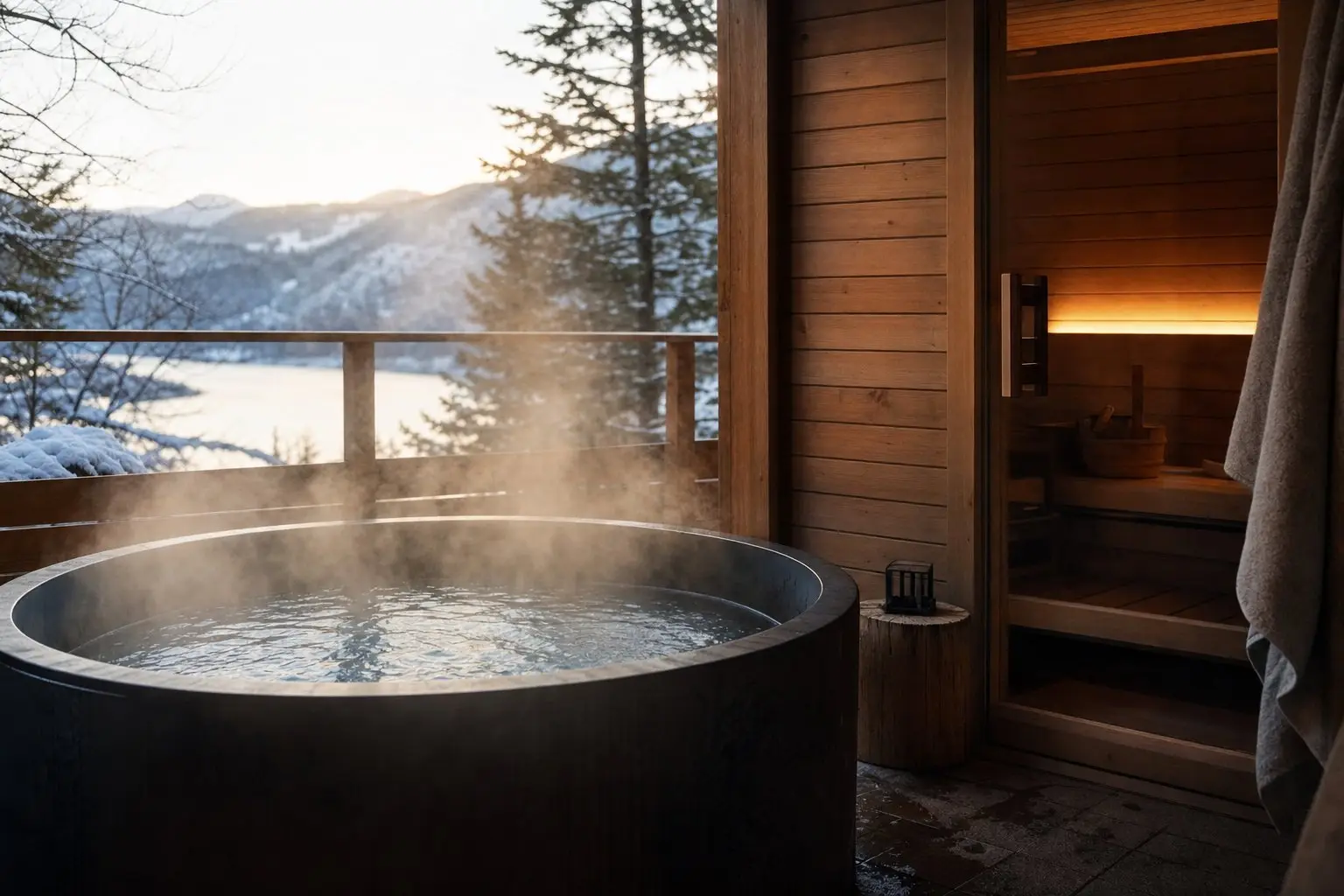
Short answer: Contrast therapy alternates cold at or below 50°F with heat at or above 160°F, in repeated rounds. Heat opens blood flow and relaxes muscle, cold constricts and triggers a sharp nervous-system response, and cycling gives you both plus a circulatory pump. The evidence is real but narrower than the marketing around it.
Contrast therapy is having a moment, and most of what’s written about it is either breathless or trying to sell you a $12,000 plunge tub. This is the version with the boring middle, what the protocols actually do, what the research supports, who should sit it out, and what we’d tell a friend before their first session.
What contrast therapy actually is
Contrast therapy is the practice of alternating exposure to cold (≤50°F water or air) and heat (≥160°F sauna), usually in repeated rounds. The idea is simple: heat opens up blood flow and relaxes muscles; cold constricts vessels and triggers a sharp nervous-system response; cycling between them gives you both effects plus a “pump” of circulation as your vessels dilate and constrict.
A typical session runs three rounds:
- 10 to 15 min sauna
- 1 to 3 min cold
- 5 min cool-down
End on cold. Most protocols recommend two to four rounds per session. If you want the deeper dive on each half on its own, we’ve broken them down in the ice bath and cold plunge guide and the infrared vs traditional sauna guide.
What a first session is like
The sauna part is easy, warm, drowsy, sweaty. The cold is where everyone’s eyes go wide. The first 30 to 60 seconds in cold water are genuinely hard: your breath catches, your heart rate jumps, and your whole body wants out. That’s the cold-shock response, and it’s normal. Most people who breathe slowly through it find the panic settles by the one-minute mark, replaced by a strange, alert calm. You step out flushed, tingling, and weirdly clear-headed. Then you do it again.
You do not need to be cold-adapted, athletic, or brave. You need to be able to control your breathing and know when to get out.
What the research says (the useful subset)
Most internet writing about cold plunge cites the same three findings. Here’s what they actually show:
- Reasonable evidence for:
- Norepinephrine and mood. Cold exposure spikes norepinephrine roughly 5× baseline. That’s significant, it correlates with mood improvement in about half of subjects studied, and it’s why some people feel hyped for hours after a plunge.
- Sauna and cardiovascular health. Frequent sauna use (4, 7×/week) is associated with lower all-cause mortality in long-term Finnish cohort studies. The catch: that’s sauna, not contrast therapy specifically.
- Recovery and soreness. Cold-water immersion modestly reduces perceived muscle soreness after exercise.
- Debated or mixed:
- Brown fat activation. Cold exposure does increase brown adipose tissue activity, real and measurable, but the effect on body composition is small. You do not get lean from cold plunging.
- Sleep. Many people report better sleep in the first weeks, but that’s often confounded by the other habits they clean up at the same time (less late caffeine, earlier mornings).
- Whether contrast beats either alone. Most published cold-plunge research is short-term and on athletes; few studies isolate “contrast” as superior to just sauna or just cold.
- Not established / overstated:
- Weight loss, “detox,” large testosterone increases, immune “boosting,” and the claim that one specific temperature/time protocol is dramatically better than another.
If you want the high-tech, dry version of the cold half, see whole-body cryotherapy; for the wilder, outdoor version, see wild swimming.
What a few months of it actually feels like
The first 30 days, the cold is just hard, and the norepinephrine lift is the obvious reward, most people feel sharper for two to three hours after a plunge. After that, the routine matters more than the physiology. The cold becomes less hard but also less interesting. By a few months in, the novelty fades and you keep going because the ritual has value: the early wake-up, the discipline of the cold, the few quiet minutes in the sauna where you actually think. This is the honest middle nobody writes about, because it isn’t exciting.
Four mistakes most people make
Mistake 1: Doing it post-workout. Cold plunge immediately after strength training blunts muscle growth. If you lift, do your plunge on rest days or 6+ hours after.
Mistake 2: Drinking caffeine right before. The norepinephrine spike plus caffeine equals jittery, not focused. Delay the coffee until after.
Mistake 3: Going too cold too soon. 38°F for 3 minutes is not a beginner experience. Most newcomers do better at 45 to 50°F for the first 30 days, then progress.
Mistake 4: Treating sauna as the supplement, not the main event. Sauna has more research support than cold for long-term health outcomes. A lot of people have it backwards.
Who it’s for, and who should skip it
Contrast therapy suits generally healthy people who want a mood and recovery ritual and can tolerate the cold sensibly. Skip it, or get medical clearance first, if you:
- have heart disease, uncontrolled high blood pressure, or a history of arrhythmia (the cold-shock response stresses the cardiovascular system);
- are pregnant (overheating in the sauna is the main concern);
- have Raynaud’s, cold urticaria, or peripheral vascular disease;
- have a seizure disorder, or anything that could make a sudden gasp underwater dangerous.
Talk to your doctor if you take blood-pressure or heart medication. And never plunge alone in deep or open water, cold-shock can incapacitate even strong swimmers in the first minute.
What it costs
The easiest entry point is a drop-in studio with both a sauna and a cold plunge in one space: expect $20 to $50 per session, with class packs or memberships ($100 to $250/month) bringing the per-visit cost down. Some gyms, bathhouses, and hot springs include contrast setups in a day pass. Home setups range widely, a chest freezer “cold tub” conversion for a few hundred dollars up to $5,000, $15,000 for a dedicated plunge-and-sauna combo. You don’t need any of that to start.
FAQ: contrast therapy
How often should I do contrast therapy? Two to four sessions a week is typical. More isn’t clearly better, and recovery days matter.
Should I end on hot or cold? Most protocols end on cold for the alertness effect, but if you want to sleep soon after, finishing warm and relaxed may suit you better. Either is fine.
Is contrast therapy safe to do every day? For most healthy people, yes, at moderate temperatures. Listen to your body, stay hydrated, and don’t chase colder-and-longer as a goal in itself.
Does contrast therapy actually help with weight loss? Not meaningfully. The brown-fat effect is real but small. Treat fat loss as a bonus myth, not a reason to start.
The honest summary
Contrast therapy is worth doing. It’s not magic, the benefit is largely in the routine you build around it and the genuine mood lift of the cold. If you have a heart condition or you’re pregnant, clear it with a doctor first. And if you try it twice and don’t return, that’s information too: not everything has to work for everyone.