Sauna vs steam room: what's the difference and which is better?
They sit side by side at the gym and feel similar, but dry heat and wet steam do different things to your body. Here's how to tell them apart and pick the right one.
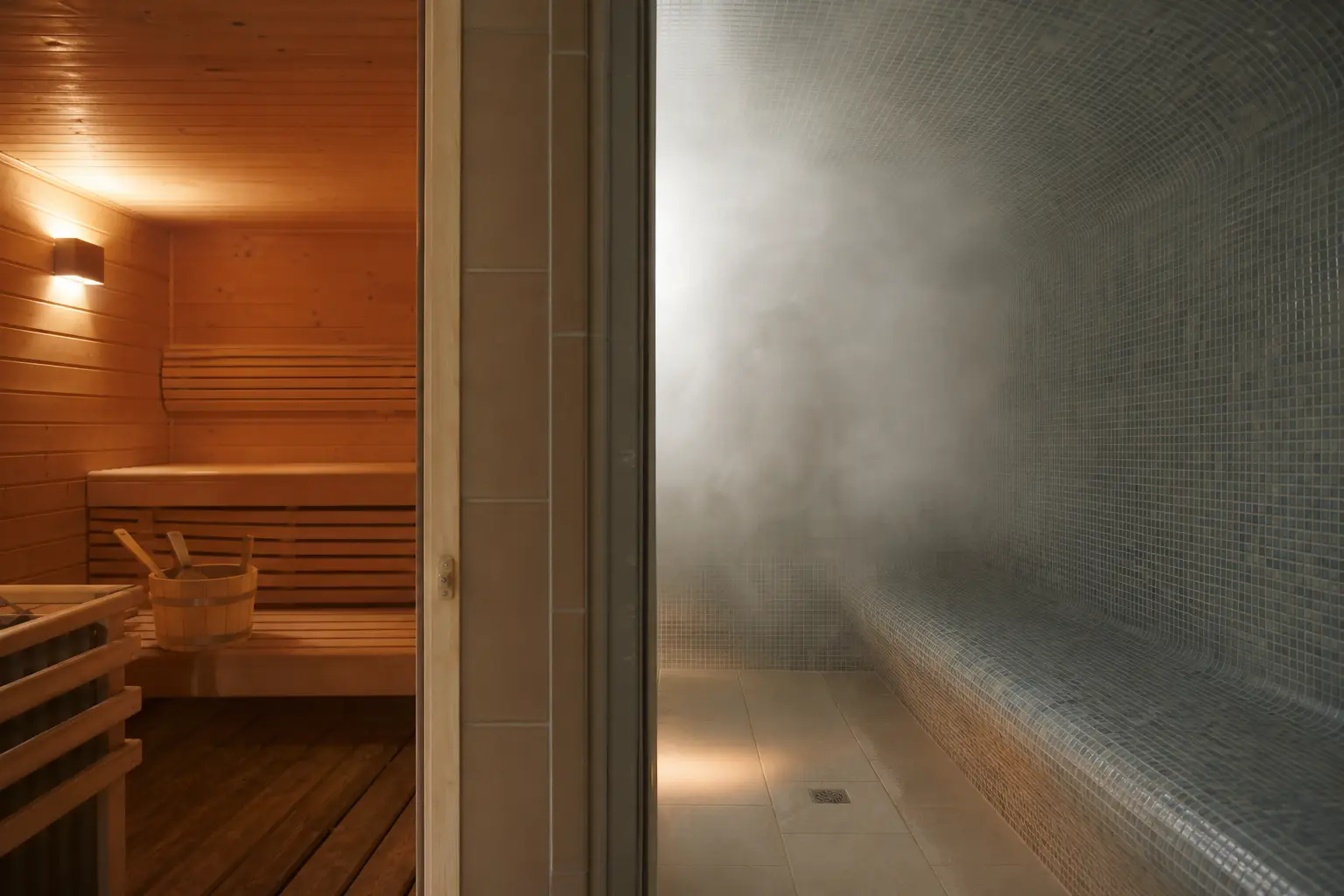
Short answer: A sauna is dry heat, usually 150 to 195°F with low humidity, in rounds of 10 to 20 minutes. A steam room is wet heat, cooler at 110 to 120°F but with humidity near 100 percent, and most people last 10 to 15. Neither is simply better: dry heat suits longer, more intense sits and has the deeper research base, while steam feels softer on skin and sinuses.
A sauna uses dry heat, usually 150 to 195°F with low humidity. A steam room uses wet heat, cooler at around 110 to 120°F but with humidity near 100 percent. That single difference, dry air versus saturated steam, changes how each one feels, how long you can stay, and which one suits what you came for.
The reason a steam room cannot simply be run hotter is the humidity. Fully saturated air at sauna temperatures would be unbearable on skin long before it was pleasant, so steam rooms stay in the low hundreds and get their intensity from the water in the air instead.
We don’t take placement fees, so nothing here is paid for.
Dry heat and wet heat at a glance
| Sauna (dry heat) | Steam room (wet heat) | |
|---|---|---|
| Temperature | 150 to 195°F (65 to 90°C) | 110 to 120°F (43 to 49°C) |
| Humidity | 10 to 20 percent | Near 100 percent |
| Typical round | 10 to 20 minutes, two or three rounds | 10 to 15 minutes |
| How it feels | Hot, dry, light air, easier to sit in longer | Enveloping, heavy, warm mist on skin and in the lungs |
| Best for | Longer sits, contrast with cold, the deeper research base | Sinuses and skin comfort, people who find dry heat harsh |
| Sweat | Heavy and visible | Heavy, but impossible to tell from condensation |
| Evidence base | Stronger, from long-running cardiovascular cohorts | Thinner, mostly comfort and short-term relaxation |
| Home version | An appliance and a room | A construction project |
How long should you stay in each one?
In a traditional sauna, 10 to 20 minutes is a normal round, usually repeated two or three times with a cool-down between. Our guide on temperature and time covers where that convention came from, and it is convention plus a handful of studies rather than a proven dose.
In a steam room, most people are comfortable for 10 to 15 minutes. The humidity makes it feel longer than dry heat at the same clock time, and because sweat cannot evaporate, your body loses its main cooling route. That is worth knowing: a steam room feels gentler and is in some ways harder to regulate in.
One sauna detail that changes the experience more than the thermometer does: heat stratifies strongly, so the top bench can be 30°C hotter than the bottom one. If a sauna feels too intense, move down before you decide dry heat is not for you. Our first sauna session guide covers the bench question and the etiquette around it.
Which one is better for a blocked nose or sinuses?
Steam, for comfort, and it is worth being precise about what that means.
Warm humid air is generally well tolerated and many people find it loosens a stuffy nose or eases a tight chest, in the same way a hot shower does. That is symptomatic relief while you are sitting in it, not treatment, and it does not shorten a cold. Our guide on whether to sauna when you are sick covers the line between a head cold and chest involvement, which is the clear stop signal.
If you have asthma, the pattern surprises people: the humid room is usually the comfortable one, the very dry room can feel harsh without being a classic trigger, and cold is the element to plan around. The one thing to ask at the desk is whether the steam is scented, because eucalyptus and menthol are common and are a recognised trigger for some people. Our guide on sauna, steam and asthma covers it properly, including the large Finnish cohort that found frequent sauna users developed fewer respiratory diseases.
Which is better for your skin?
Steam is the more comfortable room for skin, and both are being oversold.
Steam adds surface moisture and leaves skin feeling soft and hydrated afterwards, which is real and short-lived. Dry heat at 180°F does the opposite in the short term, which is why people moisturise after a sauna and not after a steam.
Neither cleans out your pores in the way spa copy suggests, and sweating is temperature regulation rather than detoxification. Our guides on whether a sauna helps your skin and whether sweating detoxes anything cover both claims. If you have eczema or psoriasis, heat and sweat can cut either way and our eczema and psoriasis guide covers what to test first.
Which is better after training?
The sauna, mostly because of what it pairs with.
A sauna slots naturally into a hot, cold, rest cycle, and contrast is the format most recovery studios are built around. Our contrast therapy guide covers the rounds, and our sauna or cold plunge first guide covers the order.
A steam room is harder to build a contrast round around, and the wet floor between a steam room and a plunge is its own hazard. If your gym has both and you want to sweat, sit down, and then get cold, the sauna is the one to use.
Neither does much for tissue repair. What they do is make you feel looser and calmer, which has value and is not the same claim.
What does each cost?
At a gym they are usually included, which is how most people meet them. Our gym sauna vs dedicated studio comparison covers what the paid version actually adds.
At a dedicated studio, a drop-in sauna and cold plunge contrast session runs about $25 to $65 in most US cities, and a standalone infrared session $35 to $70. Steam is more often bundled into a bathhouse or spa entry than sold on its own. Our session cost guide has the fuller picture, including where memberships start to pay.
At home the gap is enormous, and this is the most consequential part of the choice. A home sauna is an appliance in a room, frequently with no plumbing and sometimes on a standard circuit. A home steam room is a construction project: a sealed vapour barrier, a sloped ceiling, a proper door, and a drain, with mould behind tile as the failure mode. Our guide on what a home steam room really takes puts real numbers on both, and the short version is that many people who install steam actually wanted dry heat.
Who should be careful?
Both are generally fine for healthy adults in moderate sessions, and both lower blood pressure by opening the vessels in your skin, so stand up slowly. Skip either with alcohol, and get out at the first sign of light-headedness rather than waiting to see if it passes. Our guide on what to do if you feel faint in a sauna is the sequence worth knowing.
Pregnancy, cardiovascular conditions and blood pressure medication all warrant a conversation with your doctor first rather than a rule of thumb from an article. A steam room adds one consideration a sauna does not: it is a warm, permanently wet shared surface, which is why a new tattoo or any open skin means waiting.
Which is right for you?
Choose a sauna if you like intense dry heat, want to sit for longer rounds, plan to pair heat with cold, or want the format the research was actually done in.
Choose a steam room if you prefer moist, enveloping warmth, find dry heat harsh on your airways, are after the sinus comfort, or want the softer version on your skin.
Use both, which is what most people at a bathhouse do. Our guide to sauna vs banya vs hammam vs Korean spa covers the wider family, and a hammam is the steam tradition worth trying if you like the wet side.
FAQ: sauna vs steam room
Is a steam room hotter than a sauna? No. A steam room runs at 110 to 120°F and a sauna at 150 to 195°F. Steam feels hotter than the thermometer because saturated air stops your sweat evaporating.
Which is better for a cold? Steam is more comfortable for a blocked nose, and neither shortens a cold. Skip both if it has moved to your chest or you have a fever.
How long should a beginner stay in? Start at five to ten minutes in either, on a lower bench in a sauna, and see how you feel before extending.
Do you sweat more in a sauna or a steam room? You sweat heavily in both. In a steam room you cannot tell, because the moisture on your skin is mostly condensation.
Should you shower between them? Yes, and it is basic etiquette at any bathhouse. Rinse before entering either, and again between rooms.
Can you do a cold plunge after a steam room? You can, though the sauna is the better partner for contrast. Watch the wet floor, which is the most likely thing to hurt you in a bathhouse.
Which should I build at home? A sauna, for almost everyone. It installs easier, costs less, and has no vapour barrier to get wrong.
The bottom line on sauna vs steam room
Sauna means dry heat, longer rounds, contrast with cold, and the deeper research base. Steam room means wet heat, softer on skin and sinuses, and a shorter, heavier sit.
For a blocked nose and comfort, steam. For recovery habits, cold pairing and evidence, the sauna. For a home build, the sauna by a wide margin.
To go deeper, our infrared vs traditional sauna comparison covers the sauna side, our types of sauna explainer covers the rooms that get labelled sauna without being one, and our sauna vs hot tub comparison covers the other heat option people weigh.