The Feldenkrais Method Explained: Movement, Awareness, and What the Evidence Shows
Feldenkrais is a slow, attention-based movement practice with genuine evidence for pain and mobility, and a lot of mystique worth cutting through.
Short answer: A slow, attention-based movement practice: group Awareness Through Movement classes ($15 to $30) or one-on-one Functional Integration with gentle touch ($80 to $180). Randomized trials support it for chronic low back pain and for balance in older adults, on a par with other active movement therapies. No force, no manipulation.
The Feldenkrais Method is not yoga, not physical therapy, and not massage, though it overlaps with all three in small ways.
It is a movement-based learning practice built on the idea that inefficient movement habits drive a lot of chronic pain and limitation, and that very slow, attention-rich movement can reset those habits at the level of the nervous system. That core idea has more research behind it than most people realize.
What the Feldenkrais Method is
The Feldenkrais Method was developed by Moshé Feldenkrais, an Israeli physicist and judo practitioner, beginning in the 1940s. After a serious knee injury that doctors said would require surgery, he applied principles from physics, neuroscience, and martial arts to rehabilitate himself, and then formalized those principles into a teachable system.
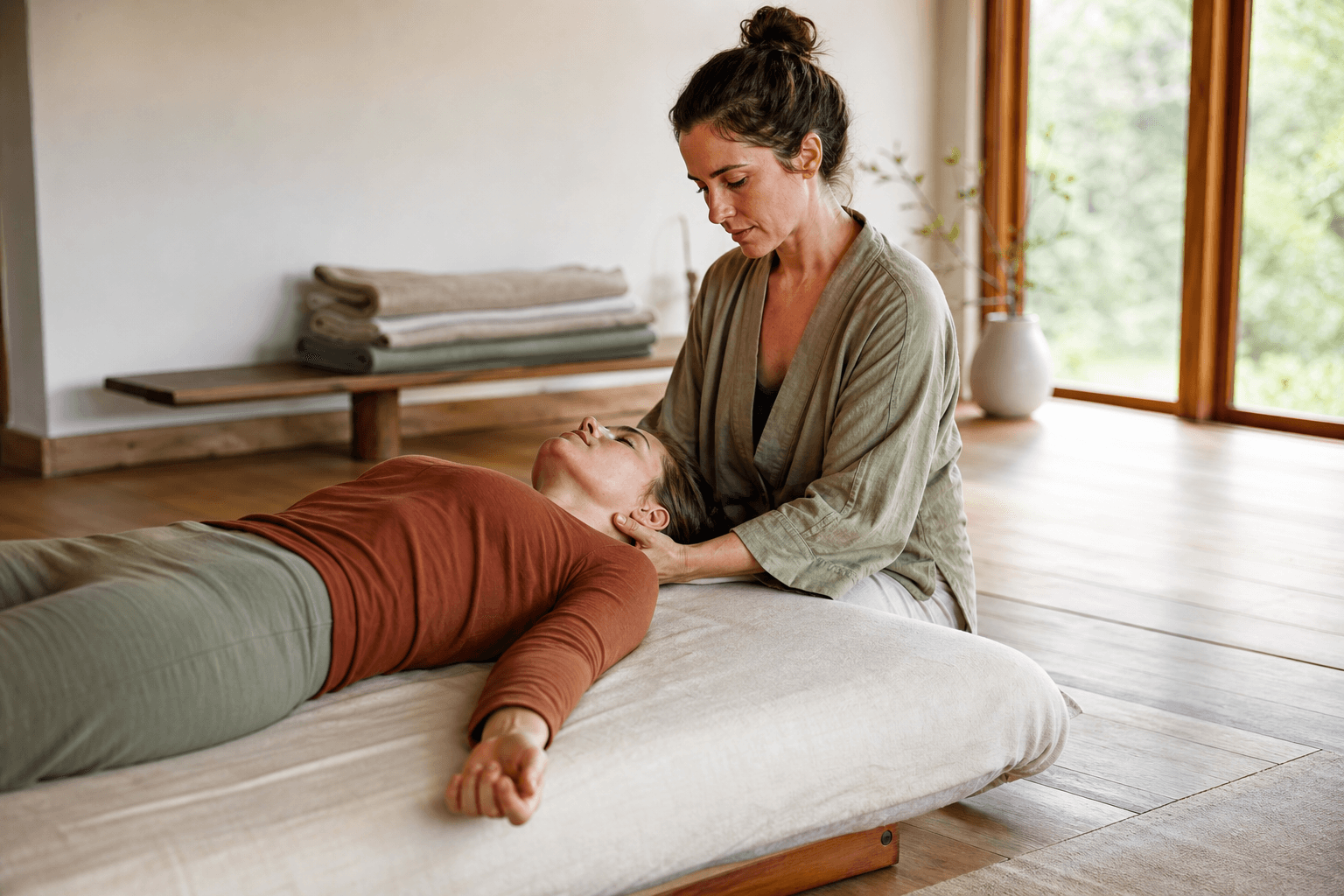
The method comes in two forms. Awareness Through Movement (ATM) is a group class format in which a teacher verbally guides participants through slow, exploratory movement sequences, often while lying on the floor. You are not told to stretch or strengthen; you are invited to notice and experiment. Functional Integration (FI) is a one-on-one session in which a certified practitioner uses gentle, non-forceful touch to guide the client’s body through movement patterns, typically while the client is clothed and lying on a low table.
The underlying premise is neurological: movement habits are learned and can be relearned. The nervous system, presented with novel movement input delivered slowly and without strain, tends to reorganize around more efficient patterns.
What a Feldenkrais session is like
In an ATM group class, you typically lie on a padded floor mat. The teacher speaks in calm, unhurried language, something like “slowly begin to roll your left knee outward, just a few centimeters, and notice what happens in your lower back.” You follow at your own pace.
There is no demonstration to mirror; the instructions are deliberately open-ended to encourage internal attention rather than external imitation.
Sequences often seem deceptively simple. You might spend ten minutes exploring tiny variations of turning your head while your eyes follow in different directions. The point is not the motion itself but the quality of attention brought to it.
Sessions run 45, 60 minutes. Most people feel a sense of ease in their body afterward, a reduction in held tension, that can be surprisingly pronounced given how small the movements were. Some people feel disoriented or tired; the sustained attention is genuinely effortful.
FI sessions with a practitioner are quieter still. You lie clothed on the table while the practitioner makes subtle, gentle contacts, a hand under the base of your skull, fingers resting along a shoulder blade, and introduces slow movements. There is no manipulation, no cracking, no deep pressure.
What the evidence says about Feldenkrais
- Reasonable evidence for: Chronic low back pain, multiple randomized trials show Feldenkrais reduces pain and improves function compared to control or usual-care groups, with effects similar to other active movement therapies. Mobility and balance in older adults, several well-designed studies show improved balance scores and reduced fall risk. Chronic neck pain, smaller studies show benefit, though evidence is less robust than for back pain. Quality-of-life outcomes in people with multiple sclerosis and Parkinson’s disease, positive findings in multiple trials, though sample sizes are modest.
- Debated or mixed: Whether Feldenkrais works specifically because of its neurological learning mechanisms or whether the benefit comes from any attentive, slow movement practice (or from the therapeutic relationship). The mechanism is plausible but not definitively established.
- Not established / overstated: Claims that Feldenkrais can treat neurological diseases, reverse structural changes in joints or discs, or produce outcomes beyond what well-designed movement therapy generally produces. Some practitioners make broad claims about brain rewiring that go further than the evidence warrants.
Benefits people report from Feldenkrais
- Reduced chronic back, neck, and hip pain, often after just a few sessions
- Improved ease of movement and range of motion without forceful stretching
- Better posture and body awareness during everyday activities
- Reduced anxiety and sense of physical tension
- Improved balance, particularly in older adults and people with neurological conditions
- A sense that habitual movement patterns have shifted in a lasting way
Who Feldenkrais suits, and who should skip it
Feldenkrais is particularly well-suited to people with chronic musculoskeletal pain who have not responded well to more forceful interventions, older adults working on balance and fall prevention, performers and athletes looking to improve movement efficiency, and people with neurological conditions like Parkinson’s or MS who want a gentle, non-fatiguing movement practice.
It also appeals to people who enjoy the overlap between somatic practices like TRE and Somatic Experiencing or the attentional quality of tai chi and qigong, all of which share an emphasis on slow, aware movement over forceful exertion.
There are very few hard contraindications. Because the method uses no force or manipulation, it is generally safe even for people with acute injuries, though you should inform your practitioner of any recent injuries or surgeries. Feldenkrais is not a replacement for medical care for structural injuries or disease management.
What Feldenkrais costs
- ATM group class: $15, $30 per class; often available at yoga studios, community centers, and wellness centers
- ATM class pack or subscription: $60, $120 for 5, 10 classes
- FI private session: $80, $180 per session with a certified practitioner; $120, $220 in major cities
- Intensives and workshops: $200, $600 for weekend or multi-day formats
Finding a certified practitioner (GCFP, Guild Certified Feldenkrais Practitioner) typically costs more than a drop-in class but offers a more personalized experience.
How to choose a good class or practitioner
The gold standard credential is Guild Certified Feldenkrais Practitioner (GCFP), which requires completion of an accredited 3, 4 year training program. The Feldenkrais Guild (US) maintains a searchable directory at feldenkrais.com.
Good ATM classes feel exploratory, not prescriptive. If an instructor is telling you to push further, stretch harder, or achieve a specific position, they are probably not teaching genuine Feldenkrais. The method is fundamentally about ease and curiosity, not effort and correction.
For FI sessions, one session is usually not enough to assess benefit, most people notice something meaningful within 3, 5 sessions. A good practitioner will check in about your experience after each session and adapt accordingly.
FAQ: the Feldenkrais Method
Is Feldenkrais the same as the Alexander Technique? They share a focus on movement awareness and nervous system learning, but they differ in approach. The Alexander Technique emphasizes upright posture and head-neck-back relationships, primarily in sitting and standing. Feldenkrais explores a wider range of movement patterns, often while lying down, with less focus on a specific postural ideal.
Can Feldenkrais help with an old injury or chronic pain? This is where its evidence is strongest. Chronic low back and neck pain, in particular, show consistent positive outcomes in clinical studies. It is not a cure, but it is a credible, low-risk option worth trying if standard approaches have not fully helped.
How many sessions do I need? You will often notice something after a single ATM class. For meaningful change in pain or movement patterns, most practitioners suggest 6, 10 sessions as a starting point. Some people practice ongoing ATM classes for years, similar to yoga.
Do I need to be in pain to benefit? No. Athletes, musicians, and performers use Feldenkrais to refine movement efficiency. Anyone curious about how they move can find value in the practice.
The honest summary on Feldenkrais
The Feldenkrais Method has a stronger evidence base than its niche reputation suggests, particularly for chronic pain and balance in older adults, and its neurological learning model is scientifically plausible even if not fully proven. It is slow, gentle, and requires genuine attention; people who want high-intensity or fast-result approaches often find it frustrating.
For those open to its pace, it is one of the more interesting and underused movement practices available.