Ecstatic dance: what it is, what a session feels like, and who loves it
Free-form movement, no steps, no alcohol, a sober, expressive practice that's part workout, part release.
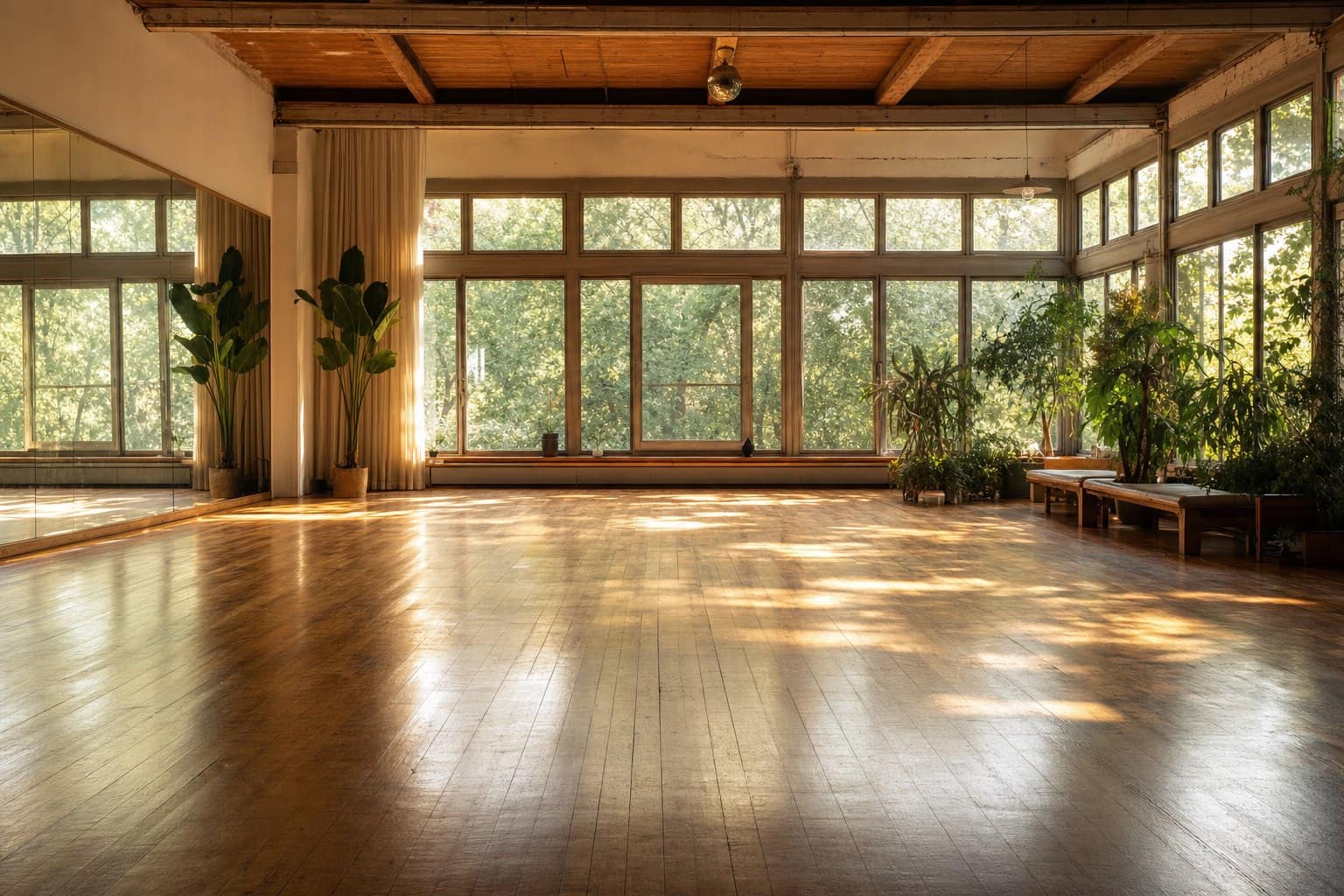
Short answer: Facilitated free-form movement in a sober, substance-free space, usually a 60 to 90 minute DJ set that builds and resolves. No steps, no partner, no talking on the floor, phones off. It is genuinely aerobic and often cathartic, beginner-friendly, and typically $10 to $40. Expect ten self-conscious minutes first.
Ecstatic dance is one of the most approachable body-based experiences once you get past the slightly intimidating name. There are no steps to learn, no choreography to follow, no alcohol to loosen you up, and no performance pressure. It is simply facilitated free movement, and for a lot of people, that turns out to be exactly what they needed.
What ecstatic dance is
Ecstatic dance is a facilitated, free-form movement practice held in a substance-free space, typically set to a curated DJ journey that builds, peaks, and resolves over 60, 90 minutes. The practice has roots in the 1960s and 70s conscious-movement scene (Gabrielle Roth’s 5Rhythms and Anna Halprin’s work are key predecessors), though contemporary ecstatic dance has evolved into its own loose global community.
There are no steps to memorize, no partner required, no particular spiritual tradition to subscribe to, and no teacher at the front demonstrating what to do. The music guides the room; your body decides how to respond.
It blends the physical benefits of aerobic movement with elements of somatic expression, meditative flow, and sober community gathering. Think of it as the opposite of a club night: same space, similar music, entirely different intent.
What an ecstatic dance session is like
You arrive, remove your shoes at the door, and often leave your phone there too, most spaces have a phone-off or airplane-mode norm for the dance floor. There’s usually a brief opening circle or verbal orientation from the facilitator (5, 10 minutes), followed by the dance journey itself (typically 60, 90 minutes), and often a short closing circle or quiet wind-down at the end.
The music follows a clear arc. It opens slowly and gently, ambient textures, soft percussion, encouraging bodies to warm up, shake out, or simply stand still and breathe. Over 20, 30 minutes it builds in rhythm and energy, reaching a peak that can feel like a full aerobic workout if you let it.
Then it descends: the tempo slows, the sound opens up, and the final stretch invites stillness, floor movement, or simply lying down and letting the experience settle.
You will likely feel self-conscious for the first 5, 15 minutes. That’s almost universal. Then most people find a point where the music and movement take over and self-consciousness becomes less interesting than the movement itself. Some people cry without knowing why. Some sweat profusely. Some move barely at all. All of that is correct.
Norms vary slightly between communities, but most ecstatic dance spaces share a few: no talking on the dance floor (preserves the internal focus); check before touching or interacting with another dancer; no phones; no substances. These aren’t rigid rules so much as shared agreements that make the space feel safe enough for real expression.
What the evidence says about dance
- Reasonable evidence for: Free-form movement produces genuine aerobic exercise when engaged with fully, heart rate elevation, calorie expenditure, and the associated cardiovascular and mood benefits. There is solid evidence that physical movement, particularly rhythmic movement with music, reduces stress hormones, improves mood, and supports emotional regulation. Community-based movement also has documented social wellbeing benefits.
- Debated or mixed: Whether ecstatic dance specifically produces psychological breakthroughs or trauma processing beyond what general movement and community provide is not well-established. Anecdotal reports of emotional release and insight are consistent and worth taking seriously, but controlled research is thin.
- Not established / overstated: Claims that ecstatic dance facilitates “healing” in a clinical sense, or that it is a form of therapy, are not supported by evidence. It is a movement practice, not a treatment, and facilitators are typically not licensed therapists. The word “ecstatic” in the name is experiential shorthand, not a guaranteed outcome.
Benefits dancers report
Regular participants consistently describe: improved mood lasting 24, 48 hours after a session; reduced mental chatter and anxiety; a felt sense of being more present in the body; surprisingly good full-body exercise without feeling like exercise; a sense of belonging in a community that doesn’t center alcohol; and occasional experiences of what people variously describe as catharsis, release, or joy.
Many people who find seated meditation difficult or too abstract report that ecstatic dance delivers a similar internal quieting through movement, which aligns with research on movement-based approaches to attention and stress regulation.
Who ecstatic dance suits, and who should skip it
Good fit: People wanting to move and decompress without a class to follow; those who find conventional gyms or fitness classes uninspiring; anyone seeking sober social connection; people curious about somatic or expressive practices; those who feel they’ve lost touch with playful or spontaneous movement; people in high-cognitive-load jobs who need to get out of their heads.
Complementary practices: If the musical and communal dimension resonates, mantra-and-kirtan-chanting-explained offers another route to collective resonance and altered states through sound. what-is-a-sound-bath is a still, receptive counterpart, the same idea of surrendering to sound, but lying down instead of moving. For those drawn to laughter and play as liberation tools, laughter-yoga-explained occupies similar territory with even less self-seriousness required.
Approach thoughtfully: People with acute anxiety, trauma histories involving the body, or certain sensory processing differences may find the immersive, unstructured nature of ecstatic dance activating rather than releasing, at least initially. Many people with those backgrounds do find ecstatic dance deeply beneficial, but it’s worth arriving with some self-awareness and knowing that you can step to the edges or leave if needed. It’s not therapy and not supervised in that way.
Skip if: You’re looking for a structured dance class, partner dancing, or a social event with normal conversation. Those are different things.
What ecstatic dance costs
Most community ecstatic dance events run on a donation or sliding-scale model ($10, $25 suggested). Venue-based events at yoga studios or wellness centers typically charge $20, $40. Festival or retreat settings may include ecstatic dance as part of a broader program at no separate cost. It is one of the more accessible wellness practices financially.
How to choose your first event
Look for events explicitly described as alcohol- and substance-free with consent guidelines. Community-run events affiliated with 5Rhythms, Movement Medicine, or similar established lineages tend to have clearer facilitation standards than one-off pop-ups. Reading the event description for explicit mention of floor norms (no talking, consent, phones) is a reasonable proxy for how well the space will be held.
If you can, bring a friend for your first session, not because you’ll dance together, but because knowing someone is in the room makes that first ten minutes of self-consciousness more manageable. After that, you usually forget they’re there.
FAQ: ecstatic dance
Do I need to be a good dancer? No. That is precisely the point. There are no steps, no correct form, and no one evaluating you. People who have never danced in their lives and people with professional training often end up equally absorbed. If you can shuffle side to side, you have all the technical requirement.
What do I wear? Comfortable layers you can move freely in and that you don’t mind sweating in. Avoid anything that will restrict your hips or arms. Many people wear yoga clothes or loose pants with a t-shirt. No shoes on the floor.
Is there a spiritual element I need to sign onto? Some events have an opening invocation, a gratitude circle, or a brief spoken intention. Most don’t require you to identify with any spiritual framework. The practice is secular-compatible, the “ecstatic” is about sensation and movement, not theology. If a specific event’s framing doesn’t resonate, a different facilitator or format probably will.
What if I have a strong emotional reaction? It happens, and it’s normal. Most spaces expect it and have edges or quiet areas where you can sit, breathe, or decompress without leaving. Facilitators are generally not therapists, but they’re usually attentive and can point you to support if needed. Bringing a journal or planning for some quiet time after your first session is a reasonable precaution.
The honest summary on ecstatic dance
Ecstatic dance is a sober, judgment-light way to move, sweat, and decompress in community. The name oversells it; the practice is simply free movement that often becomes surprisingly cathartic, surprisingly aerobic, and surprisingly social, without a drink, a partner, or a step to learn.
The only real way to evaluate it is to try one full session and see how you feel an hour after it ends. Most people who bounce off it do so in the first ten minutes and never find out what’s on the other side.