Walking meditation explained: labyrinth walks, kinhin, and mindful movement
You don't have to sit still to meditate, walking meditation is legitimate, practical, and surprisingly accessible.
Short answer: Walking meditation is mindfulness with movement as the anchor: Zen kinhin, the Vipassana lifting-moving-placing lane, a labyrinth walk, or 10 minutes of slow deliberate walking. Evidence for reduced anxiety and steadier attention is reasonable, roughly on par with seated practice. The labyrinth adds ritual, not a separately proven effect over ordinary mindful walking.
Sitting meditation gets most of the press, but it isn’t the only door in. Walking meditation, in its many forms, is a legitimate, well-studied practice that uses the rhythm of movement as the anchor for attention. If you find stillness unbearable or your mind runs hot, it may actually work better for you.
What walking meditation is
Walking meditation is the deliberate practice of bringing full, sustained attention to the act of walking, the sensations of each step, the breath, the environment, or a held intention, rather than letting the mind drift. It shows up in several traditions, each with a slightly different flavor.
Kinhin is the Zen Buddhist form: slow, synchronized walking between sitting periods, often in single file around a meditation hall. Each step corresponds to an exhale; the pace is measured and intentional.
Theravada walking meditation (practiced widely in Vipassana retreats) is done in a short lane, often 10, 30 feet long. Practitioners label each component of a step, “lifting, moving, placing”, to keep attention granular and present.
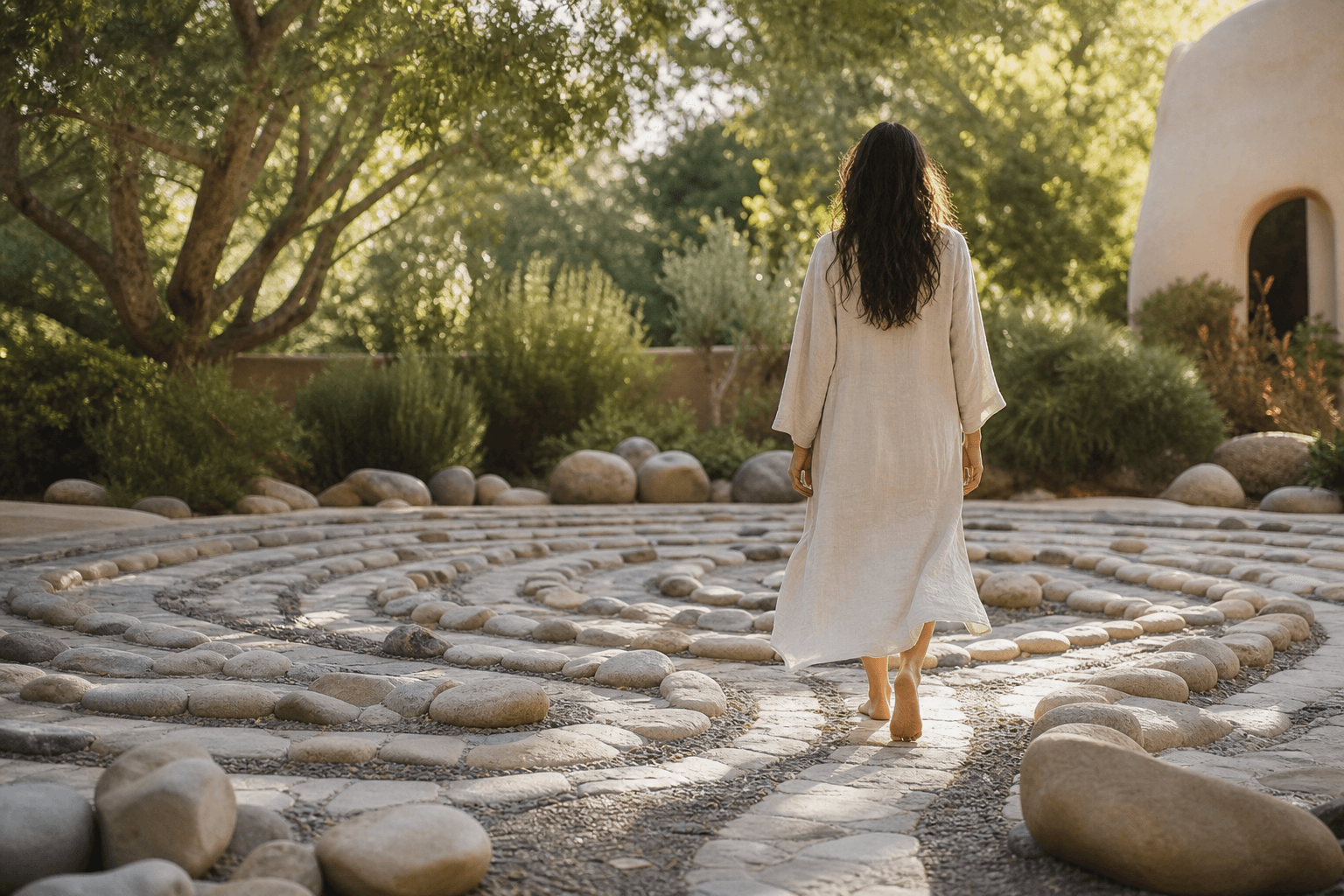
Labyrinth walking is the Western contemplative version, most commonly associated with the medieval Christian tradition (the famous Chartres Cathedral labyrinth). You walk a single winding path to the center and back, no decisions to make, no wrong turns, no maze-solving. The path takes care of itself; your only job is to notice what arises.
Informal mindful walking is the secular, everyday version: walking slowly and intentionally, with attention on breath, feet, and surroundings. It needs no special space and no instruction.
What a walking meditation session is like
In a group kinhin or retreat setting, you’ll typically:
- Arrive and orient. The facilitator (or teacher) briefly explains the pace, the posture, hands folded at the chest or clasped loosely, and what to do with your attention.
- Begin moving. Pace is usually much slower than normal walking, especially in Zen contexts. In Vipassana, it can be dramatically slow, a full minute per step in some traditions.
- Anchor your attention. You’ll be directed to feel the sole of the foot making contact, or to notice the breath, or simply to stay present with the visual field.
- Handle distraction. When the mind wanders (it will), you simply return attention to the feet or the breath, exactly as you would in seated practice.
- Close. Most formal sessions end with a brief pause, a bow, or a few quiet moments of standing still.
For a labyrinth, the session typically lasts 15, 45 minutes. You enter at whatever pace feels natural, follow the path inward, pause at the center for as long as you like, and walk back out. There’s no right emotional response, some people cry, some feel nothing in particular, many find a useful quieting of mental noise.
Duration for most walking meditation sessions: 20, 45 minutes in a structured setting, though even 10 minutes of intentional walking practice has measurable benefit.
What the evidence says about walking meditation
- Reasonable evidence for: reduced anxiety and stress, improved mood, and greater attention steadiness, consistent with the broader mindfulness meditation literature. A 2019 study in Mindfulness found that brief walking meditation significantly reduced anxiety compared to ordinary walking. Several trials show improved blood glucose regulation after mindful walking in people with type 2 diabetes.
- Debated or mixed: claims that labyrinth walking has specific therapeutic properties beyond ordinary walking and mindfulness. The calm reported is real; whether the labyrinth shape specifically causes it, versus the simple act of slow, intentional movement outdoors, is not clearly established.
- Not established / overstated: that walking meditation is meaningfully superior to seated meditation for most outcomes. They appear roughly equivalent. It’s a useful alternative, not a replacement.
Benefits people report from walking practice
Most practitioners describe a reliable reduction in mental “spinning”, the kind of looping, low-grade anxiety that sits in the background during a busy day. Walking meditation is particularly useful when seated stillness feels impossible: the body has somewhere to put its energy.
People also report better sensory presence, noticing the texture of the ground, the temperature of the air, and a gentler re-entry into the rest of their day compared to screen-based wind-downs.
Who walking meditation is for, and who should skip it
Walking meditation is one of the most accessible forms of practice: no cushion, no special equipment, no flexibility required. It works well for people who:
- Find seated meditation frustrating or painful
- Have restless energy (including ADHD, though formal trials are limited)
- Want to integrate mindfulness into everyday life without adding a separate sit
Labyrinth walking specifically suits people drawn to ritual, symbol, or contemplative traditions, including secular seekers who find bare-bones technique too stripped down.
Who should be careful: If you have balance issues, neuropathy in the feet, or gait difficulties, very slow walking can actually be harder and more fatiguing, not easier. Use common sense. Otherwise, there are essentially no contraindications.
What walking meditation costs
- Outdoor labyrinths: free. Many are publicly accessible at churches, parks, and retreat centers. The World-Wide Labyrinth Locator lists thousands.
- Group walking meditation sessions at a retreat center or studio: $15, $35 per class. Day-long retreats that include walking practice: $50, $200.
- Residential Vipassana retreats with extensive walking practice: $0, $300 (most are dana/donation-based for the teaching; room and board varies).
- Apps with guided walking meditation (Insight Timer, Calm, Headspace): free tier available; subscriptions run $50, $100/year.
How to choose a good experience
For a labyrinth walk: find a well-maintained outdoor labyrinth with enough quiet to actually settle. Some retreat centers offer brief orientation sessions; others let you arrive and walk without guidance. Either works, follow whatever feels more accessible to you.
For a structured group practice (kinhin, Vipassana walking): look for a teacher with formal training in the lineage they’re teaching, a Zen teacher for kinhin, a trained Vipassana instructor for noting practice. Ask how long they’ve practiced, and with whom. Well-established retreat centers (Spirit Rock, IMS, Zen Mountain Monastery, local dharma centers) tend to offer solid instruction.
For casual integration: start with 10 minutes of slow, deliberate walking in a quiet place, outdoors or indoors. No app required. Notice the sensation of your foot leaving the floor, moving through air, and landing. That’s the whole practice.
Compare to mindfulness meditation if you want to understand seated practice alongside walking, the two complement each other well. And if you’re drawn to movement as a meditative form, tai chi and qigong cover the structured martial-arts end of the same spectrum.
FAQ: walking meditation
Do I need to walk slowly? Normal walking feels more natural. Slow walking makes it easier to notice detail and keeps attention from defaulting to autopilot. That said, “mindful walking” at a normal pace is a real and useful practice, especially outdoors in nature. Start slow to learn the skill; apply it at any pace once it’s familiar.
Is labyrinth walking religious? The form has Christian medieval roots, but most labyrinth facilitators and sites today are interfaith or secular. You don’t adopt any belief to walk one. Treat it as a moving meditation, and whatever you find there is yours.
Can I practice walking meditation at home? Yes. You can practice walking meditation in a hallway, a backyard, or any quiet stretch of floor. Draw a simple path with tape if you want a defined lane. The practice doesn’t require a scenic location.
How is walking meditation different from just going for a walk? Intention and attention. A mindful walk keeps returning attention to the present-moment experience, sensation, breath, sound, rather than letting the mind plan, replay, or scroll. The movement is the same; the quality of engagement is different.
The honest summary on walking meditation
Walking meditation is a practical, well-supported mindfulness practice for anyone who struggles with stillness. The evidence for stress and anxiety reduction is solid. Labyrinth walking adds a contemplative layer with centuries of use behind it, though its effects above-and-beyond ordinary mindful walking are not separately proven.
At minimum, you get intentional movement, a quieter mind, and a break from screen time, which is more than most wellness interventions can honestly claim.