The best silent meditation retreats in the US for 2026: Vipassana, Zen, and a few quieter alternatives
An honest guide to sitting in silence this year, what the major traditions ask of you, where to go, and how to book without buyer's remorse.
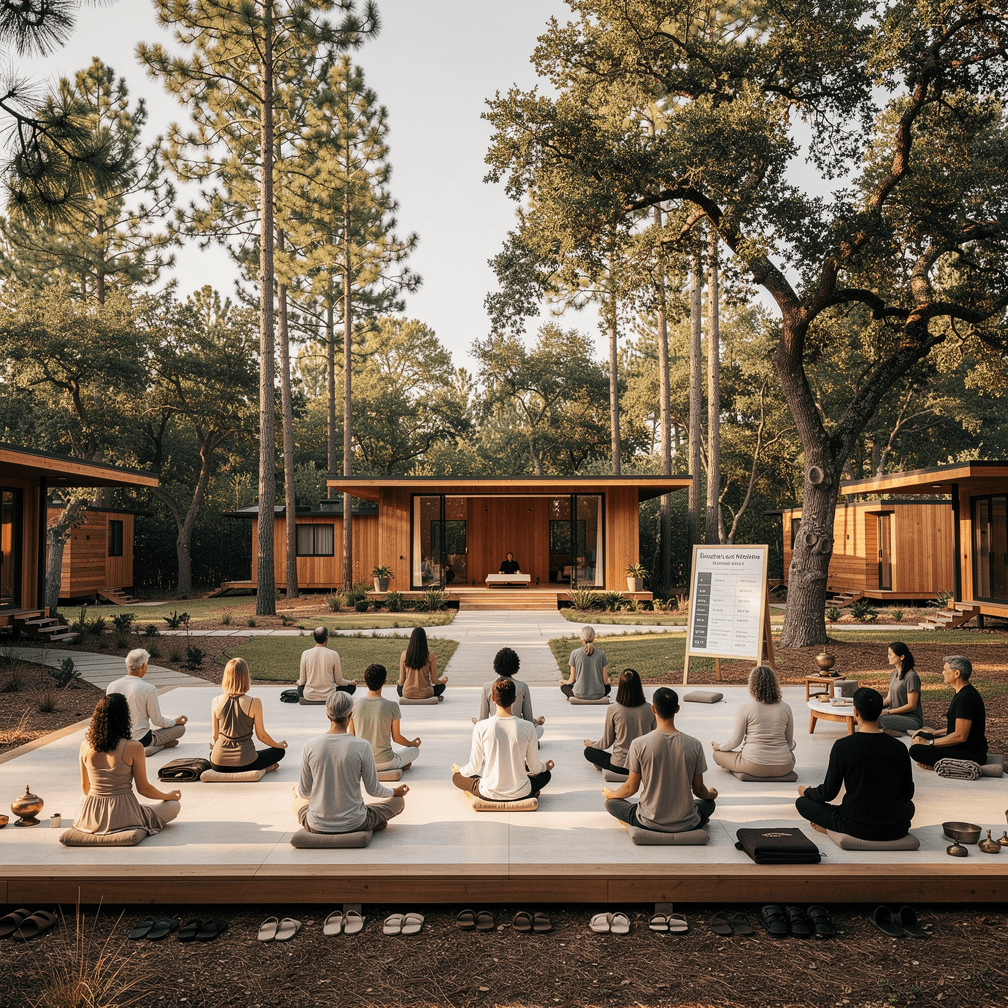
Short answer: Goenka Vipassana is ten days, donation-based and rule-heavy, with roughly ten hours of sitting a day. Insight centres such as IMS and Spirit Rock are warmer and run $700 to $1,400 a week. Zen sesshins are three to seven ritualised days. Secular trauma-informed weeks cost $1,500 to $3,500.
Silent meditation retreats are having a quiet moment again. Search interest is up, waitlists are longer than they were two years ago, and a few of the well-known centers are now booking into late 2026.
If you’ve been circling the idea for a while, this is a practical guide to what’s actually out there, what each tradition asks of you, and how to choose without romanticizing the experience.
We’ve spent the last few years visiting retreats and talking with people who teach at them. What follows is the version we’d hand a friend.
What “silent” actually means
Most silent retreats use what’s called Noble Silence: no talking, no eye contact, no reading, no writing, no phones. You can speak with a teacher during scheduled interviews, and you’ll usually break silence to ask logistical questions of staff. Beyond that, the social world goes away for the length of the course.
This is harder than people expect on day two and easier than people expect by day five. The first 48 hours tend to be loud inside your own head. After that, something settles. Almost everyone we’ve talked to says the same thing: the silence itself was the medicine, not the technique.
The major traditions you’ll encounter
Vipassana in the S.N. Goenka lineage
Ten days, donation-based, taught the same way at every Dhamma center in the world. You sit for roughly 10 hours a day, follow a strict schedule, eat vegetarian food, and learn a body-scanning technique called Vipassana. There are centers in Texas (Kaufman), California, Washington, Massachusetts, Illinois, and a dozen other states. Courses fill months in advance; the application process is short but earnest.
What it’s good for: people who want a structured, no-frills introduction and don’t mind a rule-heavy environment. What it isn’t: gentle. Pain in the knees and back is part of the deal, and the schedule does not bend.
Insight Meditation (IMS, Spirit Rock, and friends)
IMS in Barre, Massachusetts, and Spirit Rock in Woodacre, California, are the two anchor centers for Western Insight practice. Retreats run from a weekend to three months. The teaching is warmer and more psychologically literate than Goenka Vipassana, with metta (loving-kindness) woven in and teachers available for one-on-one meetings.
Pricing is sliding scale plus dana (donation) for the teachers. A week-long retreat typically lands between $700 and $1,400 for room and board.
Zen sesshins
A sesshin is an intensive Zen retreat, usually 3 to 7 days, built around long sitting periods (zazen), walking meditation (kinhin), formal meals (oryoki), and work practice (samu). Upaya in Santa Fe, Green Gulch and Tassajara in California, and the Zen Mountain Monastery in the Catskills all run sesshins through 2026.
Zen retreats tend to be more ritualized than Vipassana. If forms and bowing feel meaningful to you, sesshin can be the deepest container in this list. If they don’t, it can feel opaque.
Secular and trauma-informed silent retreats
This is the fastest-growing category. Centers like Mindful Body Center programs, Cloud Mountain in Washington, and a handful of smaller venues now offer silent retreats that drop the Buddhist framing and add trauma-informed pacing, optional movement, and shorter sits. They cost more than donation-based courses (often $1,500 to $3,500 for a week) and tend to feel closer to a wellness retreat than a monastery.
Notable retreats and centers for 2026
Texas Hill Country
The wellness retreat Texas Hill Country scene has matured a lot in the last three years. Between Wimberley, Dripping Springs, and Fredericksburg, you can find 3 to 7 day silent retreats hosted at small ranch venues with cedar saunas, spring-fed pools, and good cooks.
These are usually run by independent teachers rather than residential centers, which means the quality depends heavily on who’s leading. Ask for a teacher bio and at least two references from past retreatants before you put down a deposit.
Dhamma Siri, the Goenka Vipassana center in Kaufman (east of Dallas, not technically Hill Country but the closest formal Vipassana center to Austin), runs 10-day courses roughly monthly. Donation-based, lottery-style enrollment.
Sedona
A Sedona wellness retreat tends to lean energetic and ceremonial rather than strictly silent, but two or three operators run genuine silent containers in 2026, usually 4 to 6 days, often combining sitting practice with desert walks at dawn. The landscape does a lot of the work. Expect to pay $1,800 to $3,200 for a week including lodging and meals.
A word of caution: “silent retreat” in Sedona sometimes means “mostly silent with sound baths and shared circles.” If full Noble Silence matters to you, ask directly.
The Northeast
IMS (Barre, MA), Zen Mountain Monastery (Mount Tremper, NY), and Garrison Institute (Hudson Valley) anchor the region. IMS’s three-month retreat each fall is the most serious sit available in the country to non-monastics. For most people, a 7 or 10 day retreat there is a more sensible first step.
Pacific Northwest and Northern California
Cloud Mountain (WA), Spirit Rock (CA), Green Gulch Farm (CA), and Tassajara (CA, summer only) cover most of what you’d want. Tassajara is remote, hot, and beautiful; the road in is not for nervous drivers.
How to choose a silent retreat
A few honest questions to ask yourself before you book a wellness retreat online:
- How long can you actually sit? If you’ve never done a full day of meditation, a 10-day course is a heavy first dose. A weekend or 5-day retreat is a better calibration.
- Do you want a tradition or a container? Vipassana and Zen give you a specific technique and worldview. Secular retreats give you space to practice whatever you already do.
- What’s your relationship to physical discomfort? Goenka courses don’t allow chairs by default (you can request one). Insight and secular retreats are more flexible.
- What happens after? The first week back is often harder than the retreat. Plan a soft re-entry: no big meetings on day one home, a short daily sit, a phone call with someone who’s done this before.
Booking notes for 2026
Most reputable centers now take applications and deposits through their own sites. Goenka Vipassana courses are donation-based and never require payment upfront. Insight, Zen, and secular retreats typically ask for a 25 to 50 percent deposit at booking with the balance due 30 to 60 days before arrival.
A few practical things:
- Popular 2026 dates at IMS, Spirit Rock, and Upaya are already 60 to 80 percent full for fall. If you’re aiming for September through November, book by July.
- Texas Hill Country and Sedona operators tend to release dates quarterly. Get on email lists rather than checking sites manually.
- Travel insurance is worth it on retreats over $1,500. Cancellation policies are usually strict, 30 to 60 days non-refundable is standard.
If you’re not ready for silence yet
Silent retreats are not the only doorway. A week of consistent home practice, a daylong sit at a local center, or even regular sauna and cold plunge sessions can build the nervous system capacity that makes a longer retreat sustainable.
In Austin, sauna and cold plunge studios in East Austin and South Lamar are a reasonable low-cost way to practice sitting with intensity before you commit to ten days of it.
A cold plunge in Austin won’t teach you Vipassana, but it will teach you that the urge to escape a difficult sensation passes if you stay.
The best wellness retreats in 2026 are the ones you actually finish, integrate, and remember a year later. That has more to do with timing and fit than with prestige. Pick the shortest retreat that scares you a little, book it, and put it on the calendar.