Vipassana Meditation Explained: What a 10-Day Silent Retreat Actually Involves
One of the world's most rigorous meditation practices, donation-based, intensive, and not for everyone.
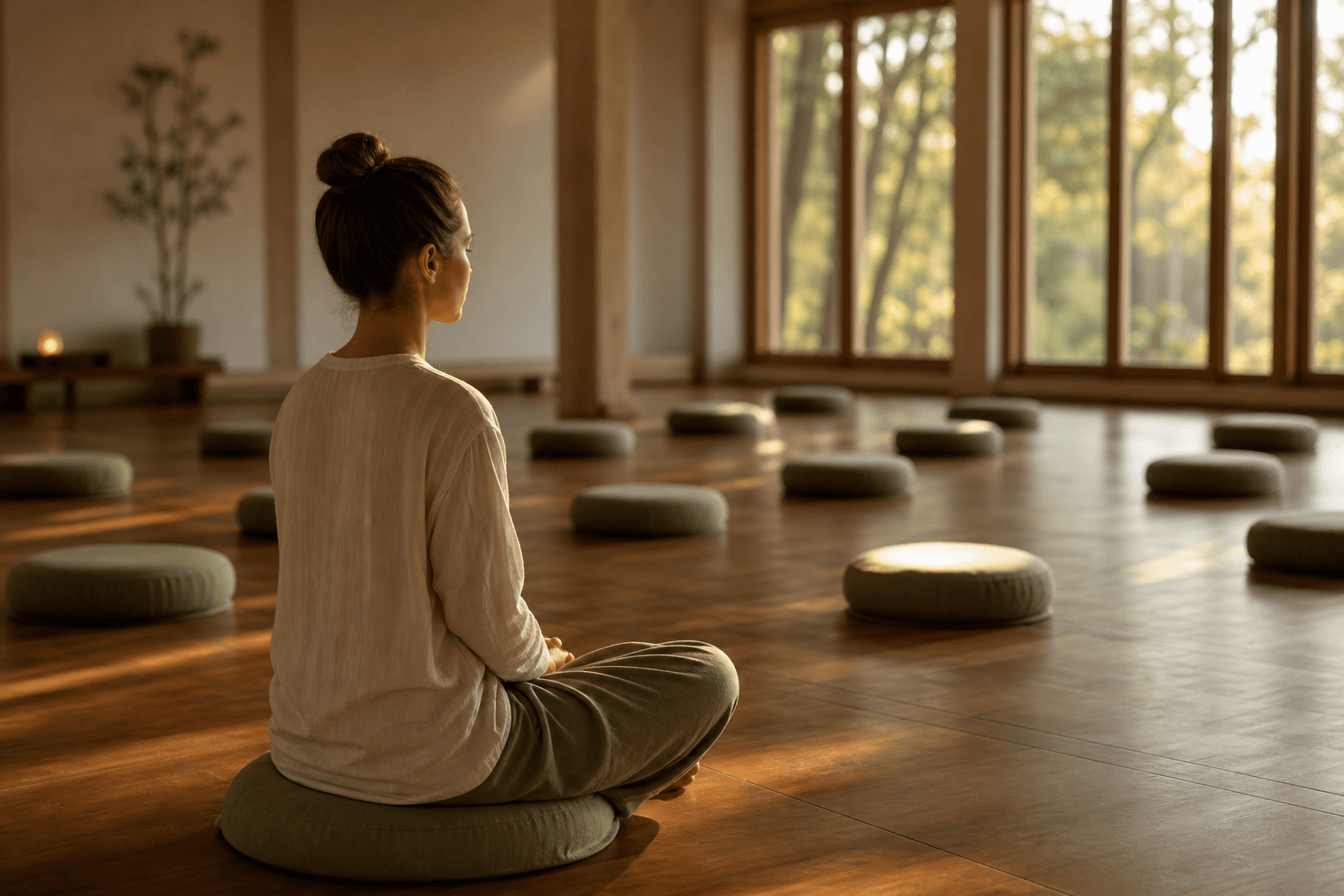
Short answer: Vipassana means insight: the systematic observation of bodily sensations without reacting to them. The best-known encounter with it is the Goenka 10-day silent course, donation-based and free to attend, running 4am to 9pm with roughly ten hours of sitting a day, no talking, phone or reading. Days four to seven are the hard part.
Vipassana is one of the oldest meditation techniques in the world, and one of the most demanding ways to encounter it is through a 10-day silent retreat. No talking, no reading, no phone, no eye contact with other participants, 10 hours of meditation daily, wake-up bell at 4 a.m.
People who complete it often describe it as the hardest and most meaningful thing they’ve ever done. Some have difficult psychological reactions mid-course. Neither outcome is uncommon.
The practice itself, stripped of the retreat format, is insight meditation: the systematic observation of bodily sensations and mental events without reacting to them. It doesn’t require a retreat to learn, but the retreat is how millions of people have encountered it.
What it is
Vipassana means “insight” or “clear seeing” in Pali. It refers to a family of meditation techniques aimed at developing direct, experiential insight into the nature of the mind, particularly how the mind habitually reacts to pleasant and unpleasant sensations by craving or aversion. The goal is to loosen that reactivity pattern over time.
The technique taught at S.N. Goenka’s global network of centers (the largest Vipassana organization worldwide) follows a specific structure: three days of anapana (breath awareness), then seven days of vipassana proper (body scanning, systematically moving attention through the body, observing sensations without reacting).
It traces lineage back through Burmese teacher Sayagyi U Ba Khin and aims to present the practice in a secular, non-religious format, though it draws from Theravada Buddhism.
There are other Vipassana lineages, Mahasi Sayadaw’s noting practice, Ajahn Chah’s Thai Forest tradition, and others, but the Goenka 10-day course is what most people in the West mean when they say “Vipassana retreat.”
What a session is like
The 10-day Goenka retreat runs on a tight schedule from 4 a.m. to 9 p.m. Here’s what to expect:
You’ll be separated by gender (at most centers), surrender your phone and reading material on arrival, and agree to Noble Silence, no speaking, gesturing, or non-verbal communication with other students. You may speak briefly with teachers and course managers.
Each day includes roughly 10 hours of group meditation in the hall and personal practice in your room or a private pagoda cell. Goenka’s audio/video instructions guide each session. Meals are vegetarian, served twice daily (breakfast and lunch; a light snack in the evening for new students). There is walking time and rest built into the schedule.
The first three days can feel tedious or physically uncomfortable as you learn breath observation. Days 4, 7, when vipassana proper begins, are when most intense experiences, emotional releases, physical discomfort, or psychological difficulty, tend to arise. Day 10, Noble Silence is lifted and students can speak again. Day 11 is departure.
Most people feel a mix of boredom, restlessness, discomfort, occasional clarity, and emotional processing. Profound experiences happen; so does a lot of just sitting. Both are part of the technique.
What the evidence says
-
Reasonable evidence for: Reduced symptoms of depression, anxiety, and stress, multiple controlled studies support this. Improved attention and emotional regulation are among the more replicated findings in meditation research generally, and Vipassana-specific studies align. A 2018 study in the Journal of Clinical Psychology found significant reductions in anxiety and depression in Vipassana retreat participants versus controls.
-
Debated or mixed: Whether the retreat format (10 days, silent, intensive) produces meaningfully different outcomes than regular daily practice, or whether the benefits come from any extended period of rest and social withdrawal. Long-term maintenance of benefits without continued practice is unclear. Most studies rely on self-report, lack active controls, and have modest sample sizes.
-
Not established / overstated: That Vipassana produces permanent psychological transformation after a single course. That it treats clinical depression, PTSD, or addiction as a standalone intervention, some centers and communities imply this; the evidence doesn’t support it as a substitute for professional treatment. Claims about “rewiring the brain” after 10 days are extrapolated loosely from neuroplasticity research.
Benefits people report
- Reduced baseline anxiety and emotional reactivity, often lasting weeks to months after a course
- Greater capacity to observe uncomfortable emotions without immediately acting on them
- Improved focus and attention
- Feeling “reset”, a sense of having cleared psychological noise
- For many, a meaningful shift in how they relate to pain, craving, and aversion
- Some participants report meaningful relief from chronic stress-driven symptoms
Who it’s for, and who should skip it
Vipassana retreats are suited to people who want a serious, structured introduction to insight meditation and are prepared for an intensive experience. Some prior meditation experience helps but isn’t required. A genuine willingness to sit with discomfort, psychological and physical, is more important than experience.
Who should approach with significant caution:
This is where honesty matters. The retreat format is intense enough that a minority of participants experience adverse psychological reactions, anxiety spikes, dissociation, surfacing of trauma, or in rare cases psychotic episodes. Research on meditation-related adverse events (Willoughby Britton’s work at Brown University is the most rigorous) documents that intensive retreats carry real psychological risk for vulnerable individuals.
- People with a personal or family history of psychosis, schizophrenia, or bipolar disorder should not attend intensive silent retreats without consulting a psychiatrist first, and most Goenka centers screen for this on the application form (our guide to wellness with bipolar disorder explains why)
- Those in active grief, acute trauma, or a current mental health crisis should wait, the practice surfaces difficult material and requires stability to work with it safely
- People currently on psychiatric medication should discuss with their prescribing doctor before a 10-day course
- Vipassana is not appropriate as a primary treatment for PTSD; trauma-sensitive meditation approaches designed for that purpose are safer starting points
Talk to a therapist familiar with contemplative practice if you have any history of trauma or mental health treatment before committing to 10 days of silence.
What it costs
This is one of the genuinely unusual things about Goenka-tradition Vipassana: 10-day courses are entirely free for new students. Room, board, and instruction are covered by donations from prior students. You are explicitly asked not to donate until you have completed your first course.
- 10-day course: $0 (donation-based; Dhamma.org has ~180 centers worldwide)
- Travel to a center: varies; many US centers are rural, so factor in transport
- Shorter courses (Vipassana at non-Goenka centers, urban drop-in formats): $20, $150 per session
- Residential retreats at independent Buddhist centers (not Goenka-affiliated): $100, $400 for a weekend, often on a sliding scale
The donation model is genuine, not a marketing tactic, courses operate entirely on dana (generosity) from the community.
How to learn it / choose a teacher or course
For the Goenka format, applications are through Dhamma.org, the global center network. Applications open several months in advance and courses fill quickly. You must read the schedule and code of discipline before applying; this isn’t a wellness weekend, and the application process makes the commitment explicit.
For a gentler introduction to insight meditation without the 10-day commitment, look for MBSR (Mindfulness-Based Stress Reduction) courses, or drop-in classes at vipassana or insight meditation centers (Spirit Rock in California, Insight Meditation Society in Massachusetts are well-regarded). See also our guide to mindfulness meditation for a broader entry point.
If you want to try the body-scanning approach in shorter form before committing to a course, many teachers offer weekend or 5-day silent retreats as a reasonable preview.
FAQ: vipassana meditation
Do I need to be Buddhist to do a Vipassana retreat? No. The Goenka organization presents the technique in a secular frame and explicitly welcomes people of any religious background. The instruction draws from Buddhist insight practice but positions itself as a universal human technology rather than a religious one.
What if I need to leave mid-course? You can leave. Centers have course managers available 24/7 and leaving is always an option. That said, the first few days are typically the hardest, and many people who want to leave on day 3 or 4 are glad they stayed. If you’re experiencing severe psychological distress, leaving is the right call.
How is Vipassana different from mindfulness meditation? Mindfulness and Vipassana share roots, but Vipassana (in the Goenka tradition specifically) is more structured and technique-specific, body scanning in a precise, systematic way. Mindfulness has become a broader umbrella term for present-moment awareness practices. See our mindfulness meditation guide for a comparison.
Can I practice vipassana at home after a course? Yes, and you’re expected to. The standard recommendation is two hours of daily practice (one hour morning, one hour evening). Most people don’t maintain that, and shorter daily sits still produce benefit. Goenka centers offer one-day “sittings of old students” as refresher sessions for graduates.
The honest summary
Vipassana is a rigorous, well-structured meditation practice with credible evidence behind its core claims about stress, anxiety, and emotional regulation. The 10-day retreat format is genuinely demanding and genuinely free, an unusual combination. It is not a cure, not appropriate for everyone, and not without psychological risk for people with certain histories.
Go in informed, go when you’re stable, and treat any glowing transformation testimonials with the same skepticism Vipassana itself trains you to apply to your own reactions.