Best women's wellness retreats in the US for 2026: a grounded guide to circles, cabins, and quiet weeks
How to choose a retreat that actually fits your nervous system, your budget, and your week off, with notes on Texas Hill Country, Sedona, and the Austin day-spots that pair well before you go.
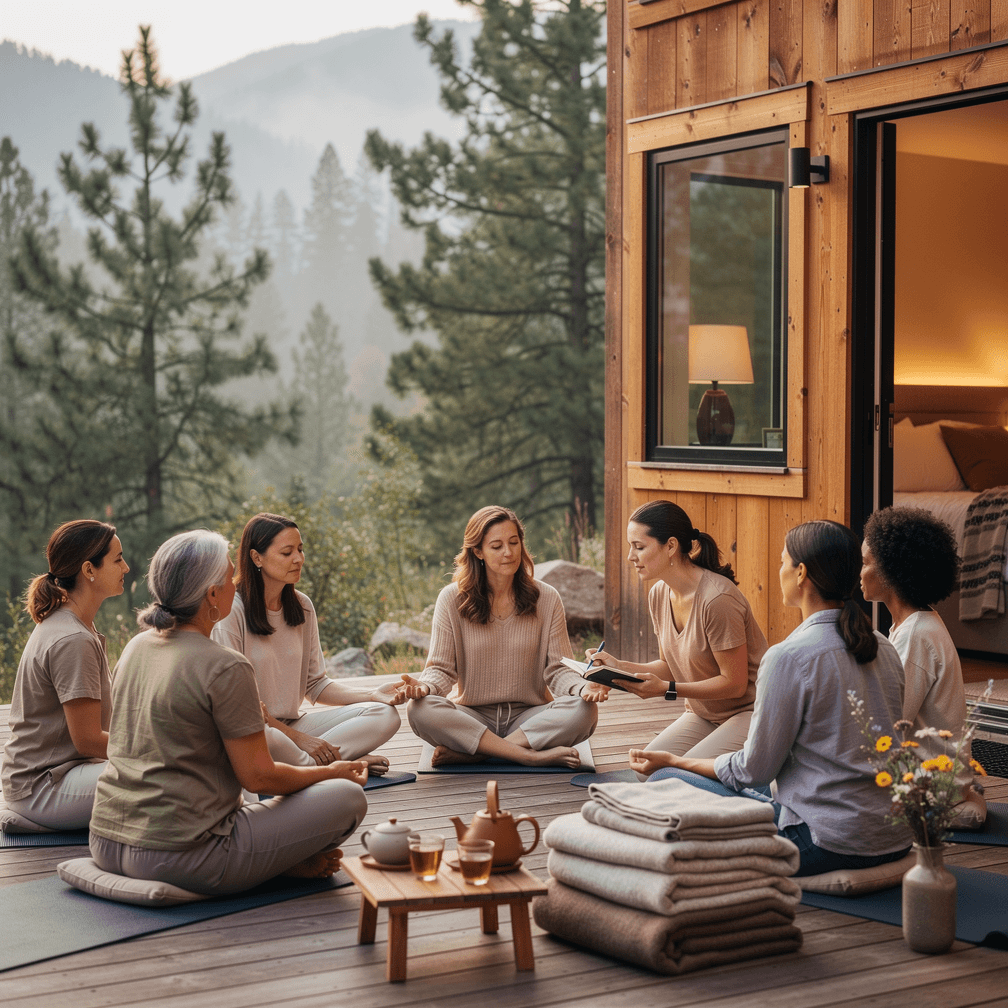
Short answer: Pick by facilitator first, location second, amenities a distant third, and by what your nervous system is actually asking for: unstructured quiet if you’re running on fumes, a fuller schedule if you’re restless. Quality programs run $1,800 to $7,500 for four to seven nights, travel excluded. Ask about integration before you pay.
There are a lot of lists floating around about the best wellness retreats 2026 will bring, and most of them read like a hotel brochure with adjectives turned up to eleven. This one is meant to be different.
We work with retreat operators, we sit in on the post-program debriefs, and we hear what women actually say in the exit circle on the last morning, not the polished testimonial they send three weeks later. What follows is what we’d tell a friend.
What “best” actually means for a women’s retreat
The word “best” depends entirely on what you need from a week away. A first-time retreat-goer recovering from a hard year of caregiving needs something very different from a forty-something founder who already has a strong meditation practice and wants to be pushed. Before you scroll any list, it helps to answer three questions for yourself.
First, what is your nervous system actually asking for? If you are running on fumes, a silent or semi-silent retreat with long unstructured afternoons will serve you better than a packed schedule of workshops, even if the workshops sound interesting. If you are restless and under-stimulated, the opposite is true.
Second, how much group intimacy can you tolerate, and how much do you want? Women’s circles range from gentle and conversational to deeply confessional. Neither is better. A circle that moves faster than you are ready for can feel like emotional whiplash. A circle that moves slower than you want can feel like wasted time.
Third, what is the realistic re-entry plan? A retreat that drops you back at the airport with no integration call, no follow-up, and no community is going to feel like a beautiful dream by week three. The best programs in 2026 have figured this out and build the landing back in from the start.
A wellness retreat in the Texas Hill Country: who it suits
A wellness retreat in Texas Hill Country has a specific texture you do not get anywhere else in the country. The land itself does part of the work. Limestone, live oaks, spring-fed creeks, and the kind of long sky that makes your shoulders drop within the first afternoon.
It is warm enough to be outside most months of the year, which means morning movement, breathwork on a porch, and evening fires under stars are all actually possible rather than weather-dependent.
The women’s programs we see succeed out here tend to share a few traits. Small groups, usually eight to fourteen. A lead facilitator with at least a decade of practice, not someone who got certified last year. Real food cooked by a real chef, with options for the people who need them.
And a schedule that includes genuine rest, not just “rest framed as a workshop.”
If you live in Texas or anywhere within a short flight, the Hill Country has the additional benefit of a low logistical tax. You are not jet-lagged on day one. You are not spending the first morning trying to remember what time zone you are in. That matters more than people think.
A Sedona wellness retreat: when the red rocks make sense
A Sedona wellness retreat is its own category. The landscape is dramatic in a way that tends to either click immediately or feel a bit much, and we’d encourage you to be honest with yourself about which camp you fall into.
Sedona attracts a particular kind of programming: vortex work, energy practices, sound journeys, plant-medicine-adjacent ceremony (legal varieties), and intuitive bodywork. If those modalities call to you, the depth of practitioner talent in Sedona is real and not something you can replicate elsewhere.
For 2026, we are watching a handful of women-only programs in Sedona that pair traditional somatic work with longer hiking days. The combination of physical exertion in beautiful terrain followed by slow nervous-system work in the evenings is, in our observation, one of the more durable retreat formats. People come home changed in small ways that hold.
The caveat with Sedona is altitude (around 4,300 feet) and dryness. If you are coming from sea level, plan for two days of feeling slightly off before you feel great. Drink more water than you think you need, and do not schedule the most intense practice on day one.
How to actually book a wellness retreat online without regret
When you book a wellness retreat online, the booking page is the easy part. The harder part is the due diligence that happens before you click. A few things we’d ask every time.
Ask for the daily schedule, not just the marketing summary. The shape of a day tells you more about the experience than any list of inclusions.
Ask who is on the team. How many facilitators, what their training is, and who is on call if something hard comes up emotionally or medically. A serious women’s retreat in 2026 should have a clear answer to all three.
Ask about the group. How many people, what the average age range tends to be, and whether they screen for fit. A good operator will tell you honestly if you are not the right match for a particular program.
Ask about the cancellation policy in plain language. Travel insurance covers some things and not others, and the financial reality of a four-figure deposit is worth understanding upfront.
Finally, ask about integration. What happens in the two weeks after you go home. If the answer is vague, build your own plan before you leave.
Preparing your body before you go: cold plunge Austin, sauna Austin, and the week-before protocol
If you live in or near Austin, the week before a retreat is a quietly important window. The contrast practices that have become common across town (cold plunge Austin studios, infrared and traditional sauna Austin spots, breathwork classes in East Austin and South Lamar) are useful here not because they will make you fitter in seven days, but because they help your nervous system get familiar with the kind of state-shifting work many retreats will ask of you.
A simple pre-retreat week, if you want one, might look like this. Two sauna sessions, twenty minutes each, with a short cold exposure at the end. One longer breathwork class, ideally in person rather than on an app. One gentle yoga or somatic class. Sleep priority for all seven nights, with screens down by ten.
Nothing dramatic. The goal is to arrive at the retreat already softened, not to arrive depleted from a heroic week of optimization.
We keep a working list of Austin operators we trust for cold plunge and sauna in the hubs section of the site. Look for studios that train their staff, keep their water clean (ask, they should tell you immediately), and do not push you past where your body wants to go.
A short note on price, and what you’re actually paying for
The range for a quality women’s retreat in 2026 runs roughly $1,800 to $7,500 for four to seven nights, not including travel.
The price reflects a few things: the cost of the venue (rural beautiful land is not cheap), the facilitator team’s time and training, real food, and the small group size that makes the work possible.
A program priced well below the range is almost always cutting one of those, and it is usually the facilitator pay or the group size. Both matter to your experience.
That said, expensive does not mean better. We have seen $2,200 retreats with brilliant teachers and tight community, and we have seen $6,000 retreats that felt like a wellness-themed hotel stay. Price is a signal, not an answer.
How we’d choose if it were our week
If we had one week off in 2026 and wanted a women’s retreat that would actually land, we’d pick by facilitator first, location second, and amenities a distant third. We’d choose a program small enough that the lead teacher knows our name by the second morning.
We’d pick a landscape that does not require us to recover from getting there. And we’d build in two genuinely quiet days at home on the back end before returning to work.
The retreat industry has matured a lot in the last few years. The best operators in 2026 are quieter, more careful, and more honest about who their program is for than the loudest names on Instagram.
If you want a starting point, look at the retreats listed on our site under Texas Hill Country and Sedona, read the operator notes (we write them after talking to past participants, not from the marketing copy), and reach out to us directly if you want a second opinion before you book.
We are happy to tell you when something is not the right fit.