Grounding (earthing): what the evidence actually says
Walking barefoot on grass feels good. Whether electrons from the earth are healing you is a much bigger claim, and the science behind it is thinner than the marketing.
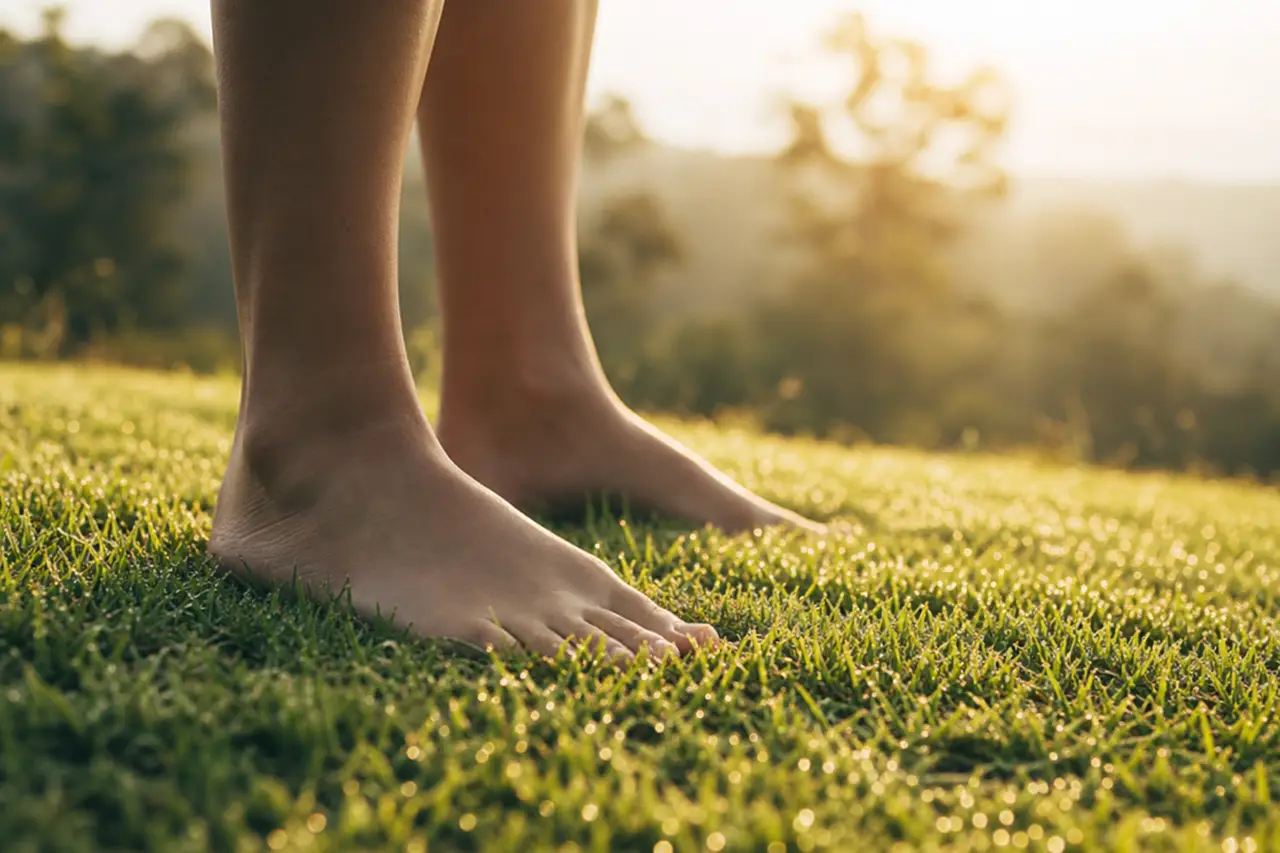
Short answer: The studies behind grounding are small, often 10 to 60 participants, frequently unblinded, and several share authors with commercial ties to grounding products, so the health claims are not established and physiologists doubt the electron mechanism. Barefoot time outdoors is free, pleasant and genuinely good for you; the $200 conductive bedsheet is not.
Grounding, also called earthing, is the practice of direct skin contact with the earth’s surface, walking barefoot on grass or sand, or using conductive mats and sheets indoors, based on the theory that transferring the earth’s electrons into the body reduces inflammation and improves sleep.
The honest evidence summary: the studies that exist are small, often industry-connected, and not strong enough to support the health claims, while the mechanism itself is viewed skeptically by most physiologists. Time outside with your shoes off is still genuinely good for you, just probably not for the reason the mats are sold on.
What does grounding claim to do?
The theory says the modern insulated lifestyle, rubber soles, raised beds, indoor living, disconnects us from the earth’s negative surface charge, and that reconnecting lets free electrons neutralize inflammatory free radicals in the body. Claimed benefits range from better sleep and less pain to faster wound healing and improved heart rate variability.
It is an appealing story: simple, natural, and free, at least until the $200 grounding sheet enters the picture.
What do the studies actually show?
There is published research, and it is worth describing honestly rather than dismissing outright. A frequently cited review by Chevalier and colleagues in the Journal of Environmental and Public Health in 2012 collected studies reporting improvements in sleep, cortisol rhythm, and pain.
The problem is the quality: the underlying studies are mostly tiny (often 10 to 60 participants), frequently unblinded, and several share authors with commercial ties to grounding products. An early cortisol study by Ghaly and Teplitz in 2004 had just 12 subjects and no control group.
That does not prove grounding is useless. It means the evidence is at the “interesting pilot data” stage, roughly twenty years after the claims went mainstream, which itself tells you something. Strong effects tend to produce strong replications; grounding has not.
Why are scientists skeptical of the mechanism?
The electron-transfer story sounds physical, but physiologists point out that the body’s inflammatory chemistry is not meaningfully governed by static surface charge, and that any charge equalization from touching the ground happens instantly and trivially.
The measurable things that DO happen when you walk barefoot in a park, lower rumination, relaxation, light exercise, morning light exposure, are already well explained by nature exposure itself.
Our nature and mental health explainer covers that evidence, and it is much stronger: the roughly two-hours-a-week outdoors association comes from a study of nearly 20,000 people, orders of magnitude beyond anything in the grounding literature.
So is it worth doing?
The free version, absolutely. Barefoot time on grass or sand costs nothing, feels good, gets you outside, and carries essentially no risk beyond watching where you step. If the ritual gets you into the park regularly, it is doing real work regardless of electrons.
The paid version is where honesty matters. Grounding mats, sheets, and patches are sold on evidence that would not clear the bar for any medication, and a bedsheet cannot give you the sunlight, movement, and green space that likely drive the real benefits. If you have $200 to spend on sleep, blackout curtains and a consistent wake time have far better evidence behind them.
The bottom line on grounding
Grounding is a low-risk practice wrapped in a high-confidence story the data does not yet support. Enjoy the barefoot walk, skip the expensive conductive bedding, and if what you are really after is a deeper reset, that is a question of rest and environment, not electrons; our guide on what a wellness retreat can and cannot do draws that line honestly too.