Wellness retreat etiquette: what to expect and how to be
Most first-timers worry about the wrong things. The unwritten rules of a retreat are simpler and kinder than you'd guess, and knowing them lets you settle in faster.
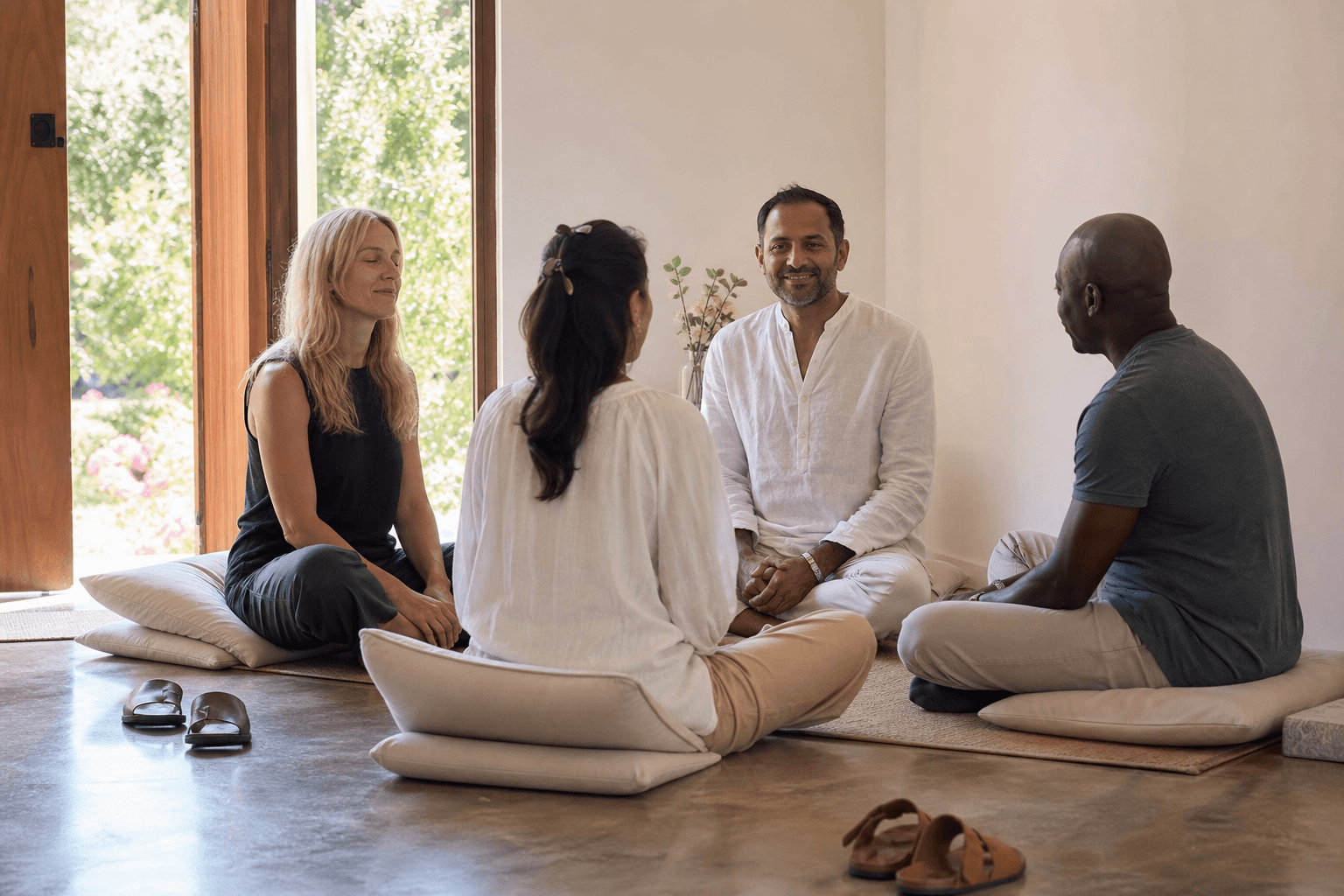
Short answer: Keep the phone away, arrive on time, hold what people share inside the group, respect silence when it is asked for, and know you can skip any session. That is essentially the whole list. Nobody is watching you the way you imagine, and opting out is part of the practice rather than a failure at it.
Keep your phone away, arrive on time, keep what people share inside the group, respect silence when it is asked for, and know that you are allowed to skip any session you want. That is essentially the whole thing.
Most first-timers arrive quietly anxious about the wrong risks: sitting in the wrong spot, saying something foolish in a circle, not being flexible or spiritual or calm enough. Almost none of that matters, and nobody is watching you the way you think they are.
Real retreat etiquette is a short list of courtesies that protect the shared space, and once you know them you stop performing and start actually resting. Here is the plain version, so you settle in on day one instead of day three.
Retreat etiquette at a glance
| Situation | What is expected | What is genuinely fine |
|---|---|---|
| Phones | Away, off, or handed in | Arranging a real emergency line before you arrive |
| Sessions | Arrive on time and quietly | Sitting one out, or leaving mid-session |
| Sharing circles | Listen, do not fix or advise | Passing, or saying nothing at all |
| Silence | Keep it, including at meals | Slipping up and simply returning to quiet |
| Group meals | Show up, help clear | Eating alone if you need the space |
| Other guests | Warm, low-key, unhurried | Not becoming friends with anyone |
| Practice level | Show up as you are | Being a total beginner in every session |
Phones and presence
Most retreats ask you to step back from your phone, and some collect them at check-in or set firm no-phone zones. This is not a power move. Half the value of a retreat is the break from the feed, and one person scrolling in a shared room quietly pulls everyone else out of it.
Sort it before you arrive. Tell people at home you will be slow to reply, give them the retreat’s emergency contact, and set an auto-reply. Then let the rest go. Our packing checklist suggests a watch or small alarm clock for exactly this reason: checking the time is the loophole that pulls most people back into the screen.
If a retreat has no view on phones at all, that tells you something about how carefully the space is held.
Silence, and when it is real
Some retreats include silent stretches: a silent breakfast, a silent morning, occasionally a full silent day. If yours does, treat it as the point rather than a rule to endure. Silence is not austerity, it is turning the volume down far enough to hear yourself.
You do not have to be good at it. If you slip and say something, just return to quiet without apologizing at length, which is itself more disruptive. If you did not expect silent periods and they appear on the schedule, that is normal rather than a mistake.
Fully silent retreats are a different commitment with their own conventions, including no eye contact and no reading. Our guide to what a silent retreat involves covers those before you sign up for one.
Group dynamics and confidentiality
You will share space, meals, and sessions with strangers, and a few simple courtesies carry the whole experience.
Arrive on time so sessions can start without a rolling apology. Let others speak without fixing, advising, or one-upping them, which is the single most common way people accidentally damage a circle. And keep what people share in the group inside the group, permanently. Confidentiality is the quiet backbone of anything that works.
You do not have to bond with everyone. A warm nod and respect for shared space is plenty, and forced intimacy is worse than none. Deeper connections happen on their own or they do not, and both outcomes are fine. If you are going alone and worried about the social side, our solo retreat guide is more reassuring than you might expect.
Opting out is always allowed
This is the rule people most need to hear: you can sit something out.
If a practice does not feel right, if you are exhausted, if your body says no, or if the session is simply not for you, rest instead. A good facilitator says this explicitly on day one and never pressures anyone past their comfort. If yours does apply pressure, that is a problem with the retreat, not with you.
Pushing through everything in order to be a good participant usually works against the whole purpose. Choosing what to do and what to skip is part of the practice rather than a failure at it. On the related anxiety about being fit or flexible or spiritual enough, that myth is worth reading before you go.
Meals, shared spaces, and quiet hours
Communicate dietary needs ahead of time, not at the table. Kitchens working at retreat scale can usually accommodate a lot with notice and very little without it.
Show up for shared meals, and help clear. Even where staff handle it, stacking your own plate reads well and costs nothing.
Respect quiet hours. Sound carries in rural buildings, walls are often thin, and rest is the entire product.
Leave shared spaces as you found them. Cushions stacked, mats rolled, bathrooms usable by the next person.
Thank the people doing the work. Facilitators, cooks, and hosts hold a lot quietly, and a genuine word at the end lands more than you would think.
Do you tip at a retreat?
Ask the organizer, ideally before you arrive, because practice varies more here than anywhere else on this page. Some retreats build gratuity into the price and tell you not to tip. Others run a shared envelope split among staff at the end of the week.
Where tipping is expected, guests commonly leave somewhere in the range of $5 to $20 per day into a shared pool, adjusted for the length and price of the stay. Nobody will treat you badly for asking the question directly, and it is far less awkward than guessing on the last morning. Our piece on tipping at wellness studios and spas covers the broader norms.
FAQ: wellness retreat etiquette
Do I have to talk in the sharing circle? No. Passing is a normal, respected option at any well-run retreat, and plenty of people pass for the first few days and speak later. If a facilitator pressures anyone to share, that is a red flag about the retreat rather than a sign you should push yourself.
What if I want to leave a session partway through? Leave quietly, without explaining or apologizing on the way out. Sit near the back or the door if you think it is likely, which is standard practice for anyone managing pain, anxiety, or a body that needs to move. Letting the facilitator know beforehand makes it easier still.
Is it rude to skip the optional early morning practice? Not at all. Optional means optional, and sleep is often the more useful choice on a retreat. The people who attend everything are not getting more out of the week than the people who rest when they need to.
How much am I expected to socialize? As much or as little as you want. Meals are the natural social hours; the rest is yours. Eating alone occasionally, walking alone, or reading instead of joining the evening conversation are all ordinary and unremarkable.
The bottom line on retreat etiquette
Retreat etiquette is not a test you can fail. It is a handful of courtesies (presence over your phone, respect for silence and confidentiality, and permission to opt out) that make the space work for everyone, including you.
Come willing rather than perfect, and assume good faith from the people around you, because they are as unsure as you are.
If you are getting ready for a first one, the first-timer’s checklist covers the practical side, what to expect at a wellness retreat walks through the days, and our guide to what wellness retreats actually do sets honest expectations.