Yoga retreats for beginners: what to expect and how to choose
You don't need to touch your toes or own the right leggings to go on a yoga retreat. Here's what a beginner-friendly one actually involves and how to pick the right first one.
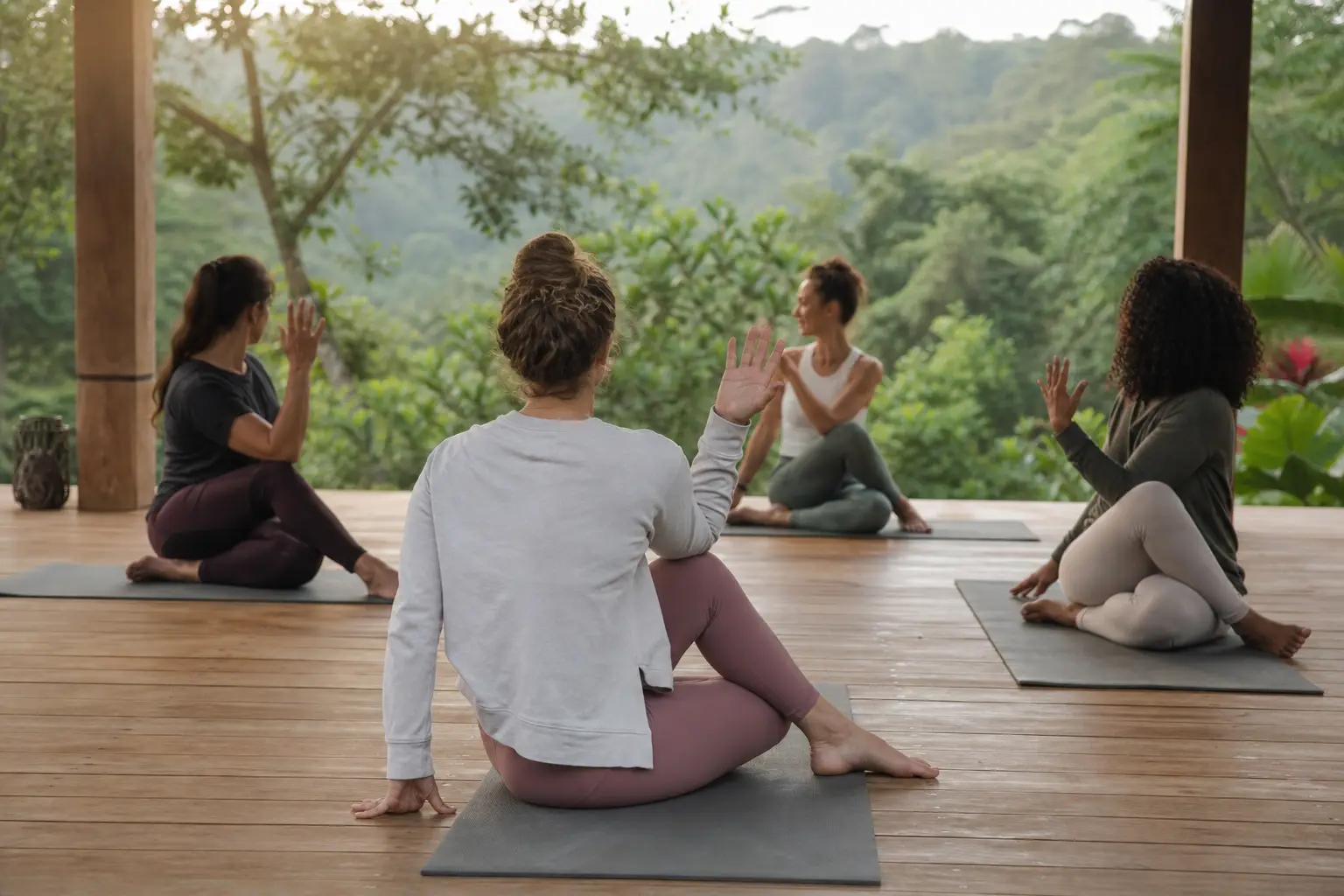
Short answer: You do not need yoga experience, you need a beginner-appropriate retreat: one that says all levels in plain words, schedules one or two practices a day rather than four, leans hatha, yin or restorative, and leaves real unstructured afternoons. US weekends run $400 to $900, a week $1,500 to $4,000.
The longer answer
You do not need yoga experience to go on a yoga retreat, you need to pick a beginner-appropriate one. That means a retreat that says “all levels” or “beginner friendly” in plain words, schedules one or two practices a day rather than four, leans hatha, yin, or restorative rather than ashtanga or power, and leaves real unstructured time in the afternoon.
On price, expect roughly $400 to $900 for a US weekend retreat and $1,500 to $4,000 for a week, depending mostly on where you sleep and whether food is included. Our wellness retreat cost breakdown unpacks what actually drives that number.
The rest of this guide is about reading a retreat listing well enough to tell the gentle ones from the intensives.
Do you actually need yoga experience?
No. What you need is a willingness to try things in a room with other people, and a body you are prepared to work with rather than against. Good teachers treat “I have done maybe five classes” as completely normal, and offer modifications without making an announcement of it.
What you do not want is to book an intensive aimed at experienced practitioners and spend five days feeling lost. That is a reading problem, not an ability problem, and it is entirely avoidable.
If you have never taken a class at all, doing three or four locally first is worth it, not for fitness but so the vocabulary is familiar. Our first yoga class guide covers what happens in a studio, and the myth-bust on needing to be fit, flexible, or spiritual handles the anxiety most first-timers actually have.
What a day on a yoga retreat looks like
Most retreats follow a shape. Something gentle in the morning, often before breakfast or right after it, lasting 60 to 90 minutes. A long open middle of the day for food, walking, swimming, napping, or a workshop on breathing or meditation. Then a softer evening practice, often restorative or yoga nidra, designed to put you to sleep rather than wake you up.
Meals are usually shared and often vegetarian. Phones are usually discouraged rather than confiscated. Nobody grades you.
You will probably be mildly sore by day two, especially in your shoulders and hip flexors, and that settles. The bigger surprise for most people is the amount of empty time, which is the actual point. Our guide to what to expect at a wellness retreat covers the wider rhythm.
Yoga styles you will meet, and which suit beginners
| Style | Pace | Beginner friendly | What a session feels like |
|---|---|---|---|
| Hatha | Slow, held poses | Yes, the safest default | Steady, instructional, plenty of time to adjust |
| Yin | Very slow, long holds | Yes | Floor-based, 3 to 5 minutes per pose, quiet |
| Restorative | Slowest | Yes | Fully supported by props, close to lying down |
| Vinyasa or flow | Moderate to fast | Sometimes, if labeled all levels | Continuous movement linked to breath |
| Iyengar | Slow, precise | Yes, if you like detail | Alignment-focused, heavy prop use |
| Kundalini | Variable | Mixed, it is unusual | Repetitive movement, breathwork, chanting |
| Ashtanga | Fast, fixed sequence | Not for a first retreat | Demanding, athletic, same series daily |
| Hot or Bikram | Moderate, in heat | Not for a first retreat | Physically taxing, heat adds real load |
A beginner-leaning retreat will usually blend the top half of that table. If a listing describes its practice as vigorous, dynamic, or intensive, believe it. Our yoga styles explainer goes deeper on each, and hot yoga versus regular yoga covers why heat changes the difficulty more than people expect.
How to spot a genuinely beginner-friendly retreat
It says so in plain language. “All levels welcome” and “suitable for beginners” mean something. “Deepen your practice” usually means the room will assume you have one.
The schedule has gaps. Count the hours of scheduled practice. Two a day with an open afternoon is a retreat. Five a day is a training.
The teacher describes how they teach. Look for mentions of modifications, props, and mixed-level groups. A bio that lists only lineages and hours of certification tells you about them, not about you.
The group is small and mixed. Eight to fifteen people is a comfortable size for asking questions. A room of long-time practitioners is a harder first room.
The listing answers logistics honestly. Room sharing, dietary needs, refund terms, and what happens if you sit a session out. The buyer’s FAQ on refunds, single supplements, and dietary needs covers what to ask before you pay a deposit.
We only recommend what we would send a friend to, and the listings that fail here usually fail on the schedule, not the scenery.
How long should your first one be?
A weekend is the low-risk entry: two or three nights, one travel day, and enough time to feel the difference without committing a week of leave. Our roundup of weekend wellness retreats covers the format, and how long a retreat should be walks through the tradeoff.
A week gives the practice time to compound and the group time to relax, but it is a bigger bet on a teacher you have not met. If you are going alone, our solo retreat guide covers the social side, which is usually easier than people fear on a small yoga retreat.
FAQ: your first yoga retreat
Will I be the least experienced person there? Possibly, and it will matter far less than you expect. On a beginner-friendly retreat, several people are in the same position, and everyone else is too preoccupied with their own hamstrings to notice yours.
Can I skip a session? Yes. Sitting out a practice to nap or walk is normal and not rude. If a retreat’s materials imply attendance is mandatory, that is useful information about how the week will feel.
Do I need to be flexible? No. Flexibility is an outcome of practice, not a prerequisite for it. Props exist precisely so that a beginner and a long-time practitioner can do the same pose differently. If back pain is your reason for going, our piece on whether yoga helps back pain sets honest expectations.
What should I pack? Less than you think, plus layers for early mornings and something warm for restorative sessions where you stop generating heat. Most retreats supply mats and props, but confirm. Our retreat packing checklist covers the rest.
The bottom line on yoga retreats for beginners
A yoga retreat is a genuinely good place to start, provided you book one built for starting. Read the level, count the scheduled hours, favor hatha or yin over ashtanga or hot, and keep the first one short. Go willing rather than skilled.
To go further, our yoga retreat versus meditation retreat guide helps you pick the focus, the first-timer’s checklist covers vetting, wellness retreat etiquette covers what to expect once you arrive, and our roundup of US yoga retreats is a place to start looking.