Acupuncture vs massage: which for pain and stress?
Both are hands-on, both are sold for pain and stress, and they work in completely different ways. Here's the honest comparison, including where the evidence is strong and where it isn't.
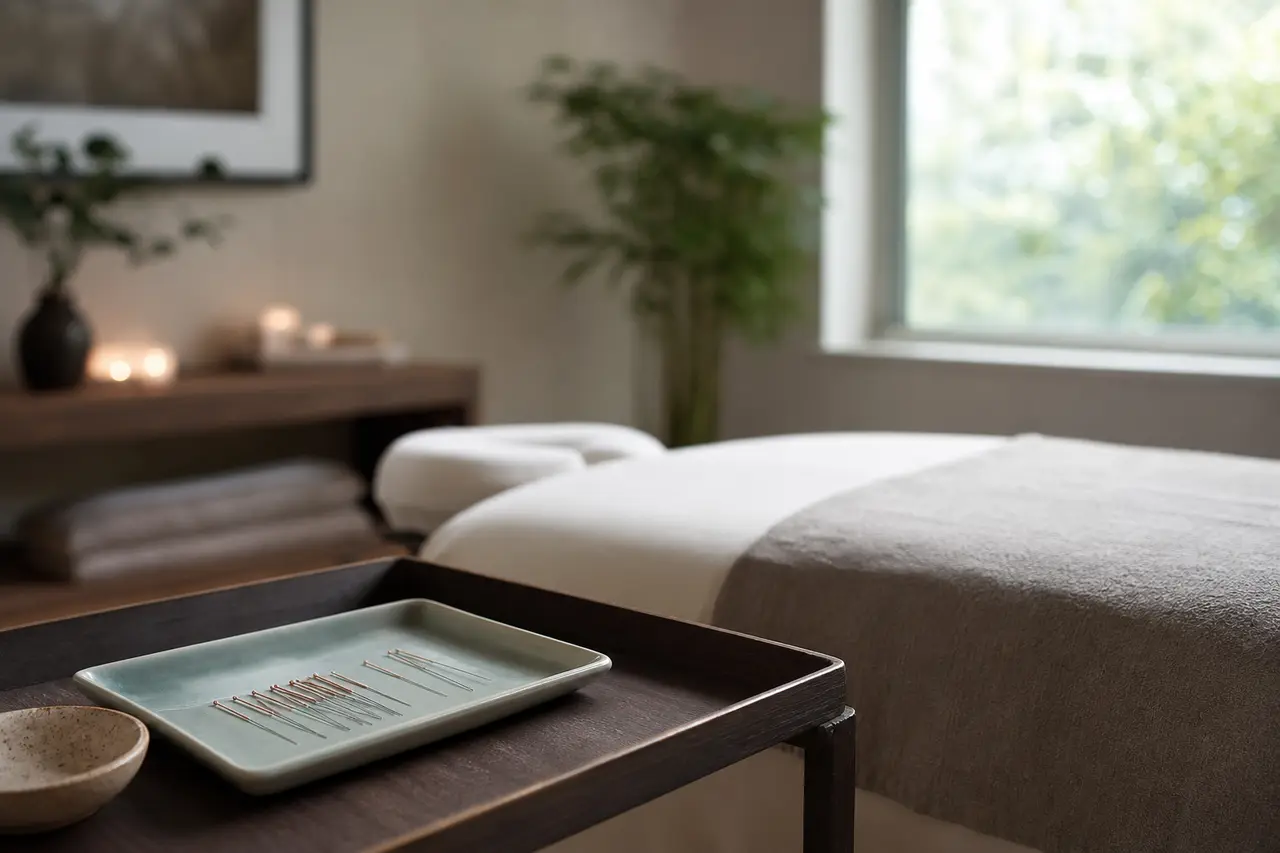
Short answer: Massage is the more direct choice for diffuse muscle tension and dependable, same-day stress relief, at roughly $70 to $130 an hour plus tip. Acupuncture’s strongest evidence is in specific chronic pain: low back pain, neck pain, tension headache and migraine, and knee osteoarthritis, at $75 to $150 a session, and it is worth a course of six rather than a single visit. The two combine well.
For broad muscle tension, stress you carry physically, and general relaxation, massage is the more direct and lower-stakes choice; for certain specific chronic pain conditions, acupuncture has meaningful evidence and is worth a course of sessions. Both can help pain and stress, and both have real but bounded support.
The practical difference most people care about is the timeline. Massage pays out the same day and the effect fades, so you repeat it. Acupuncture is assessed over a course, and a single session tells you very little.
Acupuncture vs massage at a glance
| Acupuncture | Massage | |
|---|---|---|
| Session length | 45 to 75 minutes total, needles in for 15 to 30 | 60 minutes is standard, 90 for full body |
| Typical price | $75 to $150 privately, $25 to $60 at community clinics | $70 to $130 at an independent practice, $120 to $200 at a day spa |
| Tipping | Usually not expected in a clinical setting | Customary, 15 to 20 percent |
| When you judge it | After about six sessions | The same evening |
| Strongest evidence | Chronic low back and neck pain, tension headache and migraine, knee osteoarthritis, chemotherapy and post-operative nausea | Short-term relief of muscle tension, general and low back pain, stress |
| Insurance | Sometimes covered for specific diagnoses, notably low back pain | Occasionally, usually only when clinically prescribed |
| Credential to look for | L.Ac. or equivalent state licence | State licence, LMT in most states |
How does each one work?
Massage. A therapist manipulates muscles and soft tissue to relax tightness, improve circulation, and lower stress. The mechanism is straightforward and largely muscular and nervous-system based, and the relaxation is immediate and tangible. Our types of massage guide covers the styles, and our Swedish, deep tissue and sports comparison covers which to book for what.
Acupuncture. A practitioner inserts hair-thin needles at defined points on the body. In traditional terms this is about the flow of “qi”; in modern physiological terms, proposed mechanisms include effects on nerves, local blood flow, and pain-signaling pathways. What matters for your decision is less the theory than the evidence, and the evidence is specific. Our acupuncture explainer covers what it does and does not support.
What actually happens in a session?
An acupuncture first visit starts with a 10 to 20 minute intake, and in traditional practice may include looking at your tongue and taking your pulse at several wrist positions. You then lie on a table while 5 to 20 hair-thin needles are inserted and left in for 15 to 30 minutes in a dim, quiet room. Most people feel a tiny prick or nothing; some feel a dull, heavy ache at the point, which practitioners call de qi. A significant number of people fall asleep. Sessions run 45 to 75 minutes in total.
A massage is more familiar: you undress to your comfort, lie under a sheet, and a therapist works for the booked time. Sixty minutes is the standard, and the useful question to ask when booking is whether that hour is hands-on time or your total time in the room, because the two are not the same. Our guide to your first massage covers the rest.
What does the evidence say for pain?
Acupuncture has its strongest, genuinely reasonable evidence for several chronic pain conditions, notably chronic low back pain, neck pain, tension headache and migraine, and knee osteoarthritis, where large reviews find it modestly helpful, often comparable to other conservative options. There is an ongoing scientific debate about how much is a specific needle effect versus a strong placebo-and-context effect, because the gap between real and sham needling is often smaller than expected. For those specific conditions, a proper course is a defensible thing to try.
Massage has decent evidence for short-term relief of muscle tension, general and low back pain, and stress, with effects that tend to fade and need repeating. It is excellent for diffuse tightness and stress-related muscular pain, and less targeted for a specific joint or nerve issue.
So: specific chronic pain of the kinds above, acupuncture is worth a trial; general muscular tension and stress-in-the-body, massage is the more direct fit.
Which one for your specific problem?
Chronic low back pain. Either has support, and acupuncture has the stronger case for persistent pain specifically. Our lower back pain guide covers where both sit against exercise, which outranks them.
Tension headaches or migraine. Acupuncture first, on the evidence. Massage helps many people with the neck and shoulder component, and our massage for headaches and migraines guide covers that use.
Knee osteoarthritis. Acupuncture has reasonable evidence here; massage does not target the joint. Our osteoarthritis and knee pain guides cover the levers that matter more than either.
Neck and shoulder tightness from a desk. Massage, and it is not close. This is diffuse muscular tension, which is exactly what hands are for.
Sciatica or nerve pain. Get it diagnosed first. Our sciatica guide covers what bodywork can and cannot do with a nerve problem, and our carpal tunnel guide makes the same point for the wrist.
Stress with no specific pain. Massage, for the reliability of it. You will feel it that day.
Sleep. Massage has the more direct route via relaxation, covered in our guide on whether massage helps you sleep. Acupuncture users often report better sleep, and the evidence is thinner.
Nausea from chemotherapy. Acupuncture, which has genuinely strong evidence here, and only in coordination with your oncology team. Our guide on massage during and after cancer treatment covers the clearances that apply to hands-on work.
For anything not on this list, our which bodywork for which complaint guide sorts the wider field.
How many sessions, and what will it cost you?
This is where the two diverge most, and where people waste money.
Acupuncture is normally assessed over a course. Chronic conditions often take four to six sessions to show clear benefit, and most practitioners suggest reviewing at six; an initial series of six to ten is typical, dropping to once or twice a month for maintenance. At $75 to $150 privately, that is a real commitment, which is why community acupuncture clinics at $25 to $60 on a sliding scale are the sensible way to find out whether it does anything for you. Some insurance plans cover acupuncture for specific diagnoses, low back pain in particular, so check before paying cash.
Massage is priced per session and judged per session: roughly $70 to $130 an hour at an independent or clinical practice, $120 to $200 at a day spa, and $200 or more at a resort, plus a customary 15 to 20 percent tip. Our massage cost guide covers the venue tiers, and the honest summary is that above the clinical tier you are buying setting rather than skill.
One booking note: do not buy a large prepaid package at a first acupuncture visit. A practitioner confident in the treatment will let six sessions make the argument.
Who should be careful with which?
Acupuncture. Clearance first if you have a bleeding disorder or take anticoagulants, and our guide on wellness on blood thinners covers why. Electrical stimulation with needles is contraindicated with a pacemaker. In pregnancy, some points are traditionally avoided, so make sure the practitioner knows. Look for an L.Ac. or equivalent licence, and single-use sterile needles opened in front of you, which is non-negotiable.
Massage. Tell the therapist about blood thinners, recent surgery, lymphedema, or active cancer treatment, all of which change what is appropriate rather than ruling it out. Our guide on checking a practitioner’s credentials covers verifying a licence in your state.
For either, be wary of anyone promising to cure conditions well outside pain and stress, and see a doctor first for pain that is severe, worsening, or unexplained. Our massage vs chiropractic guide covers those red flags, and our massage vs physical therapy guide covers when you need an assessment rather than an hour of relief.
Should you combine them?
Often, yes. They address different layers, acupuncture at specific points and pain pathways, massage across the muscles, and many people with chronic pain use both, sometimes in the same clinic. There is no conflict in doing so.
A sensible approach: match the first choice to your primary problem, run acupuncture as a course if that is the pick, and add massage alongside it for the general tension rather than instead of it.
FAQ: acupuncture vs massage
Which is better for chronic back pain? Acupuncture has the stronger evidence for persistent chronic low back pain specifically. Massage helps the muscular component and fades faster. Exercise outperforms both over time.
How many acupuncture sessions before I know if it works? Four to six for chronic conditions, with most practitioners reviewing at six. One session is not a trial.
Does acupuncture hurt? Not in the way people fear. The needles are close to a hair in diameter. The dull, heavy de qi sensation at some points can be strong without being painful.
How much does each cost? Acupuncture runs $75 to $150 privately and $25 to $60 at community clinics. Massage runs $70 to $130 an hour independently, $120 to $200 at a day spa, plus tip.
Do you tip an acupuncturist? Usually not in a clinical setting, where it is treated like other healthcare. Massage is tipped 15 to 20 percent in most US settings. Norms vary, so ask at the desk if unsure.
Which is better for stress? Massage, if you want it reliably and today. Acupuncture is deeply relaxing for many people, and the evidence for anxiety specifically is less settled.
Is dry needling the same as acupuncture? No. Different training, different framework, similar-looking needles. Our guide on dry needling vs acupuncture covers the distinction.
Can you do both in the same week? Yes. There is no interaction to worry about, and plenty of chronic pain patients run both.
The bottom line on acupuncture vs massage
Massage for diffuse muscle tension and dependable stress relief, judged the same evening at $70 to $130 an hour. Acupuncture for specific chronic pain conditions where it has real evidence, judged after a course of about six at $75 to $150, or far less at a community clinic.
They complement rather than compete, so combining them is reasonable. Choose by your main problem, keep expectations bounded to what each supports, and get a diagnosis first for anything severe or unexplained.