Massage vs chiropractic care: which do you actually need?
One works on your muscles, the other on your joints, and people often book the wrong one for their problem. Here's the honest guide to choosing, plus when to see a doctor instead.
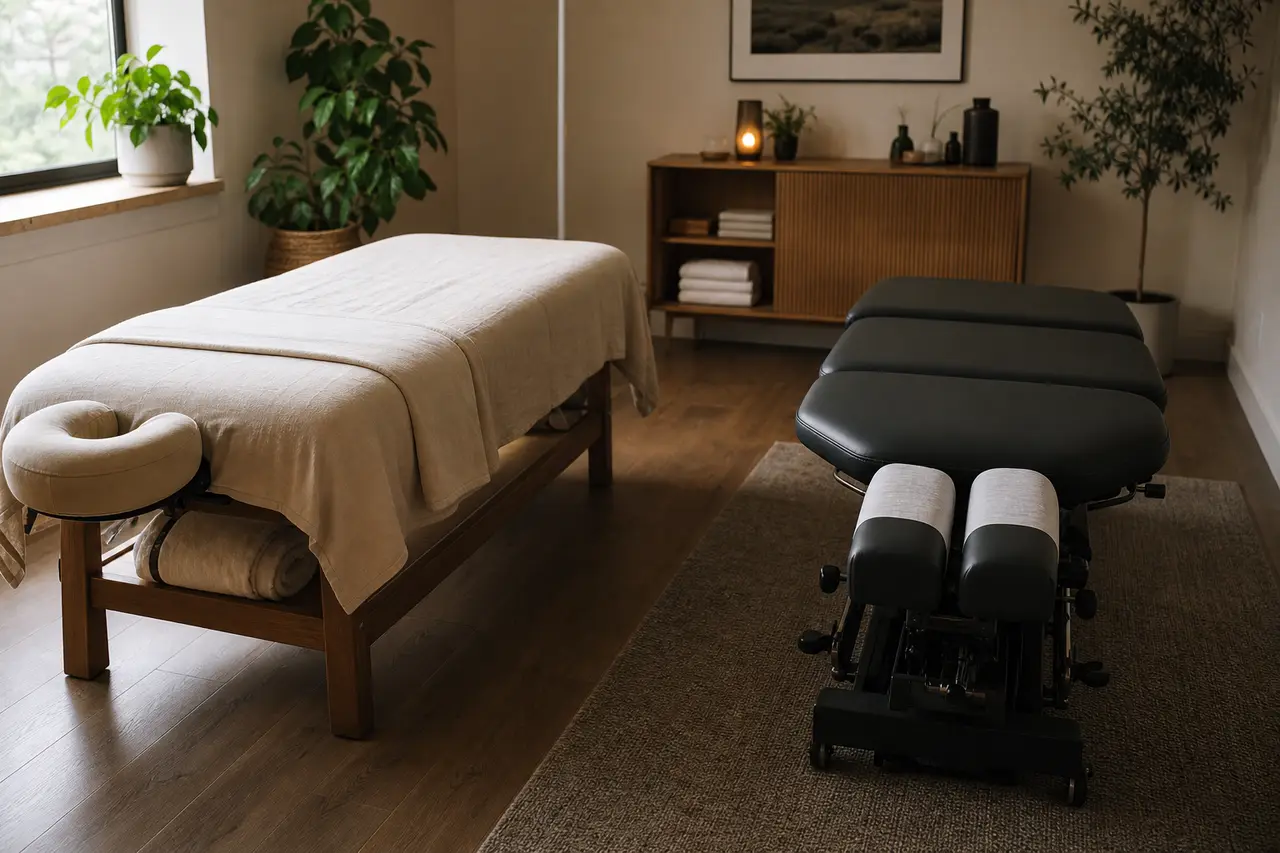
Short answer: Massage works on soft tissue, so it suits muscle tightness, tension headaches, soreness and stress; chiropractic works on joints, so it suits back and neck stiffness and mechanical back pain. Evidence for both is real but bounded and short-lived. Severe, worsening or unexplained pain needs a doctor first.
Choose massage for muscle tension, tightness, stress, and general aches; choose chiropractic care for specific joint and spinal issues, stiffness, and certain kinds of back and neck pain.
The simplest honest distinction: massage therapists work on your soft tissue, muscles and connective tissue, to release tension and improve circulation, while chiropractors work on your joints and spine, using manual adjustments to address alignment and mobility.
Many people benefit from both, and for a lot of everyday tension a massage is the gentler, lower-stakes first stop. But persistent, severe, or unexplained pain should be seen by a doctor before either.
What does each actually do?
Massage. A therapist manipulates your muscles and soft tissue by hand to relax tight muscles, ease knots, improve circulation, and lower stress. It is broadly relaxing and its evidence is decent for short-term relief of muscle tension, stress, and some chronic pain. It does not “realign” anything structural; it works on the muscles. Our types of massage guide covers the styles, from relaxing Swedish to deeper work.
Chiropractic. A chiropractor uses manual techniques, including the quick, sometimes audible spinal “adjustment”, to address joint mobility and alignment, most often for the back and neck. The evidence is moderate for certain conditions, notably some kinds of low back pain, and weaker or absent for the broader whole-body health claims some clinics make. It is hands-on care focused on your joints and spine rather than your muscles.
Which suits your problem?
Reach for massage if your issue is muscle tightness, tension headaches, general soreness, stress you carry in your shoulders and neck, or you just want to feel less clenched. It is the natural fit for soft-tissue complaints and for stress that lives in the body.
Reach for chiropractic if your issue is specific joint stiffness or restricted movement in the back or neck, or a mechanical back problem, and you want a practitioner focused on that. Many people with low back pain get relief from spinal manipulation, often alongside exercise.
Honestly, the two overlap for back and neck pain, and many people use them together: chiropractic for the joint work, massage to release the surrounding muscles. Some clinics offer both for exactly this reason.
What does the evidence say, plainly?
Both have real but bounded support. Massage is well-supported for short-term relief of pain, muscle tension, and stress, with effects that tend to fade and need repeating, our companion piece on myofascial release covers the “real but temporary” pattern.
Chiropractic manipulation has moderate evidence for certain low back and neck pain, comparable to other conservative treatments, but the sweeping claims that adjustments treat unrelated illnesses are not supported.
For either, be cautious of a practitioner promising to cure conditions far outside muscles and joints, or pushing long, expensive treatment packages before you have seen any benefit.
When should you see a doctor instead?
Before either, if your pain is severe, came from an injury, is getting steadily worse, wakes you at night, or comes with red flags like numbness, weakness, tingling down a limb, loss of bladder or bowel control, fever, or unexplained weight loss. Those need medical evaluation, not bodywork.
Massage and chiropractic manage symptoms and everyday complaints; they are not a substitute for diagnosing something that needs a doctor. If in doubt, get the diagnosis first, then use hands-on care as support.
The bottom line on massage vs chiropractic care
Massage for muscles, tension, and stress; chiropractic for specific joint and spinal issues. They overlap on back and neck pain and often work well together, so it is not always either-or. Start with the one that matches your actual problem, keep your expectations bounded to what each is good at, and see a doctor first for anything severe, worsening, or unexplained.
If the pain is chronic rather than mechanical, there is a third option worth weighing: our acupuncture vs massage comparison covers where needling has genuine evidence, and how many sessions it takes before you can judge it.