The best Austin day-long wellness experiences for 2026: sauna, cold plunge, and breathwork
A practical guide to building a real recovery day in Austin, plus how to decide when a full retreat in the Hill Country or Sedona is the better call.
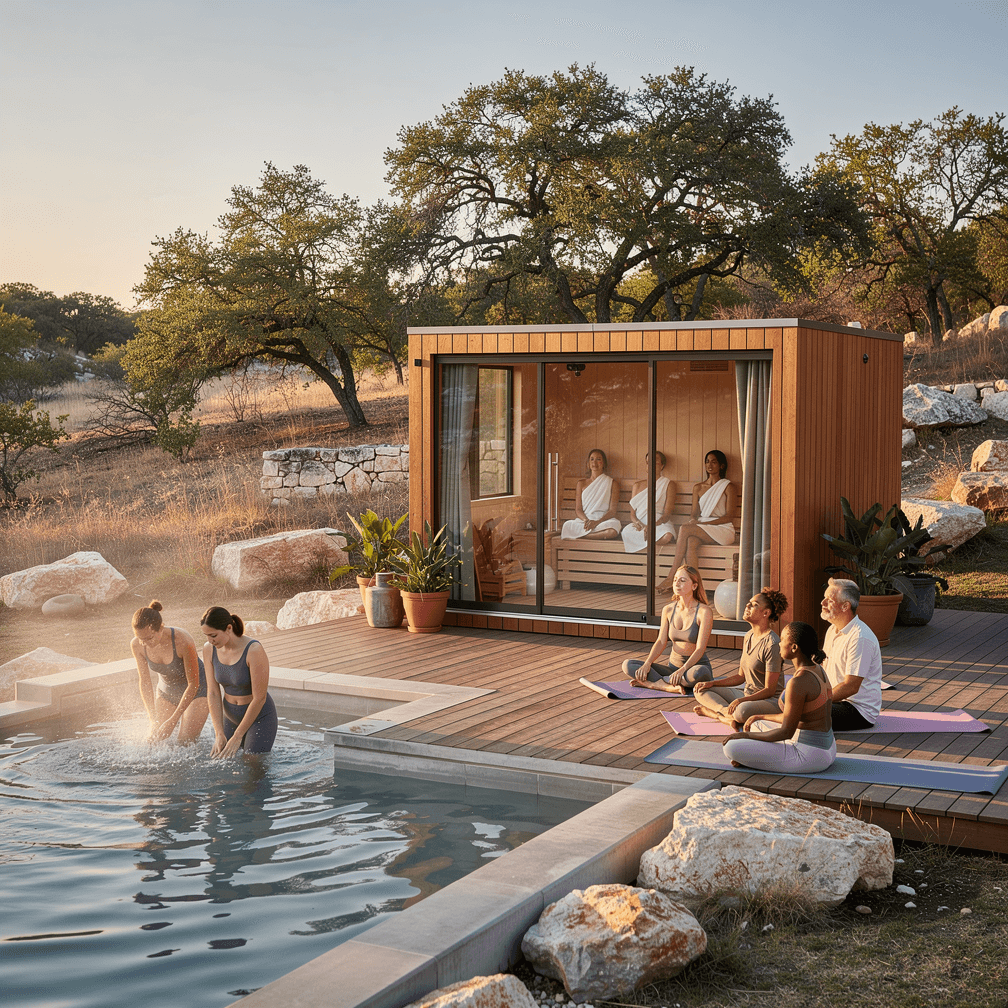
Short answer: A well-built Austin recovery day costs $140 to $240 and gets a surprising way toward what a retreat does. Stack it in order: light morning movement, three sauna and cold plunge rounds in the early afternoon, a real meal, then breathwork in the evening. Book sauna 48 hours out for weekends.
Most people who ask us about the best wellness retreats 2026 has on offer start the same way: they want a reset, they have a weekend, and they’re not sure whether to fly somewhere or just clear a Saturday in Austin.
The honest answer is that a well-built day in town can do a surprising amount of the work, and it costs a fraction of a destination trip. This is the guide we wish someone had handed us when we first started stacking sauna, cold plunge, and breathwork sessions across the city.
We’ll walk through how to think about the day, what order things should go in, and which Austin spots have earned a quiet, repeat-visit reputation. At the end, we’ll talk about the moment when a Hill Country or Sedona retreat actually becomes the smarter spend.
Why a structured day works
A single sauna session feels nice. A cold plunge on its own wakes you up. A breathwork class makes you cry once and then you forget about it. Stacked in the right order, on the same day, with food and rest in between, they do something different. You leave with the kind of nervous-system quiet that usually takes a long weekend away to find.
The pattern we keep coming back to:
- Light movement in the morning (a 60-minute yoga or mobility class, nothing punishing).
- A heat and cold contrast block in the early afternoon: 3 rounds of sauna and cold plunge.
- A real meal, slow, with people you like.
- A guided breathwork or sound session in the early evening.
- Bed by 10.
That’s it. No supplements you don’t already take, no IV drip, no biohacking stack. The order matters more than the brand of any one studio.
Sauna Austin: where to go and what to expect
When people search “sauna Austin” they’re usually picturing a Finnish-style wood sauna with a real stove, not the dry electric box at the back of a chain gym. Austin in 2026 has more of the former than it did even two years ago, and the prices have settled into a reasonable band.
A few things to know before you book:
- Single sessions usually run 60 to 90 minutes and give you enough time for three heat rounds with breaks.
- Communal saunas (mixed groups, sometimes swimsuit-required, sometimes towel-only) are the most common format in town.
- Private cabins exist if you want to bring two or three friends and not share. Expect to pay roughly double per person.
- Reservations are required at almost every location worth visiting. Walk-ins get turned away on weekends.
The right temperature for most people sits between 175 and 195 F. If a place is pushing 220 F and selling that as a feature, it’s marketing. You want to sweat steadily for 12 to 20 minutes per round, not survive a dare.
Cold plunge Austin: the part most people overthink
“Cold plunge Austin” is now a category with maybe a dozen serious operators, plus a long tail of gyms that bolted a tub into a corner. The science here is narrower than the marketing suggests: cold exposure reliably bumps alertness, can help with perceived recovery, and feels genuinely good after heat. It is not a cure for anything.
What actually matters in a plunge:
- Water temperature between 38 and 50 F. Colder isn’t better past a point; it just shortens how long you can stay in.
- Clean, filtered, regularly tested water. Ask. A good operator will tell you their turnover and sanitation setup without flinching.
- 2 to 3 minutes total in the cold per session, split across rounds. Longer is not a flex.
- A warm-up plan. Shivering for an hour afterward is not the goal. Most people warm back up in the sauna or with a walk and a hot drink.
If you’ve never plunged before, start at 50 F for one minute and build from there over a few visits. The people who get hurt by cold plunges are almost always the ones who tried to prove something on day one.
Breathwork: the quiet anchor of the day
If the sauna and plunge are the loud parts of a recovery day, breathwork is the part that does the actual nervous system work. A 60 to 75 minute guided session, ideally in the late afternoon or early evening, lands differently after you’ve already moved heat and cold through the body.
Austin has three flavors of breathwork worth knowing:
- Conscious connected breathing (sometimes called holotropic-adjacent). Long sessions, big emotional range, not for a first-time visitor on a busy day.
- Pranayama-based classes from the yoga tradition. Slower, structured, easier to fold into a packed schedule.
- Functional breathwork focused on CO2 tolerance and nasal breathing. Shorter, more athletic, less cathartic.
For a stacked day, the middle category is usually the right call. You want to leave calm, not wrung out.
A sample Saturday in Austin
Here’s a real schedule we’ve run more than once. Adjust by neighborhood; the times are what matter.
- 8:30 a.m. Coffee and a slow walk.
- 9:30 a.m. 60-minute yoga or mobility class.
- 11:00 a.m. Brunch, protein-forward, not heavy.
- 1:30 p.m. Sauna and cold plunge, three rounds, about 90 minutes total.
- 3:30 p.m. Nap or a quiet hour outside.
- 5:30 p.m. Breathwork class.
- 7:00 p.m. Dinner with one or two people, not a group of eight.
- 10:00 p.m. Lights out.
Total cost in 2026, depending on where you book, lands somewhere between 140 and 240 dollars per person. That is a lot less than a flight.
When to skip the day and book a retreat instead
A day in Austin handles tired. It does not handle the kind of accumulated, low-grade depletion that builds up over a year of hard work, a hard relationship, or a hard loss. When you notice that no single weekend is touching the bottom of how you feel, that’s the signal to book a wellness retreat online and actually leave town.
A few honest comparisons:
- A wellness retreat Texas Hill Country trip (think 3 to 5 nights, 90 minutes west of Austin, limestone and live oaks) is the right step up when you want the same modalities you’d stack in town but with the city removed. You sleep in silence, you eat food you didn’t cook, you stop checking your phone after day two. Most Hill Country retreats in 2026 run 1,400 to 3,200 dollars all in.
- A Sedona wellness retreat is a different category. Red rock, higher elevation, a stronger lean toward meditation, sound healing, and what people loosely call “energy work.” If that language makes you roll your eyes, Sedona is probably not your first retreat. If it makes you curious, it’s worth the flight. Plan for 2,200 to 4,500 dollars including airfare.
- Anywhere else on the best wellness retreats 2026 short lists (Asheville, Big Sur, Joshua Tree, the Catskills) tends to be a regional flavor of the same idea: remove the city, add structure, hand the schedule to someone else for a few days.
The pattern we see: people who run a good Austin day once a month rarely need more than one real retreat per year. People who never build the local habit tend to chase retreats that don’t quite stick, because they go home to the same Saturday.
How to book an Austin recovery day
A few practical notes on booking, because the friction here is real:
- For sauna and cold plunge in Austin, book at least 48 hours out for weekends. Weekday mornings are usually open same-day.
- For breathwork, check whether the studio caps the class. Anything over 25 people tends to feel like a workshop, not a session.
- For a Hill Country or Sedona retreat, book 8 to 16 weeks out. The good ones with small group sizes fill earlier than you’d think, and the cancellation windows tighten 30 days before arrival.
- Read the cancellation policy before you pay. Most retreats in this price range are nonrefundable inside 60 days. That’s industry standard, not a red flag, but you should know going in.
If you’re new to all of this, start with one Austin day. See how your body feels on the Monday after. That single data point will tell you more about what to book next than any review you’ll read, ours included.
A short note on what we recommend, and what we don’t
We write about places we’ve been or that practitioners we trust have vouched for. We don’t list everything in the city, and we don’t try to.
When a sauna, plunge, or breathwork studio shows up in our guides, it’s because the water is clean, the schedule is honest, the staff actually knows what they’re doing, and the price matches the experience.
When a retreat shows up, the same standard applies, with more weight on the lead instructor’s track record and how they handle the hard moments in a room.
If you want help building a specific Saturday, or you’re weighing two retreats and can’t decide, that’s the kind of thing we answer by email. The best wellness day is the one you’ll actually do twice.
Related reading on Austin wellness days
What's actually in Austin, by the numbers
From our own mapping of 135 day-wellness venues in Austin, TX. Categories come from venue names, so a place that offers a plunge without saying so in its name is counted only as a general studio — treat these as a floor, not a census.
| Category | Venues | Share of city |
|---|---|---|
| Massage & bodywork | 34 25.2% | |
| General wellness & recovery | 29 21.5% | |
| Acupuncture | 24 17.8% | |
| Pilates | 24 17.8% | |
| Yoga | 23 17% | |
| Sauna & bathhouse | 15 11.1% | |
| IV therapy | 12 8.9% | |
| Sound healing | 12 8.9% |