Cold plunge and contrast therapy in Austin: a 2026 local guide
Where to find the best cold plunge austin and sauna austin sessions this year, plus how contrast therapy actually fits into a real week.
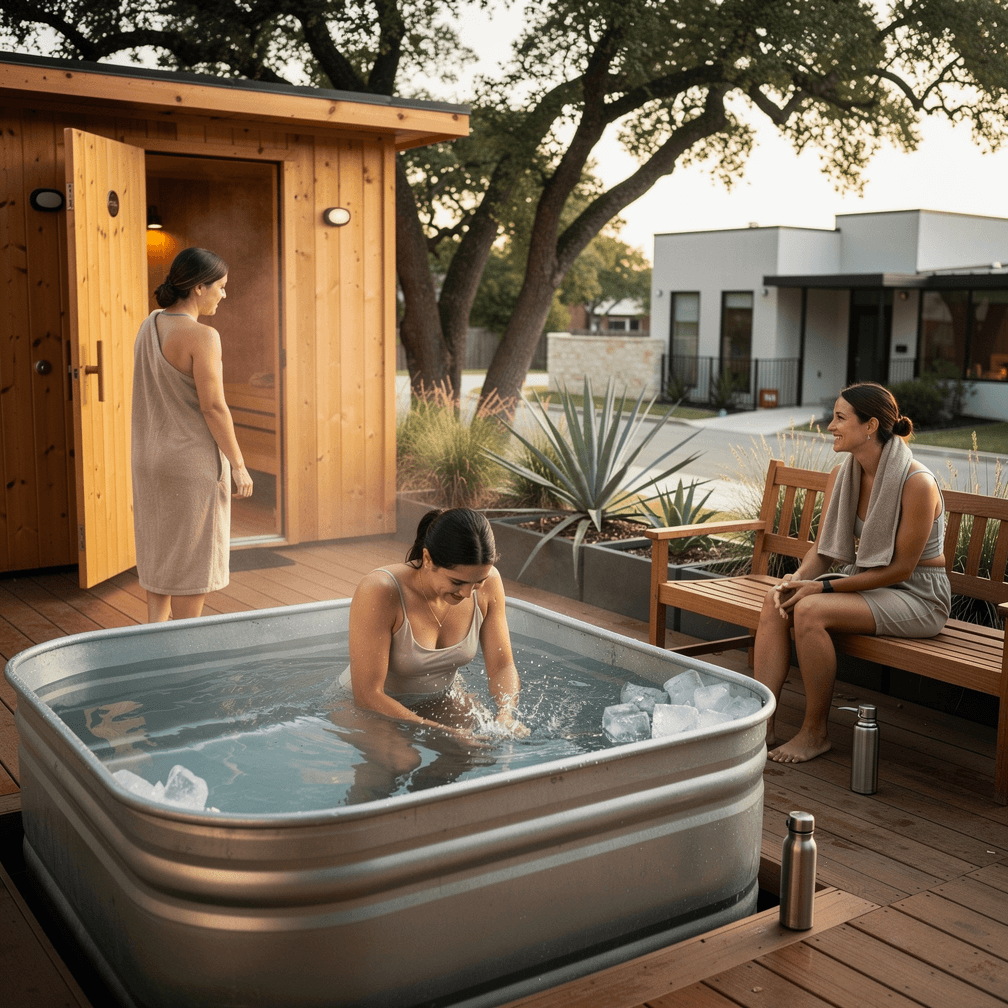
Short answer: Austin studios typically run plunges at 38 to 42 degrees next to saunas at 180 to 200. Dedicated contrast studios charge $35 to $55 a drop-in and $150 to $260 a month; bathhouse visits run $50 to $90. The evidence supports perceived recovery, mood and sleep, not fat loss.
Austin spent the last few years turning cold water and hot rooms into a small industry. In 2026, you can walk into a studio in almost any part of the city and find a plunge at 38 to 42 degrees next to a sauna running at 180 to 200.
That’s good for choice, and a little confusing if you’re trying to figure out where to actually go. This is a practical guide to cold plunge austin and sauna austin sessions, written for people who want to use contrast therapy as part of a normal week, not as a personality.
What contrast therapy actually does
Contrast therapy means alternating between cold exposure (an ice bath, cold plunge, or cold shower) and heat (a traditional sauna, infrared cabin, or steam room). The basic effects are well documented. Cold exposure constricts blood vessels and stimulates the sympathetic nervous system, which is why a plunge feels sharp and clarifying.
Heat does the opposite: vessels dilate, heart rate rises gently, and a parasympathetic rebound usually follows the session.
Where the honest answer gets more careful is everything else. Reasonable evidence supports contrast work for perceived recovery after exercise, mood lift in the hours after a session, and improved sleep on the nights you train hard. Claims around fat loss, immune boosting, and long-term metabolic change are thinner than the marketing suggests.
Treat it as a useful tool with a few real effects, not a cure.
How to read an Austin studio
Most studios in town fall into one of three shapes, and knowing which is which saves money.
Dedicated contrast studios
These are the purpose-built rooms you’ve seen on Instagram: two or three plunges, a barrel sauna or two, a rinse area, and a check-in desk. South Lamar, East Austin, and the Domain area all have at least one.
Sessions usually run 45 to 60 minutes, drop-ins land in the $35 to $55 range, and memberships sit between $150 and $260 a month depending on how many visits you want.
What to look for: water temperature posted at the plunge, filtration and ozone or UV treatment, sauna temperature you can verify on the door thermometer, and a staff member who can answer how often water is changed. If nobody can tell you the last drain date, walk.
Recovery gyms and hybrid spaces
A growing number of strength gyms and physical therapy clinics in Austin now include a plunge and sauna as part of a recovery menu. These are often the best value if you already train somewhere, and the equipment tends to be well maintained because it sits inside a business that cares about return visits. The trade-off is busier afternoon windows and shorter individual sessions.
Bathhouse-style spaces
The slower option. A bathhouse visit in Austin runs 90 minutes to two hours and usually includes multiple heat rooms, a cold plunge, lounge space, and sometimes a cold shower or bucket. Prices range from $50 to $90 for a single visit. This is the version to choose when you want the experience to feel like a Sunday morning rather than a workout.
Where to actually go in Austin
The venues below come from our mapped directory of Austin listings, grouped by what each one is listed for. Treat them as a starting shortlist, not a ranking.
Cold plunge and contrast studios
- Cryo Body Works (3501 Hyridge Dr). Listed under cold plunge in our directory. Official website
- Subzero plunge (13033 Pond Springs Rd ste 104). Listed under cold plunge in our directory. Official website
- SweatHouz Belterra Contrast Therapy Studio (12400 US-290 Suite 400). Listed under cold plunge in our directory. Official website
- The Recovery Lab and Cryo (810 Morrow St). Listed under cold plunge and wellness studio in our directory. Official website
Dedicated saunas
- Perspire Sauna Studio - Austin SW (4404 W William Cannon Dr Suite C). Listed under sauna in our directory. Official website
Float and other recovery options
- True REST Float Spa • Austin North (10721 Research Blvd Suite B-170). Listed under float therapy and wellness studio in our directory. Official website
- Austin Red Light Therapy (3727 Drossett Dr). Listed under red light therapy in our directory. Official website
- Beam Hyperbarics (3818 Spicewood Springs Rd #400). Listed under hyperbaric oxygen in our directory. Official website
These are mapped from public listings, not personal visits, so confirm hours, prices, and whether the plunge is genuinely cold before you go. The complete map lives in our directory: all 140 venues in Austin.
A simple weekly pattern
The pattern that works for most people is two or three contrast sessions a week, separated by at least 24 hours, with one of them on a hard training day.
A reasonable session looks like 10 to 15 minutes total in the sauna (split across two rounds), 2 to 3 minutes in the plunge per round, and a real rest at the end.
Total cold time across the week of around 11 minutes is the number that shows up most often in the research on mood and recovery effects.
A few practical notes from regulars:
- Cold first or heat first is mostly preference, but ending on heat tends to produce better sleep that night.
- Don’t plunge right before a heavy lift. The strength literature suggests cold immediately after resistance training can blunt some adaptations. Save the plunge for off days or several hours later.
- Breathe through the nose in the plunge. If you’re gasping, the water is too cold for you today or you went in too fast.
Choosing a studio that fits your week
Proximity matters more than features. The studio you’ll actually use is the one within 15 minutes of your home or office. After that, the questions worth asking are:
- How often is the plunge water changed and filtered?
- What’s the sauna temperature, and is it traditional or infrared?
- Is there a quiet rule, or is it a social space?
- Can you book online, or do you have to call?
That last one is small but real. If you can book a wellness retreat online in 90 seconds, you’ll go. If the booking flow is broken, you won’t.
When a studio session isn’t the right tool
Contrast therapy is not a substitute for sleep, food, or a doctor. If you have uncontrolled high blood pressure, a recent cardiac event, are pregnant, or are managing a condition that affects how your body handles temperature swings, talk to a clinician before starting. The plunge will still be there next month.
Beyond the city: when to go bigger
A studio membership covers the weekly maintenance work. A few times a year, it’s worth stepping further out. The best wellness retreats 2026 has on offer, the ones that hold up to a second look, tend to pair contrast therapy with sleep, real food, and time outside.
A wellness retreat texas hill country property an hour west of Austin can give you three days of that without a flight. A sedona wellness retreat is the version to choose when you want the landscape itself to be part of the reset.
Both pair well with the weekly rhythm you build at home, and neither replaces it.
The quiet truth about cold plunge and sauna work is that the studio matters less than the consistency. Find one that’s close, clean, and easy to book. Show up twice a week. Notice what changes. That’s the whole practice.
Related reading on Austin contrast therapy
What's actually in Austin, by the numbers
From our own mapping of 135 day-wellness venues in Austin, TX. Categories come from venue names, so a place that offers a plunge without saying so in its name is counted only as a general studio — treat these as a floor, not a census.
| Category | Venues | Share of city |
|---|---|---|
| Massage & bodywork | 34 25.2% | |
| General wellness & recovery | 29 21.5% | |
| Acupuncture | 24 17.8% | |
| Pilates | 24 17.8% | |
| Yoga | 23 17% | |
| Sauna & bathhouse | 15 11.1% | |
| IV therapy | 12 8.9% | |
| Sound healing | 12 8.9% |