Does an infrared sauna burn calories or help you lose weight?
The claim that a session torches 600 calories traces back to a 1981 letter to a medical journal, which another doctor promptly rebutted. What you actually lose on the scale is water, and it comes back as you drink.
Sources checked : 21 statements on this page, each matched to its source's own words (published studies and the Compendium of Physical Activities). How we check
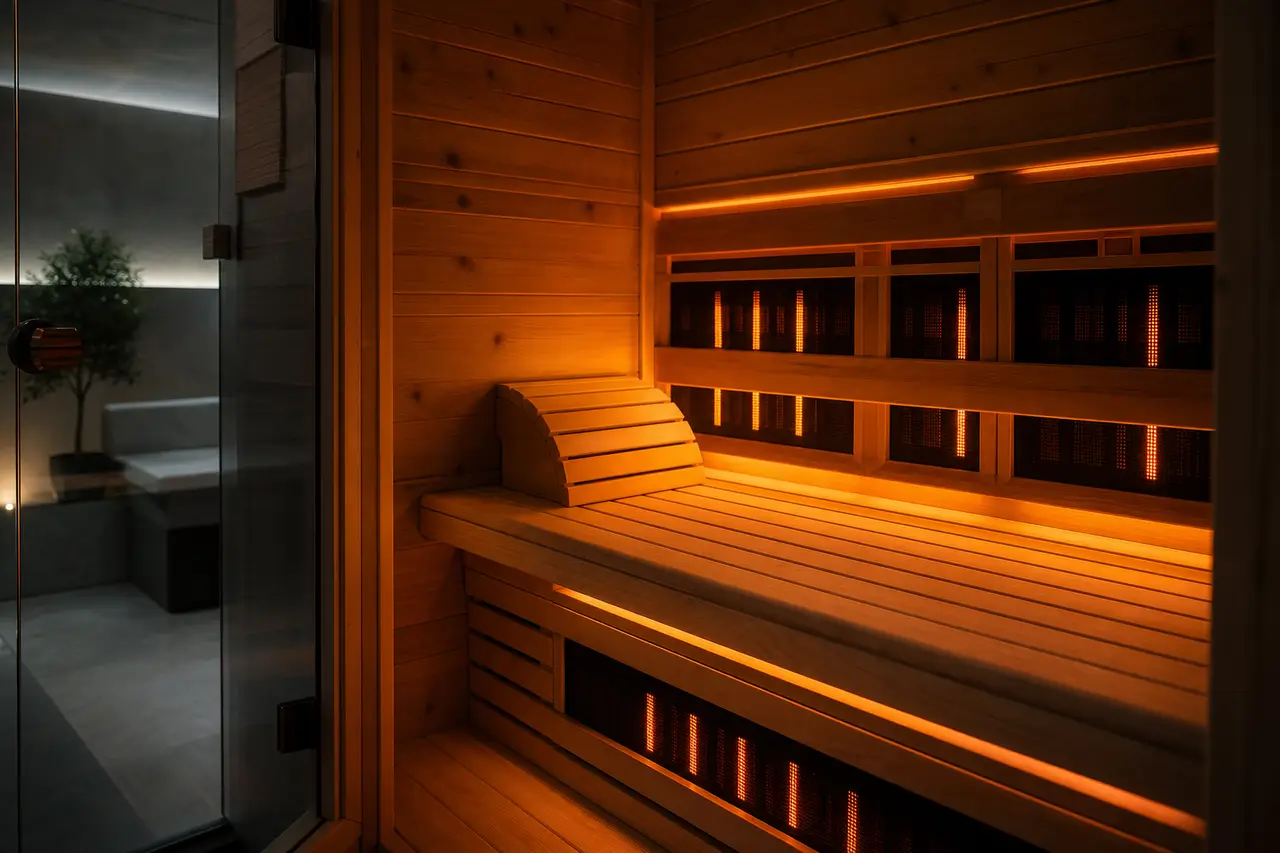
Short answer: Not meaningfully, no. The measurements show a sauna raises energy use by less than a very slow stroll adds: by our estimate, about 6 to 19 extra calories in 20 minutes for a 154-pound adult. The 600-calorie figure traces to a 1981 letter to the editor in JAMA, which another doctor rebutted in the same journal. The pound on the scale is sweated water that comes back as you drink. Infrared, at its usual settings, changes none of this.
No, not in any way that matters for weight loss. The pound or so you see on the scale after a sauna is water you sweated out, and it comes back as you drink enough to replace it, which you should.
A sauna does burn a small number of extra calories, because heating your body and running your heart faster costs some energy. But it is nowhere near the numbers on the studio wall, and it does nothing to your fat.
The sauna is genuinely worth using. Weight loss is simply not one of the honest reasons.
Where did the calorie claim come from?
A single letter to the editor, stretched for decades.
The 600-calorie claim traces back to a 1981 letter in JAMA, the Journal of the American Medical Association (Dean, 1981). Its author, a US Army doctor, objected to a JAMA article on losing weight through exercise and argued that sweating “consumes considerable energy”. The only athlete the letter’s opening mentions is a marathon runner.
A reply printed in JAMA in January 1982 summed up the letter’s claim as 500 grams of sweat in a sauna consuming “nearly 300 kcal”, and called it “highly doubtful”: people who sweat several liters a day in a hot climate would then need more food, “and clearly this does not happen” (Searle, 1982).
Sauna sellers later stretched the figure. One retailer’s page cites the letter for up to 600 calories in a 30-minute session; another claimed 600 to 1,200. It was an opinion in a letter, never a measurement.
The arithmetic behind it is the heat it takes to evaporate sweat: the Compendium of Physical Activities notes that 540 kcal evaporates 1 kg of water. In a sauna hotter than your skin, your body gains heat from the air and sheds it by evaporating sweat (Jenkins and colleagues, 2026), so our reading is that most of that heat comes from the room, not from food energy you burn.
How many calories does a sauna actually burn?
A few. The one sauna study we found that reports metabolic rate found it 25 to 33 percent higher (Leppäluoto and colleagues, 1986). The best direct measurement was made in hot water, not a sauna: an hour sitting in 40°C (104°F) water added 61 calories over resting, against 556 for an hour of moderate cycling (Faulkner and colleagues, 2017).
Hot water heats the body more than a sauna does: in a head-to-head study, core temperature rose 1.1°C in hot water and 0.4°C in a traditional sauna (Atencio and colleagues, 2025). So a sauna hour likely adds less than 61 calories. For comparison, a very slow stroll uses 2.3 times the energy of sitting quietly in the 2024 Compendium of Physical Activities, more than either figure.
The walking comparison you may have read comes from the heart, not calories: a normal sauna bath raises the heart’s workload about as much as a brisk walk (Kauppinen, 1997). Your heart works; your muscles do not (Laukkanen and colleagues, 2018). Our sauna sweat loss calculator turns these figures into an estimate for your weight and time.
Any studio quoting you a big round calorie number is repeating marketing, not measuring you. Our sauna detox guide covers a neighbouring myth that runs on the same wishful thinking.
FDA’s recall database lists one case: in January 2015, the portable far infrared sauna maker Therasage asked its consignees to discard labeling with any reference to an exact amount of calories used in an hour. FDA gave the cause of that Class 2 recall as false and misleading labeling.
Why does the scale drop then?
Because you literally poured water out of yourself.
In a typical 15- to 20-minute session you sweat out around a pint, more in a longer or hotter one, and a pint of water weighs about a pound. That is the entire explanation for the post-sauna scale drop. It is not fat, it is not permanent, and it is not a good thing to chase. Our sauna sweat loss calculator shows what sauna studies measured and works out your own number from two weigh-ins.
As you drink to rehydrate, which you should, that weight returns, because your body needs that water to function. It is not instant: in one study, an hour of steady drinking did not fully reverse the loss from an hour of sauna. Deliberately staying dehydrated to keep the number down is how you get dizzy, cramp, and unwell.
Sauna weight cutting is a known practice in sport. That same 2003 study tested it in athletes, who lost 1.4 to 1.8 percent of their body weight in three 20-minute sessions (Gutiérrez and colleagues, 2003). It has nothing to do with fat loss and everything to do with a scale reading. It can also kill: CDC reported that three previously healthy college wrestlers died between November 7 and December 9, 1997, on rapid weight-loss programs that promoted dehydration through sweating. They used vapor-impermeable suits and hard exercise in hot environments, not saunas, but the goal was the same.
If you use heat to control your weight and it worries you, talk to a clinician.
Does an infrared sauna change this?
No. The heat is gentler, and the physics are the same.
At their usual settings, infrared saunas run at a lower air temperature than traditional ones, so if anything they make you work slightly less hard: in the head-to-head study above, infrared raised core temperature the least. That is not true of every cabin. At 65°C (149°F), heart rate in one infrared study rose from 74 to 153 beats a minute (Jenkins and colleagues, 2026). The marketing sometimes claims infrared uniquely mobilises fat or detoxifies it away, but we found no good evidence for that, and Cleveland Clinic says there isn’t any clear evidence that a sauna can help you burn fat and lose weight. In a July 2022 warning letter, FDA told one seller that its claims for a far infrared sauna, including removing toxins from the body, raise misbranding and adulteration concerns. Our infrared versus traditional guide covers the real differences.
You still sweat, you still lose water, and you still burn only a modest number of extra calories. Swapping traditional heat for infrared does not add a weight-loss mechanism that the other lacks.
The “infrared melts fat” claim is one to be actively skeptical of.
Does cold do any better for weight?
A little more interesting, but still not a weight-loss tool.
Cold exposure activates brown fat and slightly raises energy expenditure, which is a genuine physiological effect and more mechanistically real than the sauna calorie story. But the studies that measured it used hours of cold, not a three-minute plunge, the boost largely ends once you warm up, and we found no trial testing cold plunging for fat loss. Our cold and metabolism guide covers exactly how far that evidence goes.
So neither heat nor cold is a weight-loss shortcut. Both are marketed as one because it sells.
So why use a sauna at all?
Because the real benefits are better than the fake one.
The best-known sauna evidence is cardiovascular: large Finnish cohort studies link frequent use to lower rates of heart disease and death. Those were traditional stove-heated saunas, not infrared cabins, and they show an association. Harvard Health reports a 2025 review of randomized trials of passive heating that found no improvement in most common measures of heart health. Our sauna and heart guide covers the strength and limits of that data.
Cleveland Clinic also says it may help reduce stress and soothe sore muscles, and that research shows it can help improve sleep. Those are honest, worthwhile reasons that do not need a fabricated calorie count propped up beside them.
If weight loss is your goal, the levers are diet, strength training, and general activity, none of which a sauna replaces. It can be a pleasant part of a healthy life, not the engine of one.
Who should check with a clinician before a sauna
Cleveland Clinic advises avoiding a sauna after a recent heart attack or stroke, or if you have been drinking alcohol.
It says to check with your healthcare provider first if you are trying to get pregnant, or have heart disease, severe aortic stenosis, heart failure, high or low blood pressure, or epilepsy. ACOG says it is best not to use saunas and hot tubs early in pregnancy, because the rise in core body temperature can be harmful for the fetus.
CDC lists diuretics, anticholinergic agents and some psychotropic medications among common medicines that raise heat risk, and Harvard Health says to avoid medications that may impair sweating. Our medication and heat checklist covers the groups.
If you are new to it, Cleveland Clinic suggests starting with five minutes. An infrared cabin is not automatically gentler, as the 153 beats a minute above shows.
The bottom line on infrared sauna and calories
A sauna burns only a modest number of extra calories, the 600 figure is a stretch of a 1981 letter, and the scale drop is water that comes back as you rehydrate. An infrared sauna does not change this.
Use a sauna for relaxation if it is safe for you, and treat the heart data as an association, not a promise. For weight, look to the things that actually move it.
The red light panel sold alongside it carries the same overreach in the other direction, and our red light therapy vs infrared sauna comparison covers which claims survive for each.
To find a sauna near you, start with our city wellness maps.
Want Google to show you more from Tendground? Add us as a preferred source.