Red light therapy vs infrared sauna: what's the difference?
They are sold side by side, often in the same room, and the names overlap enough that most people assume they are versions of the same thing. One is a heat treatment and one is not, and that single distinction decides which is right for you.
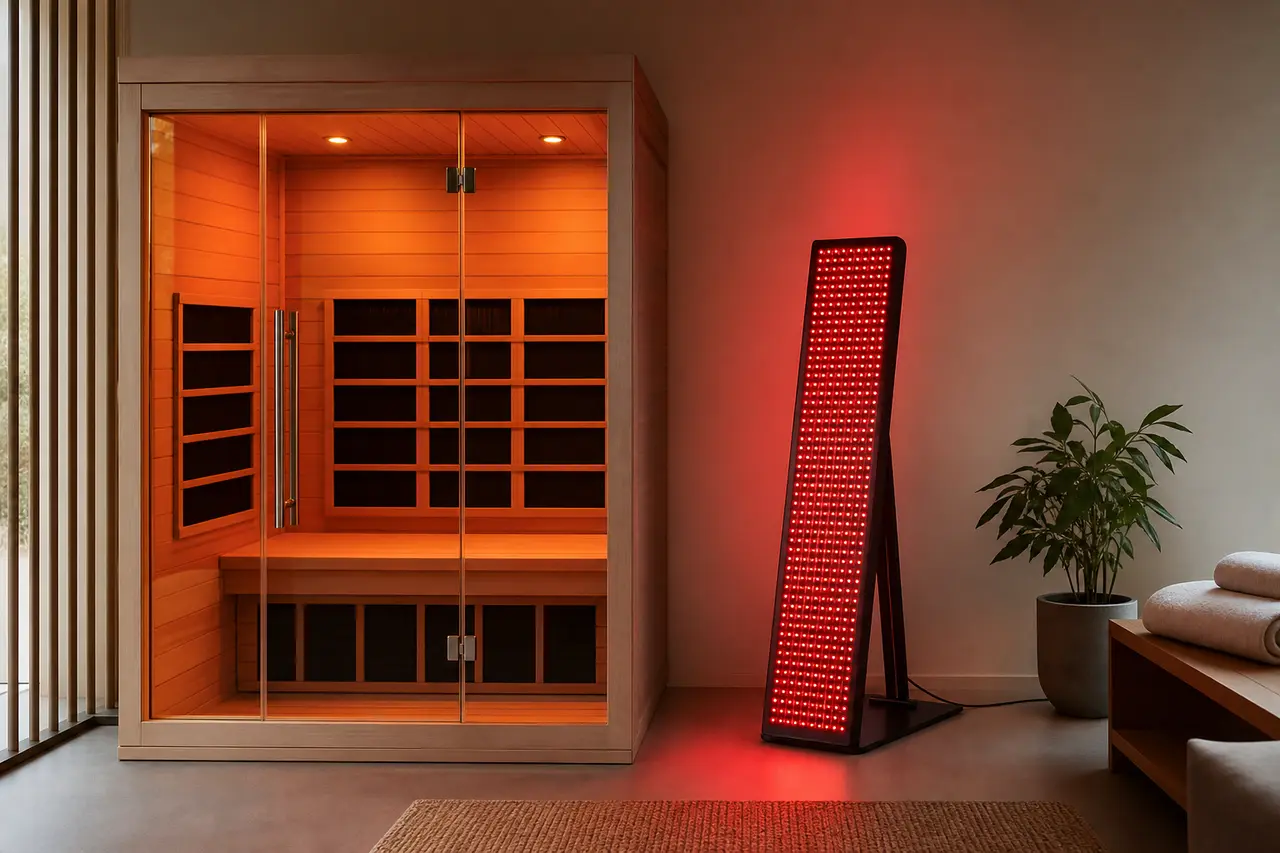
Short answer: An infrared sauna heats your body until you sweat, in sessions of 20 to 45 minutes. Red light therapy does not meaningfully heat you at all; it delivers red (roughly 630 to 660 nm) and near-infrared (810 to 850 nm) light to your skin for a few minutes per area, and skin results take eight to twelve weeks. Book the sauna for heat and relaxation, red light for skin quality.
An infrared sauna heats your body until you sweat, and its payoff is heat and relaxation. Red light therapy does not meaningfully heat you at all; it delivers specific red and near-infrared wavelengths aimed at your skin, and its best-supported payoff is skin. They are not competing versions of one treatment, and a studio selling them as interchangeable is telling you something about the studio.
The confusion is understandable: both are marketed with the word “infrared” and both are sold by the same front desk. Here is what each costs, how long each takes to do anything, and the question that separates a real red light setup from a warm lamp.
Red light therapy vs infrared sauna at a glance
| Infrared sauna | Red light therapy | |
|---|---|---|
| Wavelengths | Far-infrared, to heat you | Red and near-infrared, roughly 600 to 900 nm |
| Point of it | Raise body temperature, produce a sweat | Deliver light to skin and tissue, not heat |
| Do you sweat? | Yes, heavily | No |
| Air temperature | Around 110 to 140°F (45 to 60°C) | Room temperature |
| Session length | 20 to 45 minutes | 10 to 20 minutes, a few minutes per area |
| Undress? | Yes, it is a heat session | Exposed skin where you want the light |
| How soon you notice | Same session, it is a feeling | Eight to twelve weeks, it is a measurement |
| Best-supported use | Relaxation, the heat effects saunas share | Skin: texture, fine lines, some conditions, wound healing |
| Unsettled | Whether infrared matches traditional-sauna data | Muscle recovery and pain |
| Not supported | Sweating out toxins, weight loss | Fat loss, systemic cures |
| Typical studio price | Around $35 to $70 for 45 minutes | Around $25 to $60, often bundled |
How each one actually works
The infrared sauna is a heat treatment. Far-infrared panels warm your body directly rather than warming the air, which is why a cabin at 110 to 140°F produces a heavy sweat when a traditional sauna needs 175 to 195°F to do the same thing. The mechanism is heat, and so is the benefit. Our first infrared sauna session guide covers what a session is like, and our types of sauna explainer covers why an infrared cabin is not a sauna in the traditional sense at all.
Red light therapy is not a heat treatment. Panels deliver red (roughly 630 to 660 nm) and near-infrared (roughly 810 to 850 nm) light at low power, intended to be absorbed by cells rather than to warm you. You may feel mild warmth from the panel, but if a “red light” session leaves you sweating, you were sitting in front of a heat lamp. Our guide to your first red light session covers what a session is like.
That single distinction, heat versus light, resolves most of the confusion. One raises your core temperature. The other is trying to reach your skin.
What actually happens in each session?
An infrared session runs 20 to 45 minutes in a wooden cabin at 110 to 140°F, usually alone and in a towel. You sweat properly, leave warm and loose, and need water afterwards. Thirty minutes is plenty on a first visit, and our guide on what to wear and bring covers the practicalities.
A red light session runs 10 to 20 minutes at room temperature, six to twenty-four inches from a panel, with skin exposed where you want the light and goggles for a full-face panel. Nothing happens that you can feel, which is why people who book it expecting an experience come away disappointed. Our guide to your first red light therapy session covers it minute by minute.
How often, and how long before anything changes?
This is the most useful difference and the one studios explain worst.
An infrared sauna does its job the same day. You get warm, you sweat, you feel better that evening, and consistency is about habit rather than accumulation. Two or three times a week is a normal rhythm, covered in our guide on how often to sauna.
Red light works on a schedule measured in months. Studies generally use several sessions a week for eight to twelve weeks before measuring skin outcomes, so a package of five sessions cannot tell you whether it works. Buy enough of it to answer the question, or do not buy it. Our guide on how long until you see wellness benefits covers why so many attempts end before the effect would have shown up.
What the evidence supports for each
Red light therapy has its strongest evidence in skin. A controlled trial by Wunsch and Matuschka in Photomedicine and Laser Surgery in 2014 found improvements in skin feel, fine lines and measured collagen density with red and near-infrared treatment. Wound healing has reasonable support too. Muscle recovery and pain are genuinely under study and not settled, and the claims beyond skin, particularly fat loss and systemic “cellular health” language, are not supported.
The infrared sauna’s evidence has an honest gap in it. The cardiovascular numbers people quote for saunas come from traditional Finnish cohorts, summarised in Laukkanen and colleagues in Mayo Clinic Proceedings in 2018, using hotter, traditional saunas several times a week over decades. Infrared cabins are a milder exposure and the research on them specifically is much thinner. It is reasonable to expect some overlap; it is not honest to sell Finnish cohort data as an infrared result. Our sauna benefits explainer keeps that distinction, and the infrared vs traditional sauna comparison covers the choice between the two heat formats.
And the perennial one: sweating is temperature regulation, not detoxification. Our guide on whether sweating detoxes anything covers why that claim persists.
What the FDA has cleared red light devices for
Most red light devices sold in the US for a health or cosmetic claim go through the FDA’s 510(k) route. The FDA defines a 510(k) as a submission to show that a device “is as safe and effective, that is, substantially equivalent, to a legally marketed device.” The FDA’s letter then “clears” it for sale. Cleared is not the same as approved, and it is not proof that a particular panel works at home.
We counted the clearances in the FDA’s 510(k) database through its public API on 6 October 2026, by the product codes for light-based devices:
| What the device is cleared for | FDA product code | 510(k) clearances | Since 2021 |
|---|---|---|---|
| Over-the-counter wrinkle reduction | OHS | 163 | 117 |
| Hair growth (laser combs, caps and helmets) | OAP | 112 | 43 |
| Pain therapy, as an adjunct, without heating | NHN | 54 | 11 |
| Over-the-counter acne treatment | OLP | 51 | 18 |
| Fat reduction (low-level laser) | OLI | 33 | 11 |
| Cold sores | OKJ | 4 | 3 |
The database also lists one light-based device for dry age-related macular degeneration, from 2024. Two things stand out: most wrinkle-device clearances are recent, and each one is for a specific use, not for “red light therapy” in general.
Infrared heat is a separate category. Federal regulation 21 CFR 890.5500 defines an infrared lamp as a device that emits infrared energy, roughly 700 to 50,000 nanometers, “to provide topical heating.” That is the heat side of this comparison; the cleared red light devices above are about light, not heat.
Hair loss is where cleared home devices have the best trial evidence. A 2021 systematic review and meta-analysis in the Journal of Clinical and Aesthetic Dermatology pooled seven double-blind randomized trials of FDA-cleared home light devices for pattern hair loss and found a significant increase in hair density compared with sham devices, in men and women, with both comb and helmet designs. It also noted that only 32 home devices had been cleared for it as of January 2020; the count above has grown since.
The dose question that separates real red light from a warm lamp
Ask about irradiance and distance.
Red light results depend on delivering enough light energy to the tissue, which means the panel’s output, how far you sit from it, and how long you stay. A serious operator can tell you the device’s irradiance and the recommended distance and time. A studio that answers “just sit there until it feels nice” is selling ambience.
This is the same gap across the whole category: real clinical research exists, then a consumer version is sold at parameters the research never tested. Our guide on spotting a nonsense wellness claim covers the tells.
Who should skip which?
The infrared sauna is a heat exposure, so the usual heat cautions apply in full: pregnancy, cardiovascular conditions, blood pressure medication, anything sedating, and alcohol. Our guides on wellness on blood pressure medication and what to do if you feel faint in a sauna cover the two that catch people out. Being milder than a traditional sauna makes it a reasonable option if high heat is unpleasant for you, not a reason to treat it as risk-free.
Red light has no heat load and a much shorter list: goggles for full-face panels, care on a photosensitising medication, and your dermatologist rather than a studio for an actual condition. Our guide on checking a practitioner’s credentials applies the moment a clinic calls red light medical.
Which should you choose?
Match it to the goal, not to the package deal.
Choose the infrared sauna if you want to relax, sweat, warm up around training, or build a heat habit you can pair with cold. It is an experience as much as a treatment.
Choose red light therapy if your goal is skin: texture, fine lines, complexion, or a condition your dermatologist is already involved in. It is a short, targeted session with nothing relaxing about it.
Choose both, separately, if you want both. Plenty of studios mount a red light panel inside an infrared cabin, which is convenient, but that is two treatments at once rather than one enhanced treatment. The heat is not amplifying the light.
What about home devices?
Home red light panels are the more accessible purchase, and this is where the dose question matters most: cheap panels with vague specifications are where the money goes. Cabins and blankets are a bigger commitment, and our sauna blanket vs a real sauna comparison, home infrared sauna buying guide and home cost guide cover the tiers.
The rule applies to both: use it in a studio often enough to know you will keep using it before you put one in your house.
FAQ: red light therapy and infrared saunas
Is an infrared sauna the same as red light therapy? No. An infrared sauna heats you until you sweat; red light therapy delivers specific wavelengths without meaningfully heating you. Different mechanisms, different goals.
How long is a red light therapy session? Usually 10 to 20 minutes, a few minutes per area, at a set distance from the panel. Longer is not better if the irradiance is already adequate.
How many red light sessions before I see anything? Research on skin generally runs several sessions a week for eight to twelve weeks. A five-session package will not answer the question.
How hot is an infrared sauna? Around 110 to 140°F, much cooler than a traditional sauna at 175 to 195°F, which is why sessions run 20 to 45 minutes instead of 10 to 20.
Can I do red light therapy and an infrared sauna in the same visit? Yes, and many studios combine them. Treat them as two separate treatments, judged on their own terms.
Does red light therapy help muscle recovery? Possibly, and the evidence is not settled. Skin is where the support is strongest. If recovery is your aim, our which recovery tool for which problem guide ranks the options by what the research actually shows.
Do you need eye protection for red light therapy? Follow the device or studio instructions; most recommend goggles for full-face panels, and staring into a high-output panel is never the idea. A 2023 case report in JAMA Ophthalmology described retinal damage in a 12-year-old after repeated low-level red-light laser exposure used to treat myopia, a device aimed into the eye.
Is red light therapy FDA approved? Specific devices are cleared, not approved, and each for a specific use. The FDA’s 510(k) database listed 163 light devices cleared for over-the-counter wrinkle reduction, 112 for hair growth and 51 for acne on 6 October 2026. A studio panel without a clearance for your goal is not covered by any of them.
Does red light therapy work for hair loss? Cleared home devices have the best trial evidence of any red light use. A 2021 meta-analysis of seven double-blind randomized trials found a significant increase in hair density over sham devices, in men and women with pattern hair loss.
Is red light therapy safe during pregnancy? We searched PubMed on 6 October 2026 and found no study of red light therapy devices in pregnancy, so there is no evidence either way. Ask your OB or midwife before you start.
Does Planet Fitness have red light therapy? Some clubs do, inside the Black Card Spa: Planet Fitness describes its Total Body Enhancement booth as “a UV free application of red light, which pairs with vibra-shape technology.” Our guide to what the Planet Fitness Black Card Spa includes covers the rest.
Is red light therapy the same as a SAD lamp? No. A SAD lamp is bright white light, about 10,000 lux, used in the morning to treat winter depression; a red light panel shines red and near-infrared light on the skin. In a 2025 network meta-analysis of SAD trials, white light ranked most effective and red light last. Our guide to whether a SAD lamp works covers the routine and who should check with a doctor first.
Which is better value for a beginner? The infrared sauna, if you simply want to feel better after a hard week. Red light is worth paying for when you have a specific skin goal and will commit to a couple of months.
The bottom line on red light therapy vs infrared sauna
One is heat and one is light, and that settles almost every question people bring to this comparison. Book the infrared sauna for relaxation and a sweat, and judge it the same evening. Book red light for skin, ask about irradiance and distance before you pay, and judge it after two months rather than two visits.