Does a sauna or cold plunge lower cortisol?
Both are marketed as ways to lower your stress hormone. Measured directly, both are stressors that raise it acutely, which is the opposite of the pitch and not actually a problem.
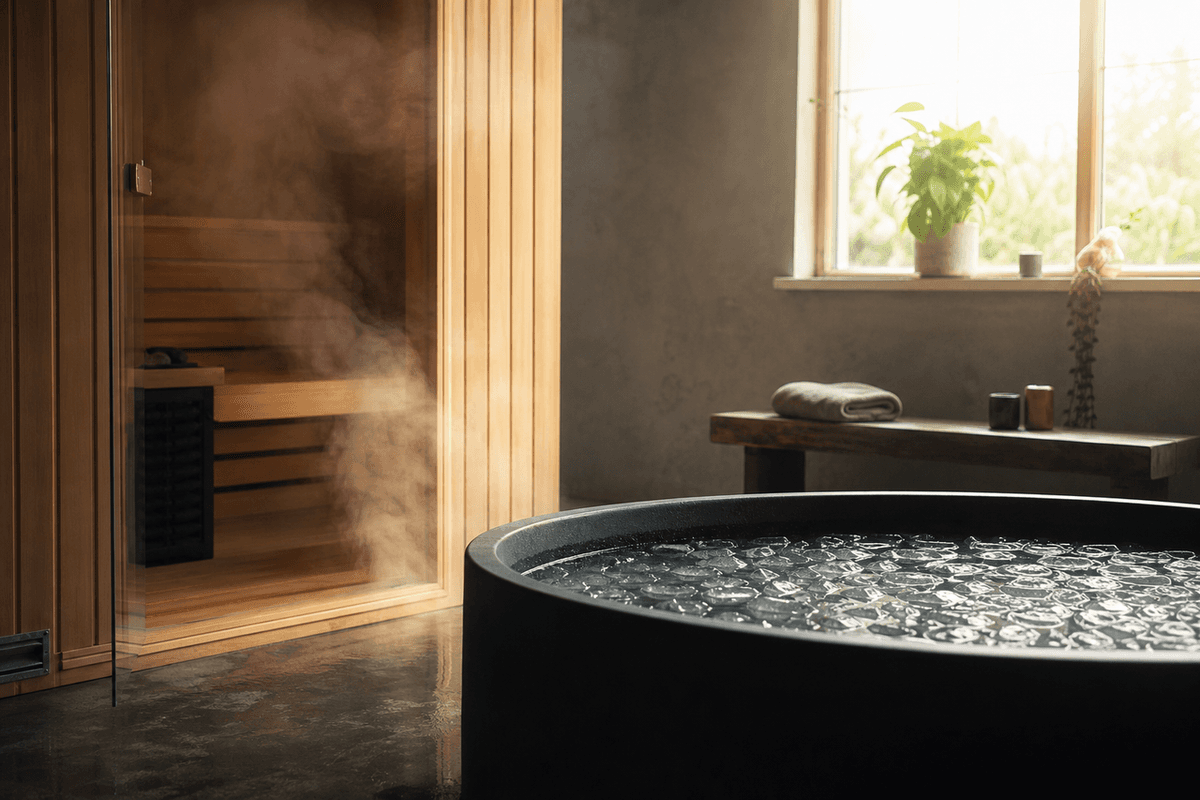
Short answer: No. Measured directly, both raise cortisol acutely, because heat and cold are physiological stressors and that is what a stressor does. It is not harmful, and it is the same category of rise you get from exercise. The health concern is a chronically dysregulated daily rhythm, not one transient spike.
Cortisol has become the villain of wellness marketing, and lowering it is offered as the benefit of almost everything. Saunas and cold plunges are both sold this way.
Measured directly, both raise cortisol acutely. They are physiological stressors, that is what a stressor does, and it is exactly what you would predict from the mechanism.
This is not bad news. It reveals that “lowers cortisol” is the wrong question, and understanding why makes the whole category of claim easier to read.
What does cortisol actually do?
It is a metabolic regulator, not a damage signal.
Cortisol is a glucocorticoid released by the adrenal glands. It mobilises glucose, regulates metabolism and immune function, and helps you respond to demand. You could not function without it, and people whose adrenal glands stop producing it become seriously ill.
It follows a strong daily rhythm: high in the morning, falling through the day, lowest around the middle of the night. That rhythm alone makes single measurements nearly meaningless, because the time of day dominates almost any intervention effect.
It also rises in response to exercise, cold, heat, excitement, a hard workout, and a good argument. Rising cortisol means your body is responding to something, not that it is being harmed.
What happens in a sauna?
It rises, along with other stress hormones.
Direct measurement in Finnish sauna conditions, such as Kukkonen-Harjula and colleagues in the European Journal of Applied Physiology in 1989, found the expected pattern: heat exposure produces haemodynamic and hormonal responses including catecholamine release, with cortisol responses varying by intensity and duration of exposure.
The general finding across the sauna literature is that a hot session is an acute stressor and hormone levels reflect that during and shortly after it. Longer and hotter sessions produce larger responses.
Which is fine. A sauna feels relaxing subjectively while being a cardiovascular and thermal load objectively, and those two things can both be true. Our guide on what the sauna evidence supports covers what the outcomes actually look like.
What about cold water?
A large acute response, cortisol included.
Cold immersion produces one of the sharpest autonomic responses available without pharmacology. The classic measurement work, Šrámek and colleagues in the European Journal of Applied Physiology in 2000, immersed participants in water at different temperatures and documented substantial rises in noradrenaline and other stress markers.
Cortisol responses to cold immersion are less consistent across studies than catecholamines, and depend heavily on water temperature, duration, and how habituated the person is. What is not supported anywhere is an acute reduction.
People habituated to cold do show blunted responses over time, which is a genuine adaptation. That is different from cold lowering cortisol, and it is a much less marketable sentence. Our guide on what the cold plunge evidence shows covers the wider picture.
Cortisol claims at a glance
| Claim | Reality |
|---|---|
| Sauna lowers cortisol | It rises acutely; the session is a thermal stressor |
| Cold plunge lowers cortisol | Acute response goes up, not down |
| A rise means it is harmful | No, that is a normal stress response |
| Habituation blunts the response | Yes, with repeated exposure over time |
| A single cortisol reading is meaningful | No, the daily rhythm dominates |
| Saliva cortisol tests tell you your stress level | Not usefully, for the same reason |
| ”Lowering cortisol” is a good goal | It is the wrong frame |
Why is “lowering cortisol” the wrong goal?
Because acute and chronic are different things.
The health concern in the research is chronically elevated or dysregulated cortisol, typically a flattened daily rhythm, seen in chronic stress, poor sleep, and some medical conditions. That is a pattern over weeks and months.
A transient rise from a sauna, a cold plunge, or a hard run is not that pattern. It is the same category of event as exercise, which nobody argues is bad because it raises cortisol.
So the target is a healthy rhythm and good recovery, not a low number. Sleep, regular exercise, and reduced chronic stressors are what move that, and none of them show up as a cortisol reading you can buy. Our guide on whether recovery trackers actually work covers a similar problem with HRV, and the vagus nerve covers the same borrowed-mechanism pattern.
Then why do they feel so calming?
The feeling is real and the mechanism is not hormonal.
You do genuinely feel calmer after a sauna or a plunge, and that experience is not imaginary. It is just not explained by a cortisol reading.
Plausible contributors: parasympathetic rebound after the acute stressor passes, warmth-driven muscle relaxation, the enforced absence of phones and tasks, the mild endorphin and catecholamine effects, and the simple fact of having done something deliberate for yourself. Our guide on whether a sauna helps with depression and mood covers the mood research, which is more interesting than the hormone story.
There is also a well-described phenomenon where a moderate acute stressor is followed by a period of lower arousal than baseline. That is a better description of what you feel walking out than “your cortisol went down”.
How should you read cortisol claims?
Treat them as a marketing tell.
When a product claims to lower cortisol, ask what was measured, when relative to the session, in how many people, and whether the outcome was a hormone number or something you would notice. Almost always it is a small short-term measurement, or nothing at all.
Be especially sceptical of direct-to-consumer saliva cortisol panels sold with supplements or protocols. Given the daily rhythm and the huge day-to-day variability, a few spot samples cannot tell you what those tests claim, and the product recommended afterwards is usually the point. Our guide on whether you need a wellness coach covers that sales pattern.
If you genuinely suspect a cortisol disorder, that is a medical question with proper diagnostic testing, not a wellness one.
FAQ: cortisol, heat and cold
So is a sauna bad for stress? No. It raises cortisol acutely like any stressor and people consistently feel calmer afterwards. Those are compatible, and the acute rise is not a health problem.
Should I avoid cold plunging if I am already stressed? If you are exhausted, sleeping badly, and run down, adding a sharp stressor may not be what you need that week. Judge it by how you feel afterwards rather than by a hormone theory.
Does timing matter? Cortisol is naturally highest in the morning, so an evening session sits against a lower baseline. There is no strong evidence this matters for outcomes.
What actually lowers chronic cortisol? Sleep, regular exercise, and removing chronic stressors. Unexciting, and the best-supported answer available.
The bottom line on cortisol claims
Heat and cold are both stressors and both raise cortisol acutely rather than lowering it, which is the opposite of how they are marketed and is not a problem. The health concern in the literature is a chronically dysregulated rhythm, not a transient rise.
Judge a sauna or plunge habit by how you sleep, feel, and function, not by a hormone number. When a product’s headline benefit is “lowers cortisol”, treat that as information about the marketing rather than the physiology.