Fasting retreats explained: water fasts, juice cleanses, and what actually happens to your body
A grounded guide to water fasts, juice cleanses, and fasting-mimicking retreats, what's real, what's marketing, and how to choose well.
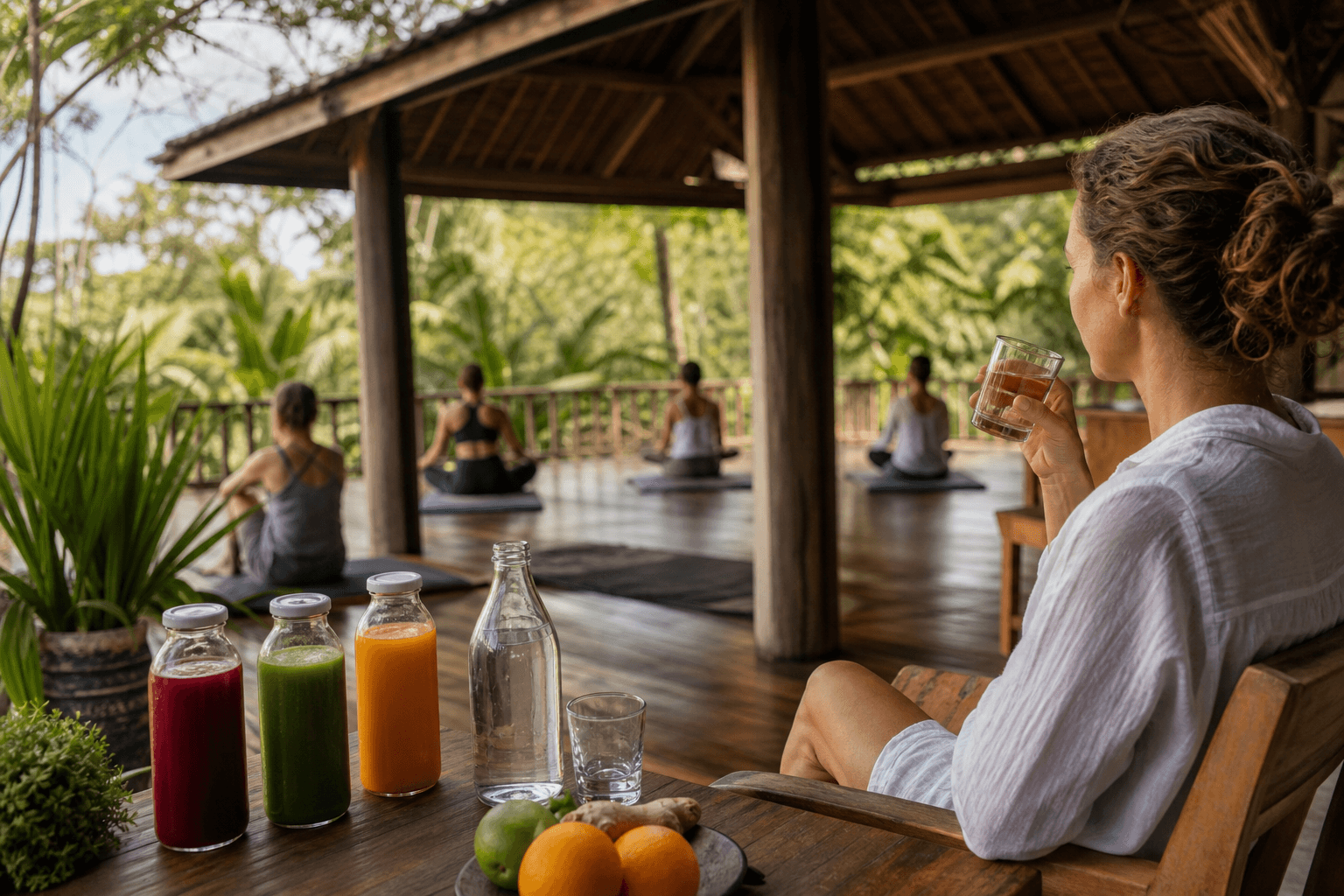
Short answer: Three to ten nights built around water-only fasting, juice programs of roughly 800 to 1,200 calories, or fasting-mimicking meals around 700 to 1,100. Supported effects are short-term insulin sensitivity, lower blood pressure and weight that mostly returns. Detox claims are marketing. Supervision, screening and the refeeding plan matter more than the format.
Fasting retreats sit in a strange corner of the wellness world. On one side: real, peer-reviewed research on autophagy, metabolic flexibility, and medically supervised therapeutic fasting. On the other: glossy “detox” marketing that promises to flush toxins no physiologist can name.
If you’re considering one of the best wellness retreats 2026 has to offer and fasting is on your shortlist, it’s worth slowing down and understanding what these programs actually are before you hand over a credit card.
This guide walks through the main formats, what each one feels like day by day, what the evidence honestly supports, and how to tell a thoughtful program from a hype-driven one.
What we mean by “fasting retreat”
A fasting retreat is a multi-day stay, usually three to ten nights, where the program is built around restricting or eliminating food, with structured support around it: rest, light movement, hydration protocols, and often bodywork, breathwork, or contemplative practice. The point isn’t only the fast. The point is the container.
Doing a five-day water fast alone in your apartment is a very different experience than doing one in a quiet room with a clinician checking on you, no work email, and someone bringing you warm broth on day three.
The formats fall into a few honest categories.
Water-only fasting
Nothing but water, sometimes with added electrolytes, for the duration. These are the most physiologically intense programs and the ones most likely to be medically supervised. Reputable water-fast retreats screen you beforehand, take baseline labs, and have a clinician on site or on call.
A typical stay is five to fourteen days, with a careful refeeding period at the end that often lasts as long as the fast itself.
Juice cleanses and juice fasts
Cold-pressed vegetable and fruit juices, usually 800, 1,200 calories per day, sometimes with broth. Less metabolically demanding than a true water fast and far more common at general wellness resorts. The marketing language around “detox” is heaviest here; the actual mechanism is mostly that you’re eating very little, very clean, for several days in a calm environment.
Fasting-mimicking programs
Popularized by research out of USC, these use small, specifically formulated meals, typically plant-based, low-protein, low-sugar, around 700, 1,100 calories, designed to keep the body in a fasting-like metabolic state while you still eat something. Easier to tolerate, easier to do safely, and the format with the most recent clinical research behind it.
Intermittent and time-restricted retreats
The gentlest format: you eat normally, but within a compressed window (often 16:8 or one-meal-a-day), with the rest of the program focused on sleep, movement, and food quality. These are common at hill country and Sedona-style retreat centers that want to offer a metabolic reset without taking on the liability of a true fast.
What actually happens in your body
The physiology is genuinely interesting, and it’s where fasting retreats earn their keep, if you choose well.
In the first 12 to 24 hours without food, your body burns through stored glycogen. Somewhere between 24 and 72 hours, depending on your metabolism and activity, you shift into producing ketones from fat. This is the metabolic switch people talk about.
Around the same window, autophagy, the cellular housekeeping process where cells break down and recycle damaged components, appears to ramp up, based on animal studies and a smaller body of human work.
What’s well-supported:
- Short-term improvements in insulin sensitivity
- Reductions in blood pressure and inflammatory markers during and shortly after the fast
- Weight loss (most of it returns without sustained changes after)
- A subjective sense of mental clarity for many people from roughly day three onward
What’s overstated or unsupported:
- The idea that fasting “detoxifies” the body in any specific, measurable way beyond what the liver and kidneys already do continuously
- Claims of curing chronic disease
- Most of the bolder cellular-rejuvenation marketing aimed at a general consumer audience
A fasting retreat can be a useful, even meaningful experience. It is not a medical treatment, and any program selling it as one deserves skepticism.
What the days actually feel like
If you’ve never done an extended fast, the honest preview matters more than the brochure.
Day one is usually fine, sometimes euphoric. You’re rested, you’re somewhere beautiful, the novelty carries you.
Day two is often the hardest. Headaches, irritability, low energy, the now-famous “keto flu” as your body transitions fuel sources. Good programs build this in, light schedule, lots of permission to nap, electrolyte support.
Days three to five tend to flatten out. Hunger usually decreases rather than increases. Many people report a quiet, clear-headed state. Sleep can get strange, sometimes deeper, sometimes lighter.
Refeeding is the part most amateur programs underestimate. Coming out of a multi-day fast with a big meal can cause real problems, including, in extreme cases, refeeding syndrome. A serious retreat treats the days after the fast as part of the protocol, not the victory lap.
Where the good programs are
The US fasting-retreat landscape in 2026 clusters in a few regions, each with a distinct feel.
Texas Hill Country
A wellness retreat texas hill country setting tends to lean toward fasting-mimicking and juice-based programs paired with hiking, river time, and Austin-adjacent practitioners. The climate is forgiving most of the year, the food sourcing is strong, and you’re close enough to a major city for medical backup. It’s a good fit for first-timers who want something more grounded than ceremonial.
Sedona
A sedona wellness retreat brings the red rock landscape and a long tradition of contemplative and energetic practice. Fasting programs here often weave in meditation, breathwork, and time outdoors. The altitude (around 4,500 feet) is worth knowing about, it can amplify the lightheadedness of a deeper fast, so pacing matters.
Other regions
The Pacific Northwest and Vermont host quieter, often clinician-led water-fast programs. California, particularly Big Sur and the desert, leans toward juice and fasting-mimicking formats inside larger wellness resorts.
How to choose a fasting retreat without getting burned
A few honest filters will save you a lot of grief.
Ask who is supervising
For anything beyond a juice cleanse or a fasting-mimicking program, there should be a credentialed clinician, MD, DO, ND, or RN, directly involved, not just “on call.” Ask for names. Ask what happens if something goes sideways at 2 a.m.
Look at the screening
A program that takes anyone with a credit card is a program that hasn’t thought hard about safety. Real fasting retreats ask about medications, history of eating disorders, pregnancy, diabetes, and cardiovascular issues, and they turn people away.
Read the refeeding plan
If the website talks about the fast in detail but refeeding gets a single sentence, that’s a signal. The reverse, a thoughtful, multi-day reintroduction protocol, is a green flag.
Watch the language
“Reset,” “clarity,” “metabolic flexibility”, fine, accurate enough. “Detox your organs,” “cure inflammation,” “reverse aging at the cellular level”, those are marketing, not medicine.
Match the format to your experience
If you’ve never fasted past breakfast, a seven-day water fast is not your starting point. A fasting-mimicking week or a three-day juice program with good support is a much better first step. The retreat that tries to upsell you into the deepest format on your first call is not the right retreat.
Before you book
A fasting retreat works best when it’s the right tool for a real question, a hard reset after a depleted year, a structured pause to examine your relationship with food, a clinical intervention for a specific metabolic goal under supervision. It works worst as a shortcut, a punishment, or a vacation strategy.
If you want to book wellness retreat online options that include fasting, take the extra fifteen minutes to email the program directly and ask the questions above. The good operators answer them clearly. The ones that dodge are telling you something.
And if you’re not sure a fast is the right move at all, that’s worth honoring too. There are quieter ways to reset, a few days of cold plunge austin sessions and sauna austin contrast work, real sleep, real food, real silence, that ask less of your body and often deliver more of what you were actually looking for.
A note on what fasting can’t do
Fasting won’t fix a job that’s eating you alive. It won’t repair a relationship. It won’t replace therapy, and for some people, particularly anyone with a history of disordered eating, it can quietly make things worse. The best fasting retreats know this and screen for it. If that history is yours, our guide to wellness in eating disorder recovery covers which practices are safe and which to skip.
The honest answer to “should I do this?” is sometimes no, or not yet, or not this format. A program willing to tell you that is a program worth trusting with the days when the answer is yes.
Two readers should not fast at all without a prescriber’s say-so: anyone on a GLP-1 drug, which our guide to wellness on Ozempic, Wegovy or Mounjaro explains, and anyone prone to kidney stones, which our kidney stones guide explains.