Hot tub folliculitis (hot tub rash): when it is safe to get back in
Hot tub rash is a skin infection from water that held too little disinfectant. Three state health departments say most cases clear on their own. None sets a number of days to stay out, so the real question is the water. Here is what pool rules require and what to ask before you get back in.
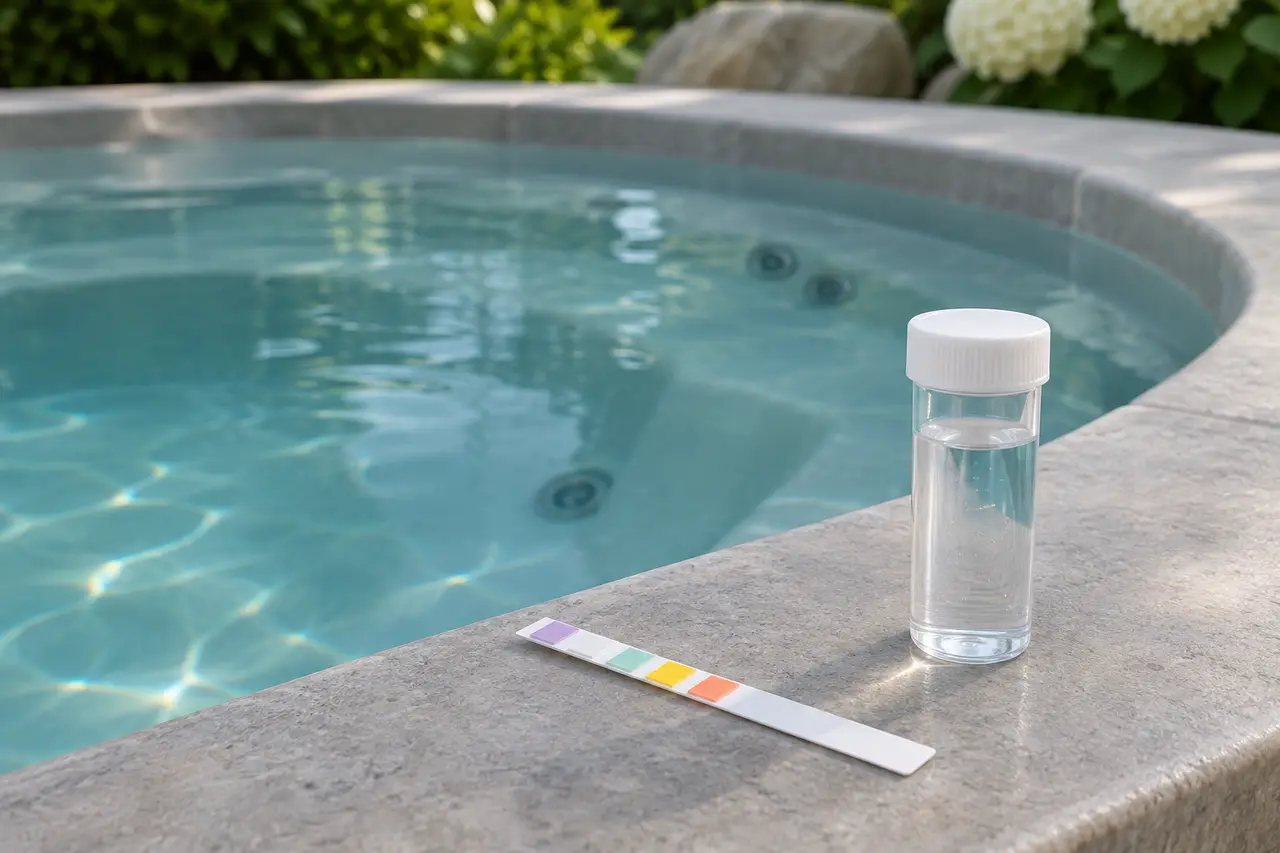
Short answer: Hot tub folliculitis, usually called hot tub rash, is an itchy, bumpy red rash, sometimes with pus-filled blisters around hair follicles. The Minnesota Department of Health says it “is often caused by infection with the germ Pseudomonas aeruginosa” and that “Most rashes clear up in a few days without medical treatment.” Washington’s health department says most people recover without treatment in 5 to 10 days. None of the three health department pages we read gives a number of days to stay out of the water. The rash comes from the tub, not from you, so before you get back in, ask whether the disinfectant and pH are checked regularly. See a health care provider if the rash lasts longer than a few days or gets worse.
This guide is for anyone who got a rash after a hot tub and wants to know two things: whether it will pass, and when it is reasonable to go back in. It uses the public pages of three state health departments, Minnesota’s pool rule, a Washington spa log sheet and published outbreak reports. We read all of them on November 11, 2026.
It is general information, not a diagnosis. A rash that does not fit what is described below needs a health care provider, not a web page.
What hot tub rash looks like
The Minnesota Department of Health lists three signs:
- “Itchy spots on the skin that become a bumpy red rash.”
- “The rash is worse in areas that were previously covered by a swimsuit.”
- “Pus-filled blisters around hair follicles.”
The Virginia Department of Health describes it as “a red, itchy and bumpy rash” and adds that the same germ can cause swimmer’s ear in the outer ear canal. Virginia also explains the swimsuit pattern: “It is often worse in areas where a swimsuit held water against the skin.”
How soon it starts, and how long it lasts
| Source | When the rash starts | How long it lasts |
|---|---|---|
| Minnesota Department of Health | Within a few days of swimming | “Most rashes clear up in a few days without medical treatment” |
| Washington State Department of Health | A few hours to a few days after exposure | “Most people recover without treatment in 5 to 10 days” |
| Hotel whirlpool outbreak, Newfoundland (J Clin Microbiol, 1986) | 1 to 5 days after exposure | Not given in the abstract |
| Pool party hot tub outbreak, 33 children (J Am Acad Dermatol, 2007) | 6 to 48 hours after the party | Not given in the abstract |
So a rash that shows up the next morning, or two or three days after a soak, fits. A 2021 review of Pseudomonas skin infections (Curr Opin Infect Dis) says local treatment is the mainstay for the infections that start in the skin, hot tub folliculitis among them, and that “prognosis is favorable in immunocompetent hosts”, meaning people whose immune system works normally.
When to see a health care provider
The health departments give two triggers. Minnesota: “if your rash lasts longer than a few days, consult your health care provider.” Virginia: “you should consult your doctor if the rash gets worse.”
Two more reasons to call come from the reports above. In the 2007 outbreak, 2 of the 33 children were admitted to hospital with low grade fevers and painful red nodules on their palms and soles, a form doctors call hot hand-foot syndrome. And the 2021 review says Pseudomonas skin infections carry more risk in people with a weakened immune system. If you have a fever, painful lumps on your hands or feet, a rash that spreads, or a condition or medicine that weakens your immune system, see a provider rather than waiting it out.
Why hot tubs, and why some people get it and others do not
Minnesota explains the hot tub part: “Because hot tubs have warmer water than pools, chlorine or other disinfectants used to kill germs (like Pseudomonas aeruginosa) break down faster.”
Outbreaks are tracked nationally. A CDC report of outbreaks linked to treated recreational water in the United States from 2000 to 2014 (MMWR, 2018) counted 47 outbreaks caused by Pseudomonas, with 920 cases. Across all 493 outbreaks of every cause in that report, hotels were the leading setting, with 157.
Not everyone in the same water gets the rash. In the Newfoundland hotel outbreak, 26 of 36 people who used the whirlpool developed folliculitis, and the attack rate “was significantly higher for children (90%) than for adults (50%).” A 2020 case report (Cureus) describes a woman who got it after a hot tub shared with several family members: “No other family member developed folliculitis.” So staying clear while your companions break out, or the reverse, does not tell you the water was clean.
When is it safe to get back in?
We found no health department page that sets a waiting time. Here is what the sources do support, and where our own reasoning starts.
- The same tub, unchanged, is the problem. Every source above traces the rash to poorly maintained water. Going back into a tub that gave you a rash, before anyone has checked or treated it, exposes you to the same germ. That is our reading of the sources, not a rule any of them states.
- Your own skin. The departments say most rashes clear in a few days to 10 days. Waiting until yours has cleared means you are not soaking open blisters in shared water. That is a cautious choice, not a rule we found in writing.
- Tell the operator. Virginia says to “Talk to hot tub operators if something doesn’t seem right.” Minnesota says to ask the operator “if disinfectant (for example, chlorine) and pH levels are checked regularly”. Washington asks people to report any suspected recreational water illnesses to the local health department.
What pool rules require for hot tub water
Two state documents give the numbers for public spas.
| Rule | Minnesota Rules 4717.1750 (spa pools) | Washington spa log sheet (DOH 333-133, October 2024) |
|---|---|---|
| Free chlorine, minimum | 2.0 parts per million | 3.0 PPM (inorganic chlorine); 3.5 PPM if stabilized |
| Bromine, minimum | 4.0 parts per million | 4.0 PPM |
| Chlorine, maximum | Ten parts per million (any pool) | 10.0 PPM |
| pH | Not less than 7.2 and not more than 7.8 | 7.2 to 8.0 |
| Water temperature, maximum | 104 degrees Fahrenheit | 104° F |
| Testing | A DPD test kit accurate within 0.1 parts per million, and a pH kit | A log sheet with daily and weekly tests, including free chlorine, pH and temperature |
The two states differ on the minimum, and both put it above the floor Minnesota sets for an ordinary pool (1.0 parts per million of free chlorine). Other states have their own codes; these two were readable by our tools on the day we checked.
The CDC’s 2000 report on outbreaks in Colorado and Maine (MMWR) focused its recommendations on two situations: offsite monitoring of disinfectant and pH levels, and cyanuric acid added as a chlorine stabilizer.
What to ask a hotel, gym or spa
These questions follow from the rules above. Ask them at the front desk before you get in, especially if you had a rash after this venue’s tub before.
- When was the water last tested today, and what were the chlorine or bromine and pH readings? Washington’s spa log sheet has a line for each of these. A reading inside the ranges in the table is a good sign.
- Who tests it, on site or remotely? The CDC’s 2000 report made offsite monitoring one focus of its recommendations.
- Has anyone else reported a rash? If so, the operator should know, and so should the local health department.
Washington’s log sheet also has a column for water clarity. If the answers are vague, or the water looks cloudy, skip it. Virginia also suggests you “Check the water pH and chlorine, or check with the hot tub operator.”
Lowering the chance next time
From the Minnesota and Virginia pages:
- “Shower BEFORE and AFTER hot tub use.” (Virginia)
- “Remove your swimsuit and shower with soap after getting out of the water.” (Minnesota)
- “Clean your swimsuit after getting out of the water.” (Minnesota)
The point of the second and third is the swimsuit, because the rash is worse where the suit held water against the skin. For a home tub, aiming for the numbers in the table is our suggestion, not a rule we found for private tubs.
For the heat side of hot tub safety, see our guides to hot tub temperature and hot tubs with high blood pressure. Our sauna vs hot tub comparison sets out which risks come with water and which do not, and the guides to a hot tub with a new piercing and with a sunburn cover broken skin.
FAQ: hot tub folliculitis
What does hot tub folliculitis look like? Itchy spots that turn into a bumpy red rash, sometimes with pus-filled blisters around hair follicles, worse where your swimsuit sat, according to the Minnesota Department of Health.
How long does hot tub rash last? Minnesota says most rashes clear up in a few days without treatment; Washington says most people recover without treatment in 5 to 10 days. See a health care provider if it lasts longer than a few days or gets worse.
How soon after a hot tub does the rash appear? Within a few hours to a few days. Two published outbreaks put it at 6 to 48 hours and 1 to 5 days after exposure.
Can I get back in a hot tub with folliculitis? We found no health department that sets a waiting time. The rash comes from poorly maintained water, so do not go back into the same tub until the operator has checked or treated it, and waiting until your own rash has cleared is the cautious choice.
Is hot tub rash contagious? The health department pages we read trace it to contaminated water, not to other people, and none of them describes it passing from person to person. In outbreaks, the people affected shared the same water.
Who is more likely to get it? In one hotel outbreak the attack rate was 90% in children and 50% in adults. A 2021 review says Pseudomonas skin infections are more serious in people with a weakened immune system.
What chlorine level should a hot tub have? Minnesota requires at least 2.0 parts per million of free chlorine in a spa pool, or 4.0 of bromine, with pH from 7.2 to 7.8. Washington’s spa log sheet sets a minimum of 3.0 PPM for inorganic chlorine, 3.5 if stabilized and 4.0 for bromine.
The bottom line on hot tub folliculitis
Hot tub rash is usually mild and usually gone within a few days to 10 days, by the health departments’ own numbers. It comes from water that held too little disinfectant, which warm tubs lose quickly.
No source we found gives a number of days to stay out. The useful questions are about the water: when it was tested, by whom and what it read. If the answer is no one knows, the tub that gave you the rash can give it to you again.
Want Google to show you more from Tendground? Add us as a preferred source.