Hot tub or sauna with a cold sore, herpes or shingles: can you go in, and can you catch it there?
Hot tub water that holds its disinfectant is not where the herpes virus lasts. Skin, shared towels and shared surfaces are. Here is what the NHS, MedlinePlus and a 1983 spa study say about cold sores, genital herpes, shingles and chickenpox, and what heat and sun do.
Sources checked : 46 statements on this page, each matched to its source's own words (published studies, NHS, MedlinePlus and official websites). How we check
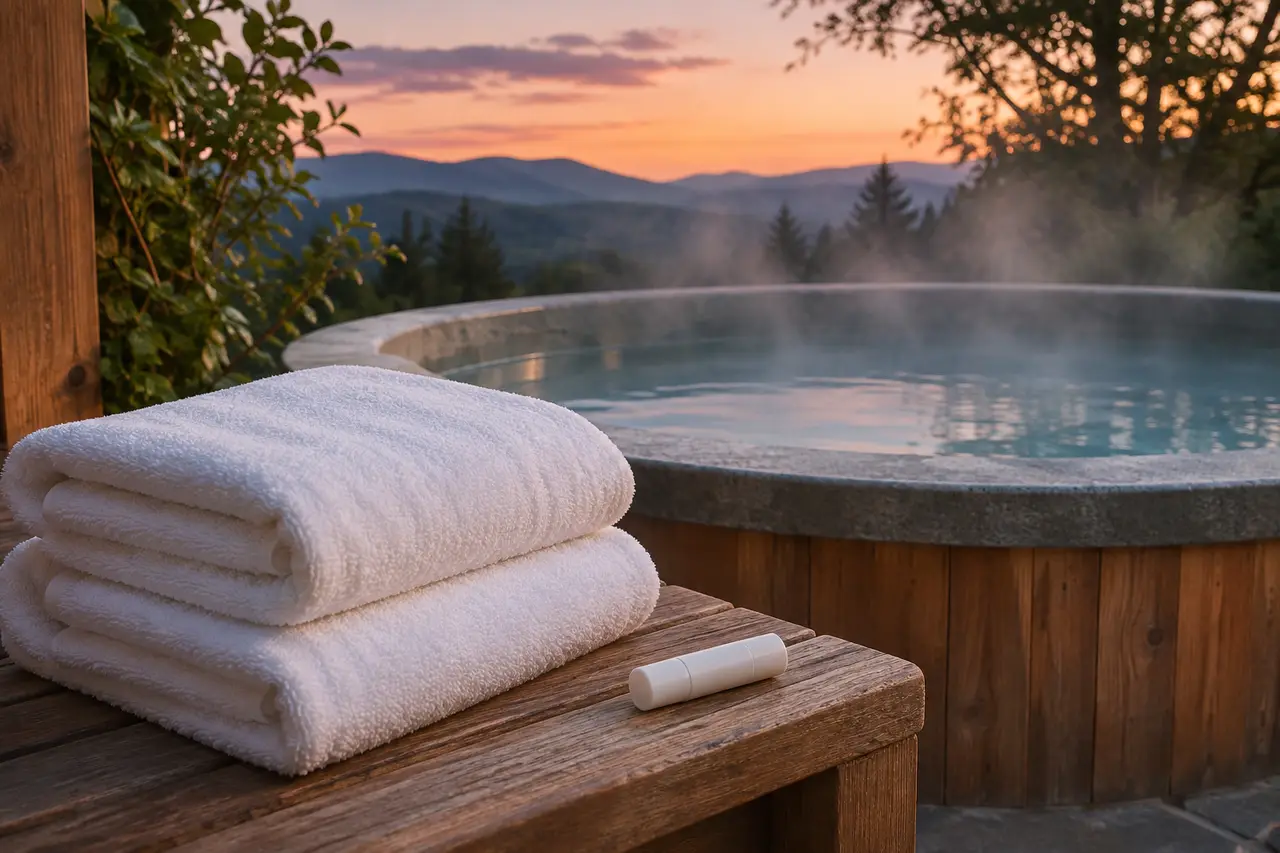
Short answer: It is safest to stay out of a shared hot tub, sauna or steam room until a cold sore has completely healed, and never to share a towel; that is our reading, not a rule any source sets for hot tubs. The NHS says cold sores “are contagious from the moment you first feel tingling or other signs of a cold sore coming on to when the cold sore has completely healed.” Well-kept hot tub water is not the likely route: in a 1983 study, spa water “immediately inactivated the virus.” With shingles, wait until the rash has dried out. With chickenpox, stay home until every spot has formed a scab.
This guide is for anyone with a cold sore, a genital herpes outbreak, shingles or chickenpox who is wondering about a hot tub, sauna, steam room, pool or shared towel. It uses NHS, MedlinePlus and womenshealth.gov pages and published studies. We read all of them on November 17, 2026.
It is general information, not a diagnosis. A sore or rash you are not sure about needs a health care provider or a pharmacist.
Can you go in a hot tub with a cold sore?
The NHS says cold sores “can easily spread to other people and other parts of your body”. Its advice is about touch: “wash your hands with soap and water whenever you touch your cold sore” and “do not kiss anyone while you have a cold sore”.
Womenshealth.gov, from the US Office on Women’s Health, names a route that matters at a spa: “You can get HSV-1 by kissing someone or sharing utensils, towels, razors, or lipstick with someone who has HSV-1.” HSV-1 is the virus behind most cold sores.
None of the NHS, MedlinePlus or womenshealth.gov pages we read mentions hot tubs. Our reading: a shared tub means faces close together and towels passed around, so wait until the sore has completely healed.
With a baby at the pool, the NHS neonatal herpes page is plain: “People with a current cold sore, or a recent history of cold sores, should not kiss your baby.”
Can you catch herpes from a hot tub, sauna or towel?
The one study we found that tested hot tub water (JAMA, 1983) began after “Several health spas were closed temporarily” over fears of herpes spreading in spa water. It sampled two spas: “No HSV could be isolated from the spa water specimens.” The spa water had high levels of chlorine and bromine, and adding it to the virus “immediately inactivated the virus.” Survival “appeared to be related to the free halogen content of water”, meaning the chlorine or bromine.
Surfaces were different. On plastic in a humid atmosphere at 37 to 40 degrees C, standing in for spa benches, “The virus was found to survive up to 4.5 hours under these conditions.” The authors noted that “transmission may require other factors, such as rubbing of skin or penetration through abrasions”, but concluded that surfaces like these “may be nonvenereal routes of HSV transmission”.
A case report (Pediatr Dermatol, 1985) describes a 10-year-old girl with eczema who developed eczema herpeticum, a herpes infection of eczema skin, after using a hot tub with a friend who had cold sores. One case cannot show whether the water, a surface or close contact passed it on; that is our reading. Our eczema and psoriasis guide covers shared water with eczema.
For genital herpes the NHS is direct: “You cannot get genital herpes from towels, swimming pools, saunas or toilet seats as there is no skin-to-skin contact.”
Our reading: the sources point to close contact, shared towels and warm, damp benches, not to water that holds its chlorine or bromine. Sit on your own towel in a sauna or steam room.
Can saunas or hot tubs cause cold sores?
The NHS says: “Certain things may trigger a cold sore, such as illness, sunshine or being on your period.” Womenshealth.gov says “Some women say the virus comes back when they are sick, under stress, out in the sun, or during their period.”
None of the cold sore pages we read, from the NHS, MedlinePlus and womenshealth.gov, names heat, a sauna or a hot tub as a trigger. Labs use heat: in one mouse study (Virology, 2001), the “mice received hyperthermic shock” to reactivate the virus. We found no study that tested whether a sauna or hot tub brings on cold sores in people, so on what we read that is an open question.
That makes the sunny pool deck the bigger concern. The NHS says to “avoid anything that triggers your cold sores, such as sunbeds” and to “use sunblock lip balm (SPF 15 or above) if you’re outside in the sun”. MedlinePlus agrees: “Protecting your lips from the sun with sunblock lip balm can also help.” The trials are mixed: a review (Cochrane, 2015) found sunscreen prevented cold sores brought on by lab ultraviolet light in two trials, “but another RCT found that sunscreen did not prevent HSL induced by sunlight”.
Hot tub or sauna during a genital herpes outbreak
The NHS says genital herpes “is very easy to pass on (contagious) from the first tingling or itching of a new outbreak (before any blisters appear) to when sores have fully healed”, but not through pools or saunas. The worry is your own skin. The NHS says to “keep the area clean using plain or salt water to prevent blisters becoming infected” and “do not wear tight clothing that may irritate blisters or sores”. Womenshealth.gov says: “Keep sores clean and dry.” The NHS names “ultraviolet light on the affected area” as a trigger. Our reading: a long soak in shared warm water, then a damp swimsuit, fits poorly with clean and dry, so wait until the sores have healed.
Can you go in a hot tub or sauna with shingles?
The NHS shingles page says: “You cannot spread shingles to others. But people could catch chickenpox from you if they have not had chickenpox before or have not had the chickenpox vaccine.”
MedlinePlus agrees: “The risk of spreading the virus is low if the shingles rash is kept covered.” It adds: “People with shingles cannot spread the virus before their rash blisters appear or after the rash crusts.” For the rash, the NHS says to “keep the rash clean and dry to reduce the risk of infection”.
None of the shingles or chickenpox pages we read mentions hot tubs, saunas or pools. Our reading: soaking keeps a rash neither covered nor dry, so stay out of shared water and saunas until it has dried out and crusted. MedlinePlus says the blisters “typically scab over in 7 to 10 days”; the NHS says “It can take up to 4 weeks for the shingles rash to heal.”
Shingles can bring “Fever” and “Chills”, MedlinePlus says, and a fever rules out the sauna; see whether to sauna when you are sick. Unsure if it is shingles or hot tub rash? The NHS says the shingles rash appears “on 1 side of your body only”. Our hot tub rash guide describes the rash that poorly disinfected water causes.
Chickenpox: hot tubs, pools and saunas
The NHS chickenpox page says: “You can spread chickenpox to other people from 2 days before your spots appear until they have all formed scabs, which is usually 5 days after your spots appeared.” You can catch it from “being in the same room as someone with it” and from “touching things that have fluid from the blisters on them”. Its rule: “you’ll need to stay off school, nursery or work until all the spots have formed a scab.”
Our reading: a public pool, hot tub or sauna is a shared room, and towels and benches are things blister fluid can reach, so stay home until every spot has scabbed. At home the NHS says to “bathe in cool water and pat the skin dry (do not rub)”. Chickenpox can bring “a high temperature”, which rules out the sauna.
Cold sores, herpes, shingles and chickenpox at a glance
| Practice | Cold sore | Genital herpes outbreak | Shingles | Chickenpox |
|---|---|---|---|---|
| Shared hot tub or pool | Wait until completely healed (our reading) | Not a route to others, per the NHS; wait until healed for your own skin (our reading) | Wait until the rash has dried out and crusted (our reading) | Stay home until all spots have scabbed |
| Sauna or steam room | Wait until healed; sit on your own towel (our reading) | Not a route to others, per the NHS; wait until healed (our reading) | Wait until crusted; never with a fever (our reading) | Stay home; never with a fever (our reading) |
| Shared towels | Never: womenshealth.gov names towels | Not a route, per the NHS; your own towel anyway (our reading) | Not one that touched the rash (our reading) | Never: the NHS names things with blister fluid on them |
| Sun on the pool deck, sunbeds | Sunblock lip balm, SPF 15 or above; avoid sunbeds | Keep ultraviolet light off the affected area | Not covered on the pages we read | Not covered on the pages we read |
When to see a health care provider
Cold sore. The NHS says to see a GP if “a cold sore has not started to heal within 10 days”, if “the cold sore is very large or painful” or if “you have a weakened immune system”.
Genital herpes. Womenshealth.gov: “If you have any symptoms of genital herpes, see a doctor or nurse.” In pregnancy, the NHS says: “See your midwife or a GP if you think you have genital herpes in pregnancy.”
Shingles. The NHS says to “see a pharmacist within 3 days of the rash appearing”, and to get urgent help if “the rash is on your eye or nose”, if “you’re pregnant” or if “you have a severely weakened immune system”.
Chickenpox. The NHS sends people for urgent help for “red, hot or painful skin around the blisters”, if “you have chickenpox and you’re more short of breath than usual”, or if “you’ve been near someone with chickenpox and you have a weakened immune system or you’re pregnant”.
A baby is an emergency. The NHS says “Call 999 immediately if your baby” is lethargic, “is becoming floppy”, “is difficult to wake up from sleep”, has trouble breathing or “has a seizure (fit)”. In the US, call 911; womenshealth.gov says to “call 911 or go to the nearest emergency room if you are experiencing a medical emergency.”
What to ask
At the venue:
- How is the hot tub water disinfected, and when was it last tested? Our hot tub rash guide gives the levels spa rules require.
- Are towels washed between guests, and can I bring my own? Womenshealth.gov names shared towels as a route for HSV-1.
- Are benches wiped between sessions? The 1983 study found the virus lasted hours on warm, damp plastic.
For a pharmacist or provider:
- Is my sore or rash still contagious, and would an antiviral medicine help?
- Does a medicine that weakens my immune system change the answer? MedlinePlus lists “steroids” among medicines that raise the risk of shingles; see our guide to prednisone and the spa.
FAQ: cold sores, herpes and shingles in hot tubs and saunas
Can hot tubs cause cold sores? None of the cold sore pages we read names a hot tub or heat as a trigger, and we found no study that tested it in people. The NHS names illness, sunshine and periods.
Can I go in a hot tub with a cold sore? Our reading is to wait until it has completely healed, since the NHS says it is contagious until then, and never to share a towel.
Can you do a sauna with a cold sore? The same applies, and a sauna bench is a shared, warm, damp surface, so sit on your own towel. None of the cold sore pages we read suggests heat as a treatment.
Can you get herpes from a hot tub or a sauna? For genital herpes, the NHS says you cannot get it “from towels, swimming pools, saunas or toilet seats”. In a 1983 study, no herpes virus was found in spa water, though it survived up to 4.5 hours on warm, damp plastic.
Can I go in a hot tub with a herpes outbreak? The NHS says genital herpes does not spread through pools or saunas. Womenshealth.gov says to keep sores clean and dry, so our reading is to wait until they have healed.
Can you get in a hot tub if you have shingles? Our reading is to wait until the rash has dried out and crusted. Until then it can give chickenpox to people who have not had it, and a hot tub does not keep it clean, dry and covered.
Can you go in a hot tub with chickenpox? No. The NHS says to stay off school, nursery or work until all the spots have formed a scab, usually 5 days after they appeared. A hot tub, pool or sauna is shared in the same way; that part is our reading.
The bottom line on hot tubs, saunas, cold sores and shingles
On the one study we found, hot tub water that holds its chlorine or bromine is not where the herpes virus lasts; skin, towels and damp surfaces are. Wait until a cold sore or genital sores have healed, a shingles rash has crusted or chickenpox spots have all scabbed. Bring your own towel, and for cold sores, keep sunblock on your lips by the pool.
Want Google to show you more from Tendground? Add us as a preferred source.