Can you drink alcohol in a sauna? The honest safety answer
Beer in the sauna is a real tradition in some places, which makes people assume it is harmless. The forensic data from the country that invented the sauna says otherwise, and the reason is specific rather than moralistic.
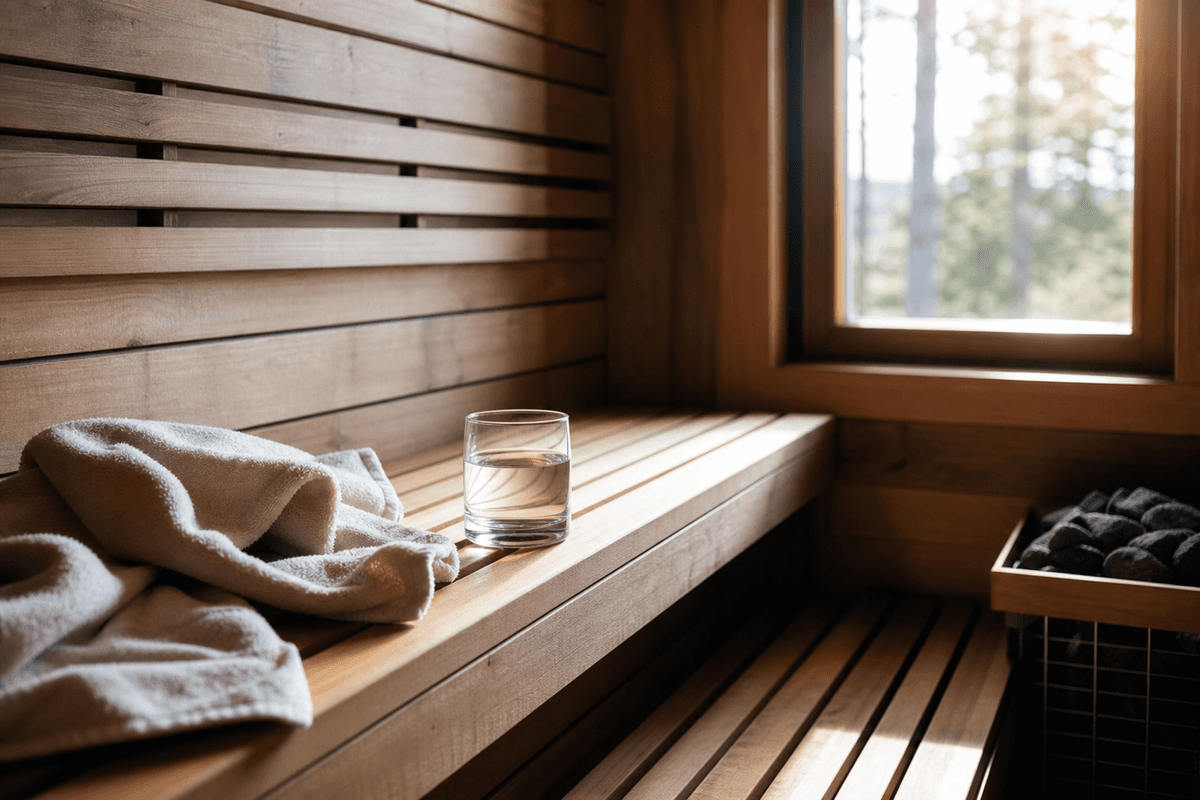
Short answer: No. Finnish forensic case series find alcohol involved in the clear majority of sauna deaths, through hyperthermia and cardiac events. Heat and alcohol both dilate vessels, drop blood pressure and dehydrate you, and both blunt the signal telling you to get out. The practical rule: if you would not drive, do not sauna.
No. Drinking before or during a sauna is the single clearest risk factor in the entire practice, and it is not a matter of moderation or tolerance. Alcohol and sauna heat push your cardiovascular system in the same direction at the same time, and they both blunt the warning signals that would normally tell you to get out.
This is not a health-influencer caution invented recently. It comes from forensic pathology in Finland, where sauna use is close to universal and the deaths that do occur have been examined carefully.
The practical version is short: go sober, drink water rather than beer, and if you want a drink afterward, put it well after you have cooled down and rehydrated. We don’t take placement fees, so nothing here is written to sell you a session.
What does the evidence actually say?
Alcohol is present in the large majority of sauna deaths.
The most direct evidence comes from Finnish forensic case series. A review of sauna-related deaths by Kenttämies and Karkola in the Journal of Forensic Sciences in 2008 examined autopsy cases and found alcohol involved in the clear majority of them, with hyperthermia and cardiac events as the mechanisms.
The clinical review by Hannuksela and Ellahham in The American Journal of Medicine in 2001 reaches the same conclusion from the other direction: sauna bathing is well tolerated and safe for most healthy people, and alcohol is named specifically as the thing that turns it dangerous.
The honest caveat is that these are observational and forensic data, not trials, because nobody is going to run a randomised study of drunk sauna use. But the signal is consistent, and it points one way.
Why do heat and alcohol combine so badly?
They both lower blood pressure and both impair judgement.
Sauna heat dilates the blood vessels in your skin to shed heat, which drops your blood pressure and raises your heart rate. Alcohol dilates blood vessels too, and it also suppresses the hormone that helps you retain fluid, so you are dehydrating while you sweat heavily.
Stack those and you get a much larger blood pressure drop than either would cause alone. That is the mechanism behind the classic incident: standing up after a long sit, feeling the room go grey, and fainting on a hard wooden bench or a tiled floor.
The second half is worse. Heat already makes you a poor judge of your own state, and alcohol removes what judgement is left. The internal signal that says this is too long, get out now is exactly the one being suppressed. People who fall asleep in a hot room after drinking are the cases that turn fatal.
How long should you wait after drinking?
Until you are genuinely sober, not just feeling fine.
There is no validated waiting period, and anyone quoting an exact number of hours is guessing. The sensible standard is the one you would use for driving: wait until the alcohol has actually cleared, which for most people is roughly one standard drink per hour and longer if you drank a lot or late.
If you had a few drinks the night before, a morning sauna is usually fine, but treat the dehydration seriously. You are starting the session already down on fluid, so drink water first and plan a shorter, cooler sit than usual.
A useful rule: if you would not drive, do not sauna. It is a stricter bar than most people apply, and it removes almost all of the real risk from the practice. Our sauna safety and etiquette guide covers the rest of the basics.
What about a drink afterward?
Better, but not immediately, and hydrate first.
A drink after a sauna is a different situation from a drink during one, and it is far less dangerous. The main issue is timing and sequencing rather than the drink itself.
You come out of a sauna dehydrated and with your blood vessels still dilated, so alcohol on top of that hits harder and hydrates you not at all. The result is usually just an unpleasant lightheadedness, but it is also how people end up more affected than they expected.
The straightforward fix is to cool down properly, drink a decent amount of water, eat something, and let your body settle before the drink. Fifteen or twenty minutes of ordinary recovery changes the experience entirely. Our guide to eating and hydration around a session covers the timing in more detail.
What about beer in the sauna as a tradition?
It exists, and it is still the risky part.
You will find beer in saunas in parts of Europe, in some banya and bathhouse cultures, and in plenty of American recovery studios that sell it at the counter. The tradition is real, and pointing at it as evidence of safety is the mistake.
Finland has the deepest sauna culture in the world and also the forensic literature showing what goes wrong. Those two facts live together. Most people who drink in a sauna are fine, in the same way most people who drive slightly over the limit arrive home, and neither observation tells you much about the tail risk.
If you are in a bathhouse that serves alcohol, the practical move is to sequence it: sauna rounds first, drinks after, in the cool room rather than the hot one. Our guide to your first bathhouse or Korean spa covers how those spaces are usually laid out.
Who should be strictest about this?
Anyone with a cardiovascular reason to be careful.
If you have high or unstable blood pressure, a known heart condition, an arrhythmia, or you take blood pressure medication, diuretics, sedatives, or anything that already causes dizziness, the combination is meaningfully riskier for you than for an average healthy adult.
The same applies if you are pregnant, in which case both the heat and the alcohol carry their own separate cautions, or if you are older and more prone to blood pressure drops on standing. Our guides to sauna and the heart, atrial fibrillation, sedating medication, pregnancy safety, and starting safely as an older adult go into each case.
Cold plunging after drinking deserves its own line: the cold shock response is a cardiac stress on its own, and alcohol plus cold water in an unsupervised tub is a genuinely bad idea. Our cold plunge safety guide covers who should avoid it.
Alcohol and sauna at a glance
| Situation | Verdict | Why |
|---|---|---|
| Drinking in the sauna | Avoid | Compounded blood pressure drop; impaired judgement about when to leave |
| Sauna while still tipsy | Avoid | Same mechanism; “feeling fine” is not the same as sober |
| Morning sauna after a heavy night | Usually OK | Hydrate first, shorter and cooler session than normal |
| A drink 20+ minutes after, rehydrated | Fine for most | Cool down and drink water first |
| Cold plunge after drinking | Avoid | Cold shock response plus alcohol, often unsupervised |
| Any of the above with a heart condition | Ask a doctor | Higher baseline risk from both halves |
FAQ: alcohol and sauna
Does alcohol actually sweat out in a sauna? No. Your liver metabolises alcohol at a fixed rate and sweating does not meaningfully speed that up. You will lose water and feel worse, but you will not be less drunk.
Is one beer in the sauna really a problem? For a healthy adult in a short, moderate session, one drink is unlikely to cause harm. The reason the advice is a flat no is that the risk is not linear, and the point where it stops being fine is not something you can feel from inside a hot room.
What about a sauna as a hangover cure? It will make you feel temporarily better and slightly worse afterward. You are already dehydrated, so if you go, go short, go cooler, and drink water throughout. It is not treating anything.
Are bathhouses wrong to serve beer at all? Not necessarily. The sensible ones serve it in the cool lounge, not the hot room, which is the distinction that matters.
The bottom line on drinking and sauna
Alcohol is the clearest single risk factor in sauna use, and Finnish forensic data links it to the majority of sauna deaths. Heat and alcohol both drop your blood pressure and both blunt the signal telling you to get out.
Go sober, hydrate with water, and save the drink for afterward once you have cooled down. That one rule removes most of the real danger from an otherwise very safe practice.