Sound baths & sacred song: what a sound healing session is really like
Bowls, gongs, and voice, what actually happens in a sound bath, what the science does and doesn't say, and how to pick a good one.
Short answer: You lie on a mat for 45 to 75 minutes while a facilitator plays singing bowls, gongs and sometimes voice. Nothing is asked of you. The evidence supports lower self-reported stress and a reliable relaxed state; it does not support frequency healing, chakra balancing or DNA repair. Drop-ins run $20 to $40.
A sound bath sounds mystical and is actually quite simple: you lie down, someone plays resonant instruments for 45, 75 minutes, and you let the sound wash over you. No movement required, no meditation experience needed, no particular belief system. Here’s what actually happens, what the evidence supports, what it overstates, and how to find a session that delivers genuine rest rather than ambient noise.
What a sound bath is
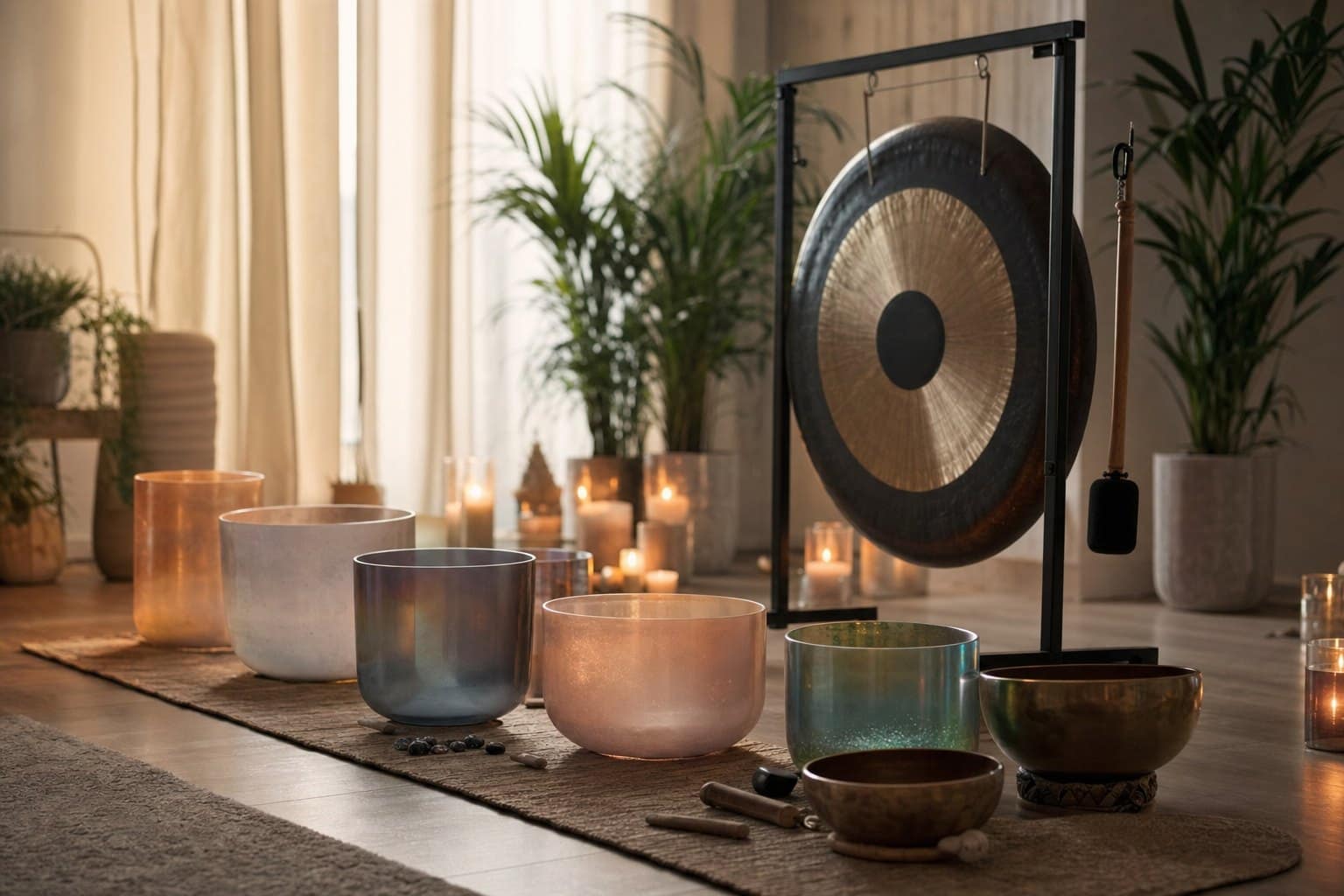
A sound bath is a guided group or individual relaxation session in which a facilitator plays resonant instruments, most commonly Tibetan singing bowls (metal), crystal singing bowls, gongs, chimes, tuning forks, and sometimes voice. The instruments overlap in sound, creating layered, sustained tones that fill a room and seem to arrive from all directions at once.
The name “bath” is descriptive: you’re not doing anything active. You lie on a mat (often with props, blanket, eye mask, bolster under the knees) and let the sound move over and through you.
Sacred song sits in adjacent territory: live chant or mantra, often kirtan-style call-and-response, sometimes communal toning, used to settle the mind through repetition and shared voice rather than instrumentation alone. Many sound healing sessions incorporate both. Some sessions are purely instrumental; others are vocal-led. Both aim for the same outcome: a deep, effortless relaxation state.
What a sound bath session is like
You’ll typically arrive 10, 15 minutes early to set up your space, laying out your mat, arranging props, deciding whether to use an eye mask. Groups range from intimate (6, 8 people) to large events (30, 100+). The facilitator usually opens with a brief centering, a few slow breaths, sometimes a short body scan, before the instruments begin.
The first few minutes often feel like just listening to unusual music. Then something shifts: the overlapping tones become harder to track individually, the room seems fuller of sound than it should be, and your body begins to relax in a way that feels less like effort and more like permission.
Many people feel vibration physically, particularly from large gongs and metal bowls played close to the body.
Common experiences include: drifting in and out of something like sleep without fully losing awareness; visual patterns behind closed eyes (especially from gongs, which produce significant low-frequency vibration); a floating heaviness in the body; and occasionally a strong emotional response or sense of release. None of these are required outcomes, some people simply feel pleasantly relaxed and nothing more remarkable than that, which is still useful.
At the end, the facilitator guides a slow return, instrumental sounds fade, gentle voice cues a gradual reawakening, you might be invited to wiggle fingers, deepen breath, and take time before sitting up. Good facilitators don’t rush this transition.
Sessions run 45, 75 minutes; some events are shorter (30 minutes) as an add-on to yoga classes or retreats.
What the evidence says about sound baths
- Reasonable evidence for: reduced self-reported stress, tension, and anxiety (multiple studies show significant decreases); induction of a relaxed, meditative state more reliably than unguided silence for many people; lower heart rate and improved mood post-session. For those who find silent meditation difficult, sound baths provide an external anchor, the sound does the work of holding attention that silent practice requires you to generate yourself.
- Plausible but less proven: slow, resonant, low-frequency sound can activate the parasympathetic nervous system (the “rest and digest” mode) via the auditory pathway, consistent with general research on music and relaxation. The physical vibration from gongs and bowls adds a tactile element that may deepen the effect.
- Not established / overstated: claims that specific frequencies “heal” organs, “tune” cells to healthy states, “repair DNA,” or “balance chakras” in any physically measurable sense. The relaxation response is real and valuable; the mechanistic explanations attached to it in marketing are not supported by evidence. Enjoy the calm; approach the pseudoscience with skepticism.
Benefits people report from sound baths
The most consistent report is straightforward: people feel less tense and more rested after a sound bath than before. For people who struggle with seated meditation, too much stillness, too much mental noise, sound baths offer a way into the same territory without requiring mental effort. The sound does the heavy lifting.
People managing anxiety, insomnia, chronic stress, and emotional heaviness tend to find the most relief. The passive nature makes it accessible to beginners without any learning curve or performance anxiety. The group setting can amplify the effect, the shared stillness of a room full of relaxed people has its own quieting quality.
Regular practitioners describe cumulative benefits: a generally lower baseline stress level, improved sleep quality over weeks of consistent attendance, and a reliable “reset” after intensely demanding periods. For active contemplative practices that pair well with this passive one, mantra and kirtan chanting engages the voice and rhythmic repetition as a path to the same inner quiet.
Who sound baths suit, and who should skip them
Sound baths suit almost anyone seeking relaxation: beginners to wellness practices, people who find movement-based practices inaccessible, those new to meditation, and anyone who wants an effortless reset.
Be aware and consider alternatives if:
- You have sound sensitivity or hyperacusis, tell the facilitator beforehand; you may want to sit farther from the gongs or skip large-gong events.
- You have a history of seizures triggered by sound or strobe effects, skip. Our epilepsy guide explains which effects matter and which do not.
- You are pregnant: most sessions are fine, but very loud gong work close to the body is worth discussing with your provider.
- You have severe anxiety or trauma history involving sound or confinement, a first session in a smaller, quieter setting is safer than a large gong event.
There are no general contraindications for most people. Tell the facilitator about any concerns before the session, a skilled practitioner will adjust accordingly.
For a related immersive rest experience that works through sensation rather than sound, a cacao ceremony occupies similar intentional-community territory and often pairs well with sound work.
What a sound bath costs
In the US, drop-in group sound bath sessions typically run $20, $40 per person. Sessions attached to yoga studios or wellness centers are often included in membership packages. Specialty or “premium” sound bath events (featured facilitators, larger venues, retreat settings) can run $50, $100+ per person.
Private sound healing sessions, one facilitator, just you, sometimes with bowls placed near or on the body, run $80, $200 for a 60, 75 minute session, comparable to a massage or bodywork session.
Online/virtual sound baths have proliferated since 2020 and are widely available for free on YouTube or Insight Timer, and via paid platforms for $10, $20 per session.
How to choose a good session
The space matters most. A quiet room with comfortable mats, blankets, and few interruptions is the baseline. Ambient noise from adjacent rooms, street traffic, or heating systems undermines the experience significantly.
Facilitation quality is variable. Look for:
- Smooth dynamics, not jarring transitions or sudden loud strikes
- A clear arc: opening, sustained middle, gradual fade, gentle return
- A practitioner who can read the room and adjust intensity
- Honest framing: “deep relaxation” is the right promise. “Heals anxiety/disease/trauma” is not.
Group size is personal. Smaller groups (6, 15) feel more contained and allow the facilitator to move through the room; large events can be magnificent but less intimate. Start small if you’re unsure.
Ask about instruments. Crystal bowls tend toward higher, cleaner tones; metal singing bowls are warmer and more complex; large gongs produce the most physical vibration and the most intense experience. If you’re sensitive to sound, a crystal-bowl-only or lighter session is a gentler start.
Avoid practitioners making clinical healing claims. Read reviews specifically for whether the space stayed quiet and whether the ending was gradual rather than abrupt.
FAQ: sound baths
Do I have to do anything? No. The practice is entirely passive. You lie down and let the sound happen. There’s no technique to learn, no correct way to experience it.
What if I fall asleep? It’s common and fine. Many facilitators consider it a sign the practice worked. You’ll be gently guided back at the end.
Is there a religious element? It depends on the session. Many sound baths are entirely secular and framed as relaxation. Some incorporate Sanskrit mantra, Buddhist chant, or other spiritual framing. Read the session description or ask beforehand if that matters to you.
How many sessions until I notice something? Most people feel something in their first session, at minimum a pleasantly relaxed state. Consistent practice (weekly or biweekly) tends to produce cumulative benefits over 4, 8 weeks.
The honest summary on sound baths
A sound bath is a passive, genuinely relaxing reset, lie down, listen, let go. The science supports the calm, not the frequency-healing marketing.
If silent meditation feels impossible or effortful, this is one of the easiest accessible paths into the same quiet state, and a well-run session with skilled facilitation is more restorative than it has any right to be. Come with low expectations and no agenda; the main risk is that you fall asleep.
Deciding between this and a plain meditation practice? Our comparison of sound bath vs meditation for stress covers which suits which person.