Mantra meditation and kirtan chanting explained: what to expect
Repeating a sound or joining a call-and-response chant is one of the oldest concentration tools in existence, and the research is more interesting than you'd expect.
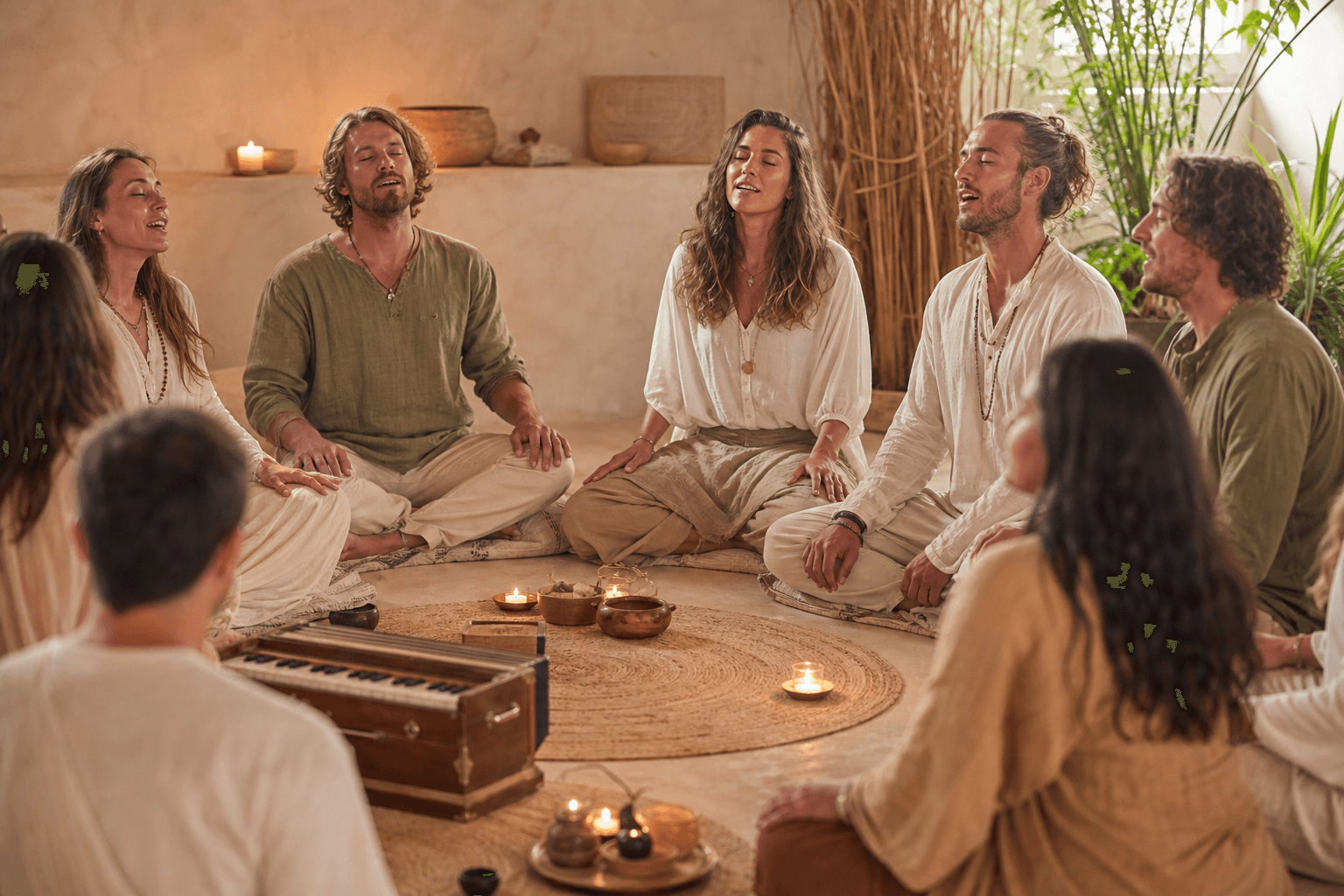
Short answer: Mantra meditation repeats a word or syllable to anchor attention; kirtan is call-and-response chanting with a harmonium, sung by the room. Mantra work, TM especially, has real evidence for blood pressure, anxiety and cortisol. The repetition seems to be the active ingredient, not the specific syllable. No belief required.
Chanting has survived thousands of years across dozens of traditions because it actually does something: it gives the restless mind a sound to hold. From repeating a single syllable alone to singing call-and-response bhajans in a room full of strangers, mantra and kirtan are among the most accessible entry points into meditative states, and one of the more socially alive ones.
What mantra and kirtan are
Mantra meditation is the practice of silently or aloud repeating a word, phrase, or syllable, a mantra, to anchor attention and steady the mind. The word “mantra” comes from Sanskrit: manas (mind) + tra (tool or instrument). The repetition is the point. When the mind wanders, you return to the sound.
Mantras appear across traditions:
- In Hindu and yogic practice, mantras like Om, So Hum, or Om Namah Shivaya carry specific meaning and are traditionally received from a teacher.
- In Transcendental Meditation (TM), practitioners are given a personal mantra and instructed to repeat it silently for 20 minutes twice daily. TM is perhaps the most researched mantra-based technique in Western clinical literature.
- In Buddhist practice, mantra recitation (like Om Mani Padme Hum) is used alongside visualization or breath.
- In secular settings, a simple neutral syllable, or even a word like “one”, functions the same way with none of the religious framing.
Kirtan is a devotional, communal form: call-and-response chanting, usually in Sanskrit, led by a musician who plays a harmonium, tabla, or guitar, with participants singing back. It comes from the Bhakti yoga tradition of devotional Hindu practice, it is rooted in a living lineage, not invented for wellness studios. Kirtan is participatory; it’s about collective sound and shared heart, not performance.
What a kirtan session is like
For mantra meditation:
- You sit comfortably, on a cushion, in a chair, and close your eyes.
- You begin repeating the mantra: silently in the mind, or softly aloud.
- When thoughts arise (they will), you return attention gently to the mantra without judgment.
- Sessions typically run 15, 30 minutes. Traditional TM practice is 20 minutes twice daily.
For a kirtan session:
- You arrive at a studio, community space, or retreat room, often set up with cushions on the floor, instruments at the front.
- The lead musician (often called a wah-lah or simply the kirtanist) begins a phrase. The group sings it back.
- Songs typically build slowly: low and intimate, then louder and more energized, then back down. The emotional arc is the structure.
- A full kirtan evening runs 1.5, 2.5 hours. Shorter community kirtan sessions are 45, 60 minutes.
- Many events close with a period of silence, followed by prasad, a shared sweet food, and informal conversation.
You do not need to know Sanskrit. You do not need to be Hindu, or religious at all. The sound does the work; you follow along as best you can.
What the evidence says about chanting
- Reasonable evidence for: mantra-based meditation (especially TM) is one of the better-studied relaxation and stress-reduction techniques. Meta-analyses have found consistent reductions in blood pressure, anxiety, and cortisol. The American Heart Association reviewed TM specifically in 2013 and found sufficient evidence to note a potential blood-pressure benefit.
- Plausible: the social and rhythmic components of kirtan, synchronized breath, shared voice, repetitive melodic structure, likely produce similar autonomic downshifting to what’s seen in other rhythmic mindfulness practices. Community and belonging also have well-documented stress-buffering effects.
- Debated or mixed: whether specific mantras have unique effects beyond other forms of meditation is not well established. The repetition and focus appear to be the active ingredients, not the specific syllable.
- Not established / overstated: claims that certain Sanskrit mantras carry healing frequencies that affect the body at a cellular or molecular level go beyond what any published research supports. The calm is real; the metaphysics are optional.
Benefits people report from mantra practice
Practitioners most often describe a quieting of mental chatter, the overactive planning, judging, and rehashing that characterizes ordinary mind. In kirtan specifically, people frequently report the experience of “losing themselves” in the collective sound in a way that feels effortless and joyful. Some describe it as the emotional equivalent of a group workout: you feel worked through, then open.
For people who find silent meditation frustratingly boring or anxiety-inducing, the sensory anchor of sound, something to actually do, makes sustained attention much more manageable.
Who chanting is for, and who should skip it
Mantra meditation works well for:
- People who struggle with silent, object-less meditation
- Anyone looking for a twice-daily stress-management practice with real research behind it
- Those drawn to contemplative traditions without needing a fully religious framing
Kirtan works well for:
- People who want a social, embodied spiritual experience, but with less physical demand than ecstatic dance
- Anyone curious about devotional practice without commitment to a specific religion
- Those who want the communal resonance of a sound bath but want to participate actively, not just receive
Who should be careful: Kirtan environments can be loud, worth knowing if you have hearing sensitivity. Mantra meditation is generally low-risk; some people with psychosis or dissociative conditions find intensive mantra practice destabilizing, so check with a mental health provider if relevant.
What a kirtan or mantra class costs
- Drop-in kirtan evenings at yoga studios or community centers: $15, $30 (often sliding scale or donation-based)
- Kirtan at retreat centers: typically included in retreat fees; standalone events $20, $45
- TM instruction: $380, $960 (one-time fee for a multi-session course with a certified TM teacher; the organization offers reduced fees for students and low-income practitioners)
- Other mantra meditation instruction through yoga studios or apps: $0, $20 per class; many apps include guided mantra practice for free
How to choose a good practitioner or session
For kirtan: look for a musician who is transparent about their lineage and training, ideally someone who has studied directly with experienced kirtanists within the Bhakti tradition. The best kirtan leaders are honest that this is a living spiritual practice from a specific cultural and religious context, not merely “wellness music.” Appropriation is real in this space; commercialized kirtan that strips away all cultural context in favor of pop production can feel hollow and can disrespect the tradition. That said, you don’t need to convert, sincere curiosity and respectful participation are welcome. Ask the leader about their training and background.
For mantra meditation: certified TM teachers have formal training; look for the official TM organization. For non-TM mantra instruction through yoga studios, ask whether the teacher has studied the practice in depth or is just passing along a technique picked up at a 200-hour teacher training.
Red flags in any chanting context: extravagant health claims, pressure to join an ongoing organization, or facilitators who can’t answer basic questions about the practice’s origins.
FAQ: mantra meditation and kirtan chanting
Do I have to believe in the Hindu religion to do kirtan? No. Many people participate in kirtan purely for the music, the community, and the calming effect of repetitive sound. Treating the practice with respect, learning what the words mean, understanding the tradition they come from, is appropriate. Signing up for a theology is not required.
Can I practice mantra meditation without a formal teacher? Yes, for secular mantra practice. Sit quietly, choose a simple syllable or word, repeat it for 15, 20 minutes. The structure is simple enough to self-direct. For TM specifically, the organization insists on formal instruction (and charges for it); you can find similar mantra-based techniques through Vedic meditation teachers at a range of price points.
What if I feel silly chanting out loud with strangers? Almost everyone feels this at first. The first few minutes of a kirtan are usually awkward; the room takes time to warm up. Most people report that the self-consciousness dissolves once the sound builds and the group finds its rhythm. If it persists, that’s useful information, kirtan may just not be your format.
How is kirtan different from a sound bath? A sound bath is passive, you receive sound, lying down, eyes closed. Kirtan is active, you generate the sound, sitting up, voice in the room. Both use sonic repetition as a settling mechanism; the experience is quite different. Try both before deciding which suits you.
The honest summary on mantra and kirtan
Mantra meditation is one of the most evidence-backed mindfulness techniques available, with a real literature on stress, blood pressure, and anxiety reduction. Kirtan offers those benefits plus the rarer thing: a socially alive, communally resonant spiritual experience that doesn’t require religious belief. Both practices are more accessible than their Sanskrit names suggest, and both reward a little patience past the initial awkwardness.