Your first silent retreat: what nobody tells you about day 2
The day-2 boredom is the whole point of a silent retreat, but most first-timers quit before they figure that out.
Short answer: Three days, phones in a basket, a 5am wake-up and roughly 45-minute sits. Day 1 is awkward and you will panic that you cannot meditate; that panic is the normal part. Day 2 is the hard one. Start with three days rather than a ten-day Vipassana, and pick a teacher who runs beginner cohorts.
The honest map of a first silent retreat
You signed up (or you’re about to) for a 3-day silent retreat. You haven’t done one before. You’re nervous. Good, that’s the correct response.
Here’s the honest map.
Day 1
You arrive in the afternoon. Phones go in a basket. You take a tour. You’re given a schedule that says “5:00am wake-up, 5:30am sit” and you laugh nervously.
You eat dinner in silence. It’s awkward, your only frame of reference is meals where you talk. You’ll find yourself trying to communicate with eyebrows. Stop. Just eat.
You sit for 45 minutes in the evening. Your mind goes everywhere. You panic for a minute that you can’t meditate. That panic is normal. The teacher will tell you so. You won’t fully believe them yet.
You sleep terribly. Cabins are usually colder than home. Strangers nearby make subtle sounds. Your phone isn’t there to scroll yourself to sleep.
Day 2, the actual hard one
Day 2 is the one nobody warns you about.
The novelty of day 1 has worn off. Your body is sore from sitting. The food is good but unfamiliar (no dressing on your salad, vegan retreat food is restrained). You realize you can’t text anyone for 36 more hours. You miss your coffee ritual. You start composing a polite excuse to leave at lunch.
This is the moment. Stay.
What happens on day 2, if you don’t quit, is that your nervous system finally drops. You weren’t restless because you needed to be doing something. You were restless because that’s what you’d trained for years. With nothing to do, the restlessness has nowhere to go. It just is. And then, slowly, it gets bored of itself.
You’ll notice it sometime in the afternoon sit. The chatter quiets. Not because you made it quiet, but because it ran out of fuel.
The afternoon nap on day 2 is the best nap of your life.
Day 3
You’re a different person on day 3 than you were on day 1. You don’t feel “transformed”, that’s a marketing word. You feel less reactive. Less in a hurry. More willing to sit with what’s actually there.
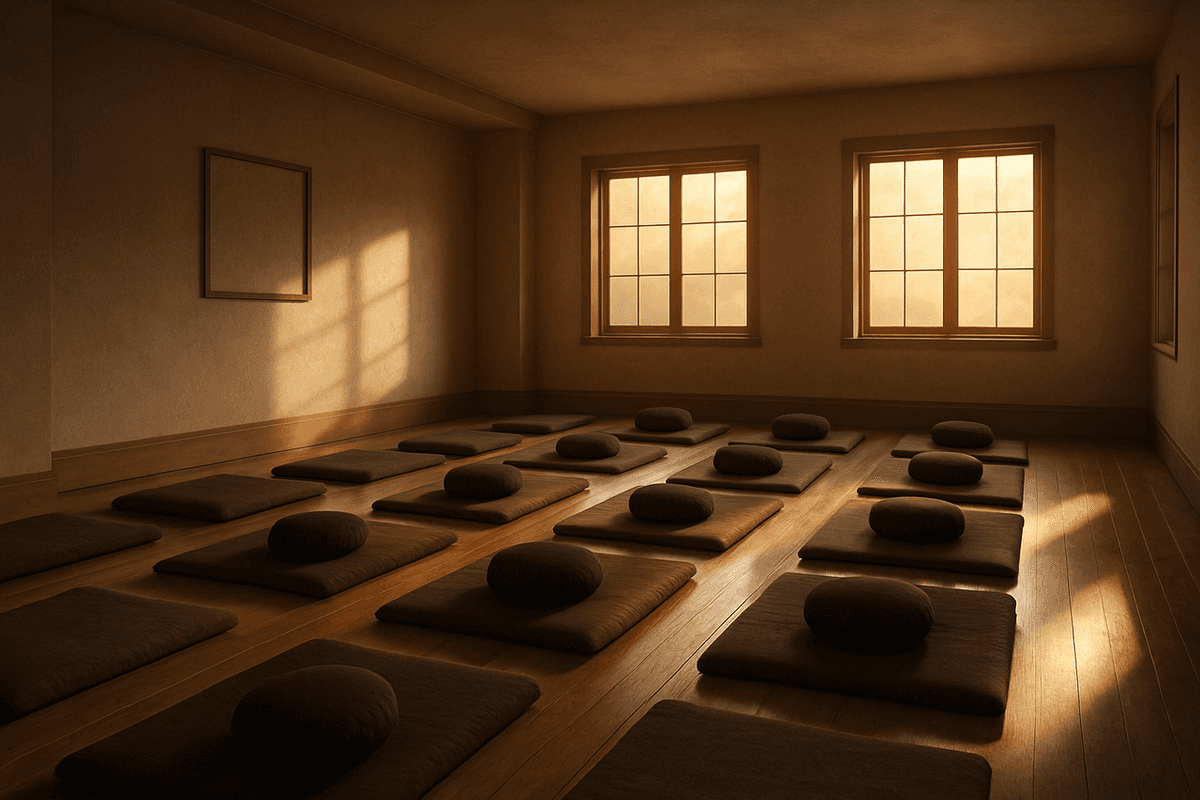
The morning sit is the one most people remember. There’s a window in the meditation hall. The sun comes up. You don’t think anything specific. You’re just there.
Day 3 lunch, the silence breaks for the final meeting. People talk softly. Some cry. Some laugh. Everyone is a little tender.
You drive home that afternoon. Within 30 minutes you’ve checked your phone. Within 60 you’ve called someone. By the time you go to bed you’re already back to your old patterns.
That’s also normal. The point of the retreat isn’t permanent transformation. It’s that you now know what the quiet feels like. You’ll know how to find it again.
What to actually pack
Standard lists tell you to bring meditation cushions and modest clothes. Those are right. Here’s what they leave off:
1. Earplugs you’ve tested at home. Cabins are echo chambers. Test the earplugs at home first, pressure points hurt at 2am.
2. Compression socks if you have circulation issues. Long sits = bad circulation. Not glamorous; very practical.
3. Magnesium tablets. Cramped legs at 4am because you slept in a cold cabin with no movement. Magnesium glycinate before bed = solved.
4. A printed photo of someone you love. No phones means no photos. Bring one printed picture. You don’t realize how much you miss faces.
How to pick your first one
Don’t start with a 10-day Vipassana. Start with 3 days. Don’t pick the most aggressive lineage, pick a teacher who’s good at first-timers.
What to look for, in order:
-
Three nights, not ten. Long enough that day 2 happens to you, short enough that you can finish. Ten-day courses are a different commitment and a bad first test.
-
A teacher who runs beginner cohorts. Ask directly whether the sitting group will be mostly first-timers. Sitting your first retreat surrounded by people on their ninth is demoralising for no reason.
-
Partial silence over total silence. Many first retreats keep a daily check-in or a teacher interview. That one conversation is often what keeps people from leaving on day 2.
-
A trauma-informed option if you need one. If you’re sitting through grief, early recovery, or anything active, say so when you book, and pick a retreat that answers the question properly rather than deflecting it.
If a retreat can’t tell you who is teaching, how many people will be there, and what happens if you want to leave early, that’s your answer.
The honest verdict
Silent retreats work. Not for everyone, not every time. They work especially well if you’re in transition, between jobs, after a relationship ends, during grief, in early recovery. They work less well as a “vacation”, the point isn’t relaxation, the point is hard.
If day 2 finds you wanting to leave, leave the thinking of leaving. Don’t actually leave. Just notice that you want to. Then go to lunch.
The next bell will ring soon.