Head to head: Sedona vs Big Sur vs Texas Hill Country, which wellness retreat fits you in 2026
Three of the best wellness retreats 2026 destinations, compared honestly on land, cost, vibe, and who actually benefits.
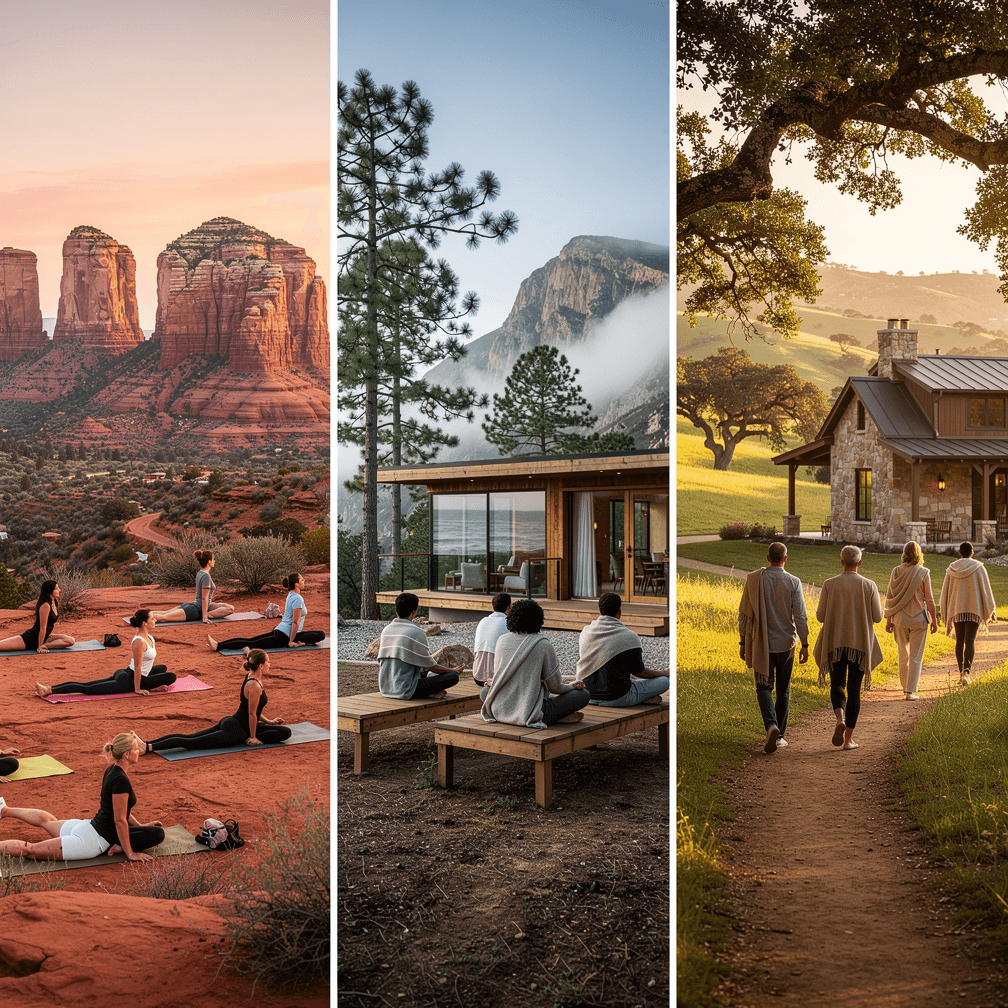
Short answer: Sedona for red rock, dry air at around 4,300 feet and a deep contemplative tradition, roughly $2,800 to $4,500 for five to seven nights. Big Sur for coastal fog and somatic depth, and the highest price at $4,200 to $7,500. The Texas Hill Country for oak, limestone rivers and the easiest travel.
People ask us this question a few times a week now: if I can only do one trip in 2026, where should it be? The three names that come up most often are Sedona, Big Sur, and the Texas Hill Country.
They get lumped together in articles about the best wellness retreats 2026, but they are not interchangeable. The land is different. The cost structure is different. The kind of work that happens there is different. Below is the honest comparison we wish someone had written for us a few years ago.
The short version on each region
If you want red rock, dry air, and a strong contemplative or energy-work tradition, Sedona. If you want coastal cliffs, fog, and a more secular, somatic, sometimes plant-curious scene, Big Sur. If you want oak savanna, limestone rivers, easy flights from most of the country, and a fast-growing operator base, the Texas Hill Country.
None of these is the “best” in the abstract. They are best at different things, for different bodies and budgets.
Sedona: red rock and the contemplative tradition
A sedona wellness retreat tends to lean into stillness. The town and the surrounding canyons have been a destination for meditation, yoga, breathwork, and various energy modalities for several decades, which means the practitioner bench is deep and the infrastructure for week-long stays is mature.
What the land does to you
Elevation sits around 4,300 feet, so plan on a day or two of mild altitude adjustment. The air is dry. The light at sunrise on the red rock is genuinely unusual, and most guests we talk to describe a real shift in their sleep and breathing by day three.
If you have asthma or run cold, the dryness can be a problem in winter; if you carry chronic congestion, it often helps.
What it costs
A mid-range Sedona retreat in 2026 runs roughly $2,800 to $4,500 for five to seven nights, all in. Luxury properties (think private casitas, included bodywork) push past $6,000. Flights into Phoenix Sky Harbor are reasonable from most of the country; the drive north is about two hours.
Who it actually fits
People who want a meditative, slower, somewhat introspective week. Solo travelers do well here. The scene is welcoming to first-timers but assumes you are okay with quiet.
Big Sur: coast, fog, and somatic depth
Big Sur retreats are shaped by two things: the cliffs and Esalen’s long shadow. Even programs that have nothing to do with Esalen tend to inherit the somatic, body-centered, slightly experimental tone that the region has carried since the 1960s.
What the land does to you
The coast is cool and often foggy, even in summer. Mornings are bracing. The ocean is loud, constant, and not optional as a background presence. Many guests find this stabilizing; some find it intense. If you sleep badly in cold rooms or need consistent sun for your mood, factor that in.
What it costs
Big Sur is the priciest of the three. Five to seven nights typically lands between $4,200 and $7,500, and the high end goes well past that. Property scarcity along Highway 1 keeps prices firm. Flights into San Francisco or Monterey, then a winding drive that can stretch to three hours depending on road conditions, which do close from time to time.
Who it actually fits
People drawn to somatic work, couples doing relational intensives, writers and creatives on sabbatical, and anyone who finds the ocean clarifying. Less ideal for guests who want a packed schedule or strong group structure; the Big Sur ethos runs toward unstructured time.
Texas Hill Country: oak, limestone, and the operator boom
A wellness retreat texas hill country search will surface noticeably more options in 2026 than it did even two years ago. The region between Austin and Fredericksburg has become a real hub, partly because flights into Austin are cheap from almost everywhere, and partly because the land itself, rolling oak savanna with cold spring-fed rivers, is genuinely restorative without being dramatic the way Sedona or Big Sur are.
What the land does to you
The Hill Country is warm. Spring and fall are excellent; summer is hot and the operators who pretend otherwise are not being straight with you. The rivers (Pedernales, Blanco, Frio) are spring-fed and stay cool year round, which is part of why cold plunge and sauna programming has become a signature here.
What it costs
This is the most affordable of the three. Four to six night programs commonly run $1,800 to $3,500. The luxury end exists (Miraval Austin and a handful of private ranch programs) and reaches $5,000-plus, but the median is genuinely accessible.
Who it actually fits
People flying in from the Midwest, South, or East Coast who want to maximize time on the ground rather than in transit. Groups of friends. First-time retreat-goers who want something gentle. People who specifically want cold plunge and sauna built into their week, which connects naturally to the broader cold plunge austin and sauna austin ecosystems most of these operators draw from.
Side by side
Travel friction
Texas Hill Country wins on access. Austin-Bergstrom is one of the easiest airports in the country, and most retreat properties are inside 90 minutes. Sedona is a solid two-hour drive from Phoenix. Big Sur is the longest haul and the most weather-dependent.
Land and climate
Sedona is dry, high, and visually overwhelming in a good way. Big Sur is cool, damp, and oceanic. Hill Country is warm, green in spring, and built around water rather than vistas.
Modality strength
Sedona is strongest for meditation, breathwork, sound healing, and energy work. Big Sur is strongest for somatic, relational, and creative work. Hill Country is strongest for contrast therapy (cold plunge, sauna), yoga, and integrative wellness that draws on the Austin practitioner base.
Real cost for a week in 2026
Hill Country median: about $2,600. Sedona median: about $3,800. Big Sur median: about $5,200. These are all-in estimates including lodging, meals, and programming, not flights.
Group versus solo
Solo travelers do well in Sedona and Hill Country. Big Sur skews more toward couples and small groups, partly because the lodging stock favors it.
How to actually choose
A few honest questions that tend to settle it:
- How much travel time can you absorb? If the answer is “not much,” Hill Country.
- Are you going to work on something specific, like grief, a relationship, a creative block? Big Sur tends to hold that work well.
- Do you want the week to feel quiet and contemplative or active and embodied? Sedona for the former, Hill Country for the latter.
- What is your real budget once flights are in? If the gap between budget and Big Sur prices is uncomfortable, do not stretch. The retreat will not undo the financial stress it caused.
A note on booking
When you book wellness retreat online for any of these three regions, you will see a wide spread of pricing for what looks like similar programming. The differences usually come down to land quality, group size, and whether bodywork and one-on-one sessions are included or add-ons. Read the inclusions carefully. A $2,400 program with $900 in necessary add-ons is a $3,300 program.
We keep our region pages updated through the year with operator notes, current availability, and the specific programs we have visited or vetted. If you want a second pair of eyes before you commit, that is what those pages are for.
The honest verdict
For most people reading this in 2026, the Texas Hill Country is the easiest yes: cheaper, closer, and increasingly well-served by serious operators. Sedona is the right call if you specifically want a contemplative or energy-focused week and the red rock genuinely calls you.
Big Sur is the right call if you have the budget, the time, and a specific reason to be there. None of them is wrong. They are just different rooms in the same larger house.
Related reading on retreat destinations
- Best wellness retreats in the Texas Hill Country for 2026
- Canyon Ranch vs Miraval style destination spas: which one fits you in 2026
- Best men’s wellness retreats in the US for 2026: brotherhood circles, hard work, and quiet
And if red rock is the draw but Sedona feels too discovered, our Utah retreat guide covers the quieter version of the same landscape.