Best men's wellness retreats in the US for 2026: brotherhood circles, hard work, and quiet
A grounded look at where men are going to do real work this year, from the Texas Hill Country to Sedona, plus what to ask before you book.
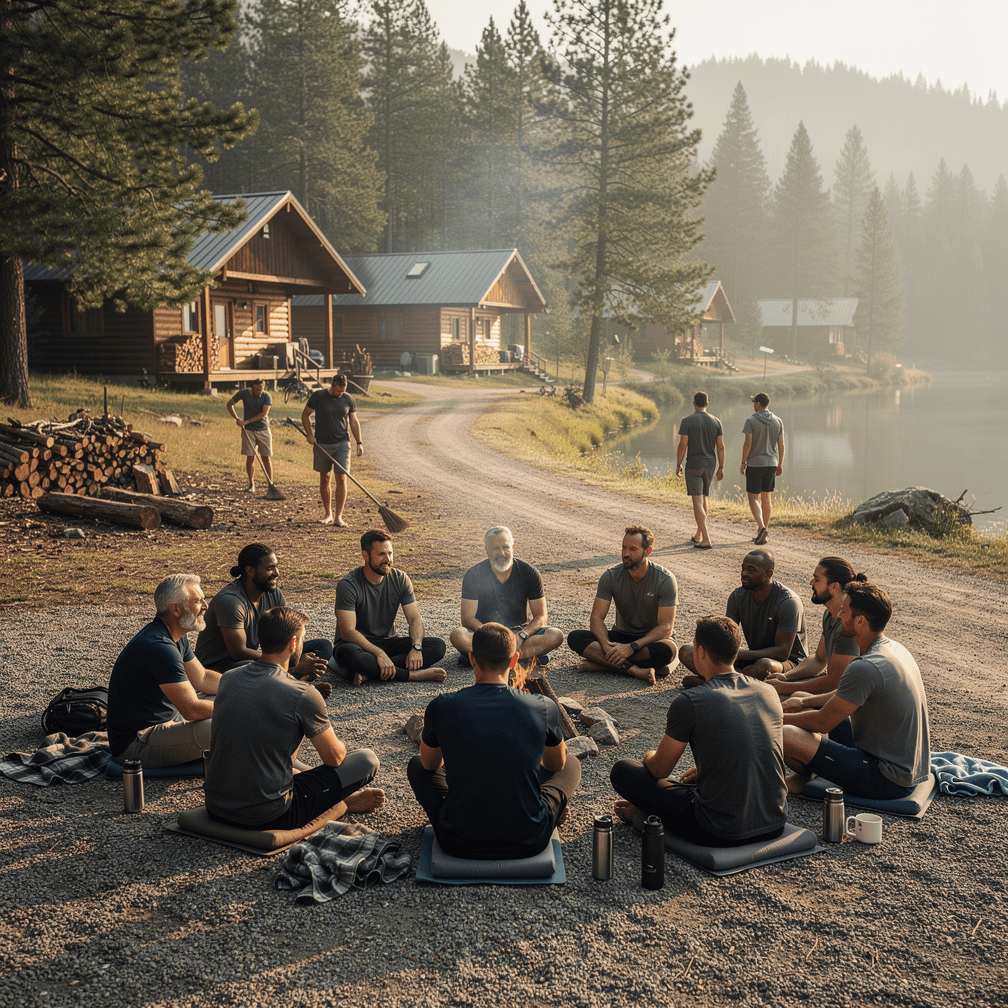
Short answer: A men’s retreat is built around a brotherhood circle: a facilitated group of six to twelve men with a talking piece, confidentiality agreements and one or two rounds a day. It is work, not a vacation. Expect $1,800 to $5,500, or $1,800 to $3,600 for four to six nights in the Texas Hill Country.
Most men we talk to don’t need another productivity hack. They need a week without a phone, three other men who’ll tell them the truth, and a fire to sit around at the end of the day.
That’s the simple thing the best wellness retreats 2026 are quietly built around, and it’s why brotherhood circles have moved from a niche curiosity to the core of what’s worth booking this year.
This is the guide we wish someone had handed us four years ago. It covers the formats that actually do something, the regions worth flying for, and the questions to ask before you book a wellness retreat online.
What a brotherhood circle actually is
A brotherhood circle is a facilitated group of men, usually six to twelve, who meet for structured conversation under the guidance of a trained facilitator. The format borrows from group therapy, men’s work lineages like the ManKind Project, and older council traditions.
There’s a talking piece, agreements about confidentiality, and a rhythm of listening that’s almost shockingly different from how men usually talk to each other.
On retreat, circles typically run once or twice a day. A morning round might be short and grounding, a check-in. The evening round goes deeper: grief, anger, fear, the thing you haven’t said out loud in a decade. Good facilitators don’t push. They make it safe enough that the truth shows up on its own.
If you’ve never sat in one, the first session can feel awkward. By day three, most men describe it as the part of the week they didn’t know they were starving for.
The regions worth flying for in 2026
Texas Hill Country
A wellness retreat Texas Hill Country setup has become one of the strongest options in the country for men’s work, and it’s not an accident. The land is quiet, the limestone creeks are cold year-round, and Austin is close enough that you can build serious infrastructure (saunas, cold plunges, real kitchens) without being remote in a frustrating way.
What we like about the Hill Country specifically:
- Cedar and oak savanna that actually feels like wilderness once you’re 20 minutes off the highway.
- Spring-fed swimming holes that double as natural cold plunges from October through April.
- A serious cluster of facilitators within driving distance of Austin, which means lead instructors aren’t flying in tired.
- Easy airport access through Austin-Bergstrom, so the travel day doesn’t eat into your week.
Typical pricing for a four to six night men’s retreat here runs $1,800 to $3,600, depending on accommodations and whether plant-medicine-adjacent work is on the schedule.
Sedona
A sedona wellness retreat hits differently. The red rock has a way of slowing men down that’s hard to describe until you’ve stood on it at sunrise. Sedona has more new-age noise than the Hill Country, so the work of choosing a retreat here is mostly the work of filtering. The good operators are very good. The mediocre ones are very mediocre.
Look for Sedona retreats that are clear about what they are and aren’t. If a program promises a personality overhaul in five days, that’s a flag. If it promises hiking, breathwork, circle, and good food, with a facilitator who has a decade of group work behind them, that’s the one to look at.
Asheville and the Blue Ridge
For men on the East Coast, the Blue Ridge corridor around Asheville has quietly built one of the best brotherhood retreat scenes in the country. Cooler summers, real forest, and a strong base of trauma-informed facilitators. Fall (late September through early November) is the window.
Pacific Northwest
For men who want silence and rain, the Olympic Peninsula and the Oregon coast both have small, well-run operators offering five to seven night formats with sauna culture, cold water, and long walks. These tend to be smaller groups (six to eight men) and book out further in advance.
What a strong week looks like
The formats vary, but the bones of a good men’s retreat in 2026 tend to look like this:
Morning
A shared physical practice. Mobility, breathwork, or a hike. Nothing punishing. The goal is to get into the body before the mind takes over the day.
Late morning
First circle. Check-in, intentions, sometimes a teach from the lead facilitator on a specific theme: fathers, shame, money, sex, the inner critic.
Afternoon
Unstructured time, usually with optional offerings. This is where sauna and cold plunge sessions usually land. If you live in Austin, you already know what a good cold plunge austin session can do for your nervous system. On retreat, the same protocol stretched across five days starts to do something deeper.
The same goes for sauna austin culture, which has trained a generation of Texas men to take heat seriously; on retreat, two-hour rounds in a wood-fired sauna with five other quiet men is its own kind of medicine.
Evening
Dinner together, then the deeper circle. Sometimes a fire. Sometimes a guided process. Lights out earlier than you’d expect.
What to ask before you book a wellness retreat online
Booking is the part most men rush. Slow down here. A good operator will welcome these questions; a shaky one will get defensive.
- Who is the lead facilitator, and what is their actual training? Names of teachers, lineages, years of group work. “I’ve done a lot of personal work” is not a credential.
- What is the group size, and is it capped? Six to twelve is the workable range for circle. Above fourteen, the depth thins out fast.
- What is the cancellation policy, and is there a payment plan? Real operators have clear policies in writing.
- What’s the ratio of structured work to free time? Too much structure burns men out. Too little and you’re just on an expensive vacation.
- Is there any plant-medicine-adjacent work, and if so, what does “adjacent” mean to you? Some retreats use legal practices like breathwork or somatic work that go to similar places. Others coordinate with separate legal ceremonies in jurisdictions where that’s lawful. You want to know which, before you arrive.
- What’s the food situation, and can you accommodate my needs? A good kitchen is not a luxury on retreat. It’s part of the medicine.
- What happens after the retreat ends? The best programs build in a follow-up call or an integration circle two to four weeks after you go home. Without that, week one back in normal life can undo a lot of the work.
Who this kind of week is for
Men who are functional but tired. Men in transitions: divorce, fatherhood, a career change, a parent’s illness, a sobriety milestone. Men who have therapists and a good marriage and a decent gym routine and still feel like something is missing. Men who have never sat in a circle and are quietly curious about it.
Who it isn’t for
Men in acute crisis. A retreat is not a substitute for stabilization, clinical care, or medication management. The best operators will tell you this directly during intake and will sometimes turn applicants away because the timing isn’t right. That’s a good sign about the operator.
It’s also not for men looking for a vacation with a wellness label on it. Real circle work is the opposite of relaxing on the days it matters. You leave rested, but you don’t get there by avoiding the hard parts.
A note on cost, and what you’re actually paying for
The price of a good men’s retreat in 2026 will land somewhere between $1,800 and $5,500 for four to seven nights. That covers lodging, food, facilitation, materials, and (on the better-run programs) the integration call after you get home.
What you’re paying for, mostly, is the facilitator’s two decades of training and the small group size. Both are expensive, and both are exactly what makes the week worth the flight.
Booking windows
For 2026, the strongest weeks (April, May, September, October) tend to fill three to five months out. If you’re reading this in early summer, the fall slots are the realistic target. Winter retreats in the Hill Country and Sedona are quieter and easier to get into, and the work is just as good.
When you find one that fits, book it. Tell two friends. Pack light. Leave the laptop at home.