Best Pacific Northwest wellness retreats for 2026: an honest location guide
Where to go in Washington, Oregon, and the Olympic Peninsula, what the rooms are actually like, and how PNW retreats compare to the Texas Hill Country and Sedona.
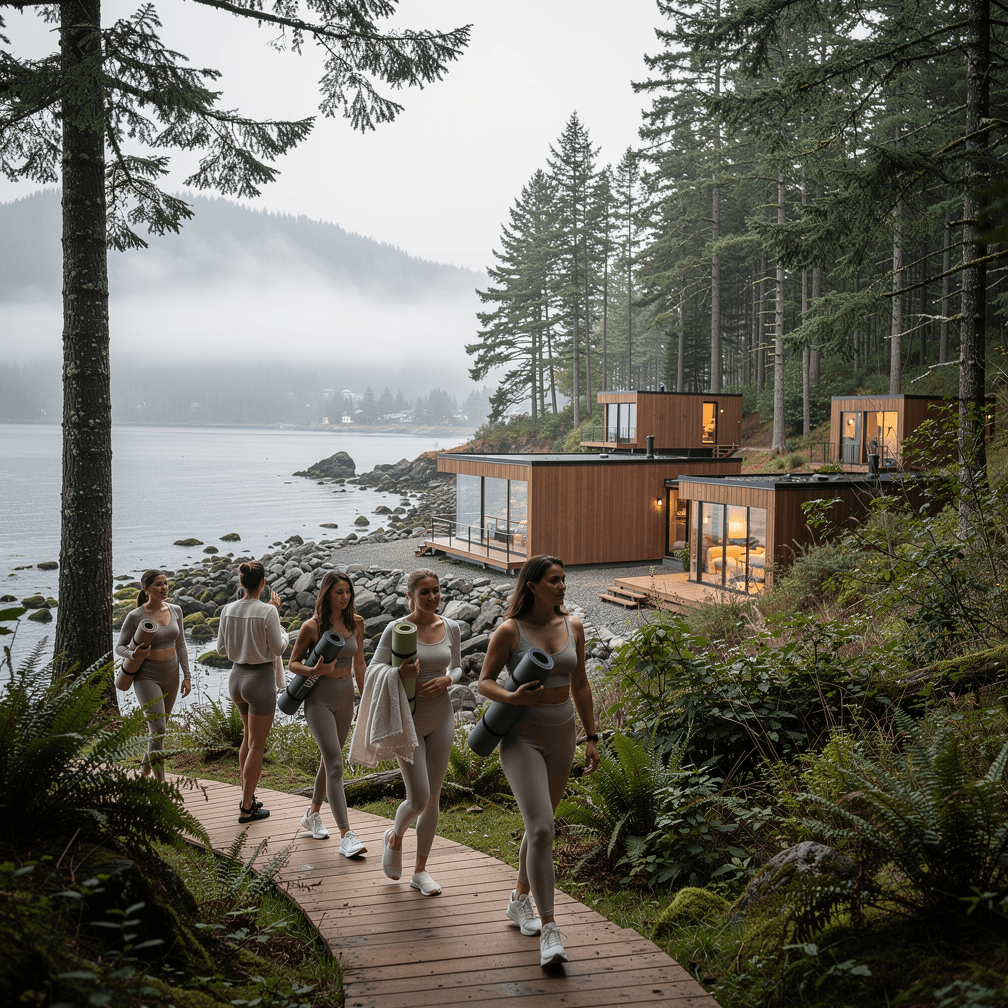
Short answer: The Pacific Northwest suits people who want forest over desert, rain over sun, and a slower pace than Sedona or the Texas Hill Country. Four zones behave differently: the Olympic Peninsula for remoteness, the San Juans for ferry-enforced stillness, the Oregon coast for creative and trauma-informed work, Central Oregon for movement and drier weather.
The Pacific Northwest is the part of the country where wellness retreats most often live up to the photos. Old-growth forest is genuinely quiet. The coast is genuinely empty in shoulder season. The food, if you pick the right place, is genuinely good.
None of that makes a retreat work for you on its own, so this guide is about matching the region to what you actually want out of a week away in 2026.
We run a marketplace, which means we see the booking patterns across the country. PNW retreats tend to attract a specific kind of guest: someone who wants forest over desert, rain over sun, and a slower pace than what you’ll find at the more programmed centers in Sedona or the Texas Hill Country.
If that’s you, read on. If you’re after heat, red rock, and a bigger group energy, the comparisons later in this piece will help you redirect.
What “Pacific Northwest” actually covers for retreats
For planning purposes, the retreat-friendly PNW splits into four zones, and they behave differently.
The Olympic Peninsula
The rainforest side of Washington. Hoh, Quinault, the Sol Duc valley. This is where you go for old-growth, hot springs, and a feeling of real remoteness within a three-hour drive of Seattle. Most retreats here are small, eight to sixteen guests, and lean into silence, forest bathing, and a lot of unstructured time. Cell service is unreliable on purpose.
The San Juan Islands and the Salish Sea
Orcas and Lopez are the workhorses. Ferries dictate your schedule, which sounds annoying and turns out to be a feature: you arrive, and you stop checking your phone for logistics because there’s nothing to coordinate. Yoga, sound work, and a lot of cold water if you want it.
The Oregon coast
Manzanita down through Yachats. Foggy, dramatic, and quieter than people expect outside of August. Retreats here tend to be writing, creative, and trauma-informed work. The rhythm of the coast does most of the regulation; the facilitator’s job is to stay out of the way.
Central Oregon and the Cascades
Bend, Sisters, the Metolius. This is the sunny, drier side, and the retreats reflect it: more movement, more hiking, more fitness-adjacent programming. If you want PNW landscape without the rain risk, this is the zone.
Our shortlist for 2026
We won’t name specific operators in a guide like this, because the list shifts every quarter and we’d rather you check the current marketplace listings than trust a frozen snapshot. What’s worth saying is what to look for.
Small group, real instructor presence
Anything over twenty-four guests in the PNW starts to feel like a conference. The land doesn’t want a crowd. Look for capacity at sixteen or below, and a lead instructor who’s actually on the property the whole week, not flying in for the opening and closing circles.
A weather-honest schedule
It rains. October through May, plan on it. The best operators build indoor backups for every outdoor session and don’t pretend the forecast won’t matter. The worst ones publish a schedule that assumes sun and then improvise badly when it doesn’t show up.
Food that respects the region
The PNW grows extraordinary produce, mushrooms, and shellfish. If the menu reads like it could have been served anywhere in the country, the operator isn’t paying attention. This isn’t a luxury point, it’s a signal of care.
A clear stance on phones and silence
Some PNW retreats are full silent retreats. Some are phone-free but talkative. Some are neither. None of those are wrong, but you want to know which one you’re booking before you arrive, not on day two.
How PNW retreats compare to other regions in 2026
We get asked this constantly, so here’s the honest version.
Versus a wellness retreat in the Texas Hill Country
The Texas Hill Country has become one of the strongest retreat regions in the country, with a real cluster of properties between Fredericksburg, Wimberley, and Dripping Springs.
The vibe is different from the PNW in almost every way: warm most of the year, big skies, more horse and ranch programming, and a food scene that leans toward live-fire cooking and local game. If you want sun in February and a property you can walk barefoot on, the Hill Country wins.
If you want forest and rain and a slower social pace, the PNW wins. Neither is better; they’re answering different questions.
Versus a Sedona wellness retreat
Sedona is the most programmed of the major US retreat regions. You’ll find more structured offerings around sound healing, somatic work, and energy-based modalities than you will almost anywhere else. The red rock landscape does heavy lifting, and the elevation is real (be honest with yourself about sleep at altitude).
A Sedona wellness retreat tends to be more facilitator-led and more group-energy-dependent than a PNW retreat, which is usually quieter and more self-directed. Pick Sedona if you want a strong container and a lot of programming. Pick the PNW if you want space to be left alone.
Versus Austin day-trip wellness
This isn’t really a comparison, but it comes up. A lot of our guests aren’t ready for a full week-long retreat and want to build their own version close to home.
If that’s you and you’re in Texas, the Austin scene has matured fast: it’s now genuinely easy to book a wellness retreat online for a weekend, or to string together a cold plunge in Austin, a sauna in Austin, and a bodywork session into something that looks a lot like a mini retreat.
The PNW is worth the trip when you want the landscape to do work that a city block can’t.
What to pack for a PNW retreat in 2026
This is the part most packing lists get wrong.
- A real rain shell, not a fashion one. Gore-Tex or equivalent. You will use it.
- Two pairs of shoes you don’t mind getting wet. One for trails, one for around the property.
- Warm layers even in July. Coastal mornings are in the fifties.
- A swimsuit. Cold plunge, hot springs, or sauna access shows up at more PNW properties than you’d expect.
- A paper book. Most properties have weak or intentionally limited Wi-Fi.
- Melatonin or your usual sleep aid if you’re sensitive to the long summer light. June and July have very long evenings this far north.
When to go
The sweet spots for 2026 are mid-May through late June, and mid-September through mid-October. July and August are beautiful and busy; rates are higher and the most-wanted properties book out in February and March. November through April is the cheapest and the rainiest, which a certain kind of guest loves and a certain kind of guest does not.
If you’re booking right now and the property you want is full, the most useful thing you can do is get on the waitlist and stay flexible on dates. Cancellations happen, especially as the date approaches, and the small operators we work with tend to fill cancelled spots from their waitlist before they re-list publicly.
How to actually book a PNW retreat
Most PNW retreats run through their own website or a small set of booking platforms. A few things that save people money and frustration:
Read the cancellation policy before you put the deposit down, not after. PNW retreats skew strict because the operators are small and can’t absorb late cancellations the way a bigger center can.
Ask about single-occupancy supplements before you book a shared room. Some properties run very high singles fees; others are reasonable. It’s almost always cheaper to ask up front than to upgrade on arrival.
If you have a specific dietary need, get it in writing in the booking confirmation. PNW operators are generally very accommodating, but the chef changes between sessions at some properties, and a verbal promise from a booking coordinator isn’t always the same as a note in the kitchen.
If the trip is meaningful, book travel insurance. Ferries get cancelled. Flights to small regional airports get cancelled. The Olympic Peninsula has had two weather events in the last eighteen months that closed roads for a day. None of that is common, all of it is possible.
A last honest note
The PNW is not a fix. No retreat region is. A week in a quiet cabin under cedars can interrupt a pattern, and an interruption is useful, but the work of building a life you don’t need to escape from happens at home, in small steady increments, after you fly back.
The best PNW operators we know say something close to this on the last morning of every retreat, and we think it’s the most truthful thing anyone in this industry says out loud.
If you want help narrowing the field, the marketplace listing pages have current availability, real photos, and the operator notes we add after we visit. That’s the most useful next step from here.