What actually happens at a cacao ceremony (and who it's for)
Ceremonial cacao, the ritual around it, and how to tell a grounded ceremony from theatre, before you sign up.
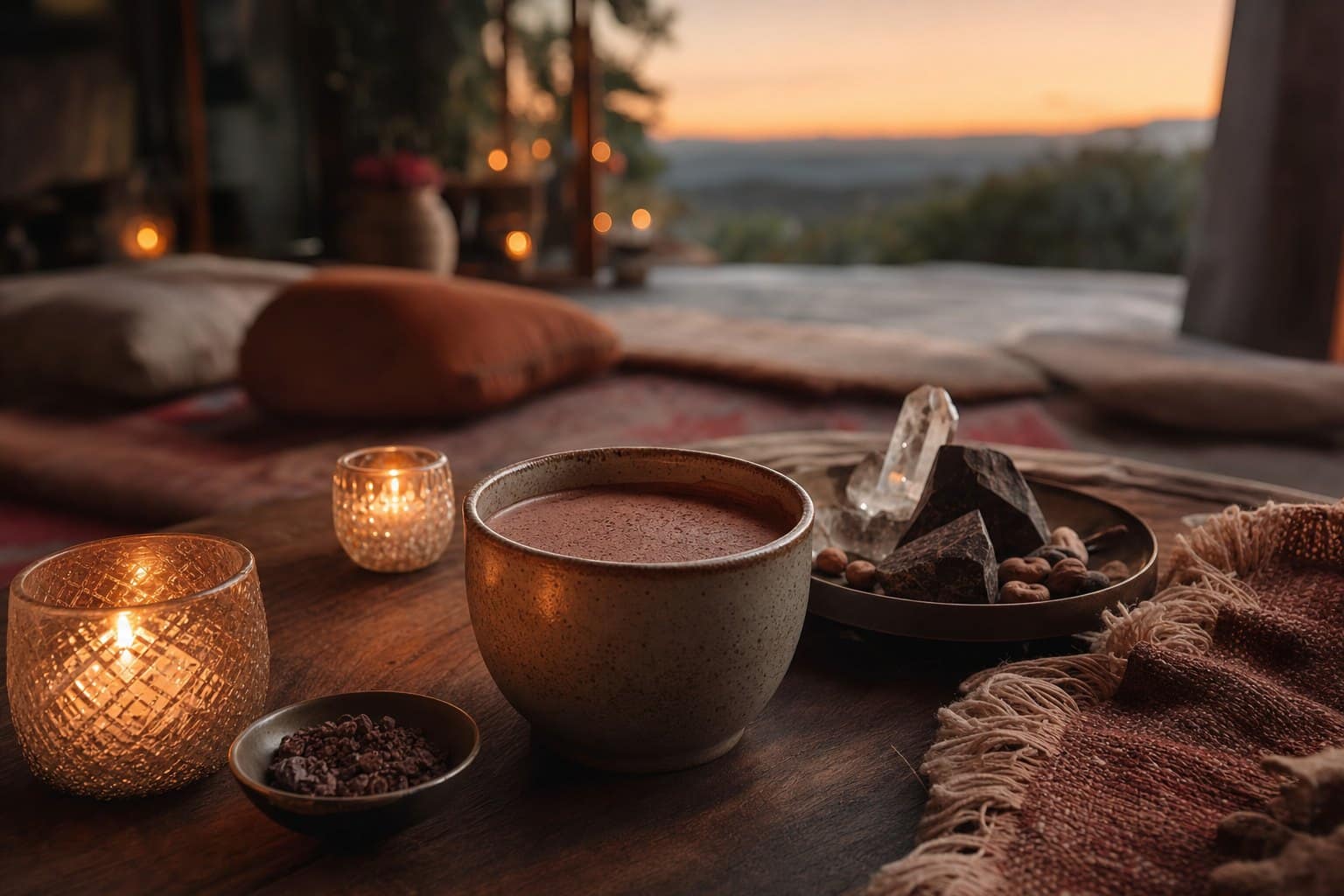
Short answer: You drink 30 to 42g of ceremonial cacao, then sit through 90 minutes to 2.5 hours of meditation, breathwork, movement or sound while it works. It’s a mild stimulant, not a psychedelic; you stay lucid and can drive home. Suits people who find silent meditation hard. Costs $25 to $150.
Cacao ceremonies have moved from the fringe to the mainstream of the wellness world, and like most things that travel that fast, the quality ranges from genuinely grounding to expensive theatre. Here’s what one actually is, what happens in the room, and how to choose wisely before you sign up.
What a cacao ceremony is
A cacao ceremony is a structured group (or sometimes individual) ritual centered on drinking ceremonial-grade cacao as a mild heart-opening and focus aid, held within a container of intention, meditation, movement, or music. The ceremony draws from Mesoamerican traditions, particularly Mayan and Aztec ceremonial use of cacao, though most contemporary Western ceremonies are syncretic adaptations rather than direct lineage transmissions.
The ritual frame matters. This is not a cacao tasting or a chocolate experience; it’s a purposeful gathering where the drink is the entry point, not the point itself. What happens after you drink it is the ceremony.
What “ceremonial cacao” actually is
Ceremonial cacao is pure, minimally processed whole cacao, the entire bean ground into a paste or block, without the alkalizing, dutching, or sugar additions of commercial cocoa. The resulting drink is rich, slightly bitter, and fatty. It contains:
- Theobromine, a gentle cardiovascular stimulant with a slower, longer, smoother arc than caffeine; typically peaks around 60, 90 minutes and lasts 3, 4 hours.
- Phenylethylamine (PEA), a compound associated with elevated mood and mild euphoria, though most is metabolized before crossing the blood-brain barrier in meaningful amounts.
- Anandamide, sometimes called the “bliss molecule,” present in trace amounts; its effects at cacao doses are probably very modest.
- Magnesium, iron, and flavonoids, genuine nutritional content in reasonable amounts.
What ceremonial cacao is not: psychedelic, dissociative, or hallucinogenic at any ceremonially typical dose (30, 42g). The effect is a soft, warm alertness, an easing into the body, not a departure from it. People who arrive expecting visions or altered states are regularly surprised by how gentle it is. That’s accurate: you stay fully aware and functional throughout.
What a cacao session is like
Most ceremonies run 90 minutes to 2.5 hours. The arc is fairly consistent across facilitators:
-
Opening. The facilitator welcomes the group, explains the cacao’s origin and the ceremonial context, and guides a brief grounding, a few breaths, a moment of silence, or an invitation to set a personal intention. This is where you begin to sense whether the facilitator is present and skilled or performing.
-
Preparing and drinking the cacao. A warm cup (typically 30, 42g of ceremonial cacao prepared with water and sometimes spices, cinnamon, cayenne, cardamom) is offered. You receive it with both hands, acknowledge it, and sip slowly. The lift comes on gradually over 20, 30 minutes, not dramatically, but noticeably.
-
The practice. This is the most variable part, and it defines the character of the ceremony. Options include: sustained meditation, gentle breathwork, guided visualization, ecstatic or free movement (sometimes combined with ecstatic dance), live music or sound bath, journaling, or sharing in a circle. The best ceremonies use the cacao to support a specific modality rather than filling time.
-
Integration and close. A slowing and grounding: rest, quiet reflection, sometimes sharing a word or two, often herbal tea and gentle conversation afterward. The closing holds the space as carefully as the opening.
You remain fully lucid throughout. You can drive home after. There’s no required behavior, you don’t have to share, move, cry, or have any particular experience.
What the evidence says about cacao
The honest position: there’s very little controlled research on cacao ceremonies as a ritual intervention. What we have:
- Reasonable evidence for: Theobromine’s mild cardiovascular effects (increased heart rate, vasodilation) are well-established at relevant doses; dark cacao flavonoids show evidence for blood pressure and endothelial function in ongoing dietary research; the group ritual context has plausible benefits for sense of belonging, presence, and intention-setting (supported by research on ritual behavior generally, not cacao specifically).
- Debated or mixed: Whether cacao’s mood-associated compounds (PEA, anandamide) produce meaningful effects at ceremony doses versus placebo; how much of the reported experience is the cacao versus the container, the music, the breath, or the social setting.
- Not established / overstated: Claims that cacao “opens the heart chakra,” “releases trauma from the body,” “detoxes the liver,” or functions as a meaningful plant medicine in the psychedelic sense at typical doses. The ceremony can be genuinely valuable without these claims being true, and they shouldn’t be why you go.
Benefits people report from ceremonies
People who return to cacao ceremonies regularly describe: a reliable way to drop into stillness that feels easier than sitting in silent meditation alone; a sense of warmth and mild elevation that supports group connection; a useful space for reflection before a major decision or transition; and a low-threshold entry into ceremonial or ritual practice for people who find pure meditation abstract. The tea ceremony tradition occupies a similar space, the ritual and attention around an ordinary drink becoming a genuine contemplative practice.
Who cacao ceremonies are for, and who should skip
Cacao ceremonies are accessible to most adults and are a genuinely good fit for: people curious about ritual or ceremony but not ready for anything stronger; those who find pure silent meditation difficult to settle into; people wanting a substance-free group experience with a real sense of presence; and those drawn to community practice.
Be cautious if you: are sensitive to stimulants (theobromine raises heart rate, sometimes to a degree that feels uncomfortable); have hypertension or cardiovascular conditions; are pregnant (theobromine’s effects on fetal development at high doses are not fully studied); are taking MAOIs or certain antidepressants (theobromine metabolism may be affected, and some facilitators recommend checking with your prescriber). A standard 30g ceremony dose is mild, but these are real pharmacological interactions worth checking.
If you want a dramatic altered state, this isn’t it. If you want to “heal trauma” in a single session, no ceremony, cacao or otherwise, can deliver that. Manage your expectations.
What a cacao ceremony costs
Drop-in community ceremonies: $25, 55. Curated studio or retreat-based ceremonies: $65, 150. Private or small-group ceremonies: $100, 250 per person. Retreat-embedded cacao ceremony (as part of a longer program): Often included in a day- or weekend-rate of $200, 600.
How to choose a facilitator
- Ask about their training and lineage. Not all facilitators have formal training, and there’s no universal certification, but good ones can speak clearly about where they learned, what tradition informs their practice, and what their ceremony container actually looks like.
- Look for dosage honesty. A skilled facilitator discusses cacao amount, contraindications, and what to expect physically. Vague “magic” language around the cacao itself is a flag.
- Check what the practice involves. You should know before you arrive whether it’s movement, meditation, music, sharing, or some combination. Surprises in a ceremonial setting aren’t always welcome.
- Notice how they talk about outcomes. Grounded facilitators make no guarantees about what you’ll experience and actively discourage inflated expectations. Anyone promising catharsis, healing, or visions is a flag.
- Ask what happens if something difficult comes up. Cacao is mild, but group ritual can surface unexpected emotion. A skilled facilitator has an answer.
FAQ: cacao ceremonies
Is a cacao ceremony the same as a plant medicine ceremony? Not in the pharmacological sense, cacao is not a psychedelic, dissociative, or entheogen at typical doses. The ceremonial format shares aesthetic and structural elements with plant medicine circles, but the experience profile is fundamentally different. If you’re curious about the intersection, that’s worth understanding before you arrive with expectations formed by psilocybin or ayahuasca accounts.
What do I wear or bring? Most facilitators suggest comfortable, layered clothing (rooms can be warm or cool depending on the practice), an open or clean journal if the ceremony includes reflection, and a water bottle. No special equipment is needed.
Will I feel the cacao? Most people notice something, a gentle warmth, a mild heart-opening sensation, a slightly elevated sense of presence, particularly during the practice portion of the ceremony. A few people feel nothing beyond the warmth of a hot drink. Both experiences are valid. The ceremony is not about chasing the effect.
How is ceremonial cacao different from just drinking hot chocolate? Dose, preparation, and context. Ceremonial cacao uses the whole bean (including the fat-rich cacao butter), at doses three to five times higher than a typical hot chocolate serving, with no sugar. Commercial hot chocolate uses dutched or alkalized cocoa at low doses, primarily for flavor. The theobromine content is meaningfully different.
The honest summary on cacao ceremonies
A cacao ceremony is a calm, substance-free group ritual built around a warm, mildly stimulating drink and a shared intention. At its best, it’s a gentle way into stillness, connection, and a quality of presence that’s harder to access alone.
It’s not magic, it’s not plant medicine, and it’s not for everyone, but a well-run one is a genuinely lovely entry point into intentional group practice. The ceremony is only as good as its container. Ask good questions before you book.