In-person yoga class vs a yoga app: which should you choose?
One costs almost nothing and fits any ten minutes you have. The other costs more, needs you to show up, and does the one thing an app cannot: watch your body and correct it. The right answer depends on why you are doing yoga at all.
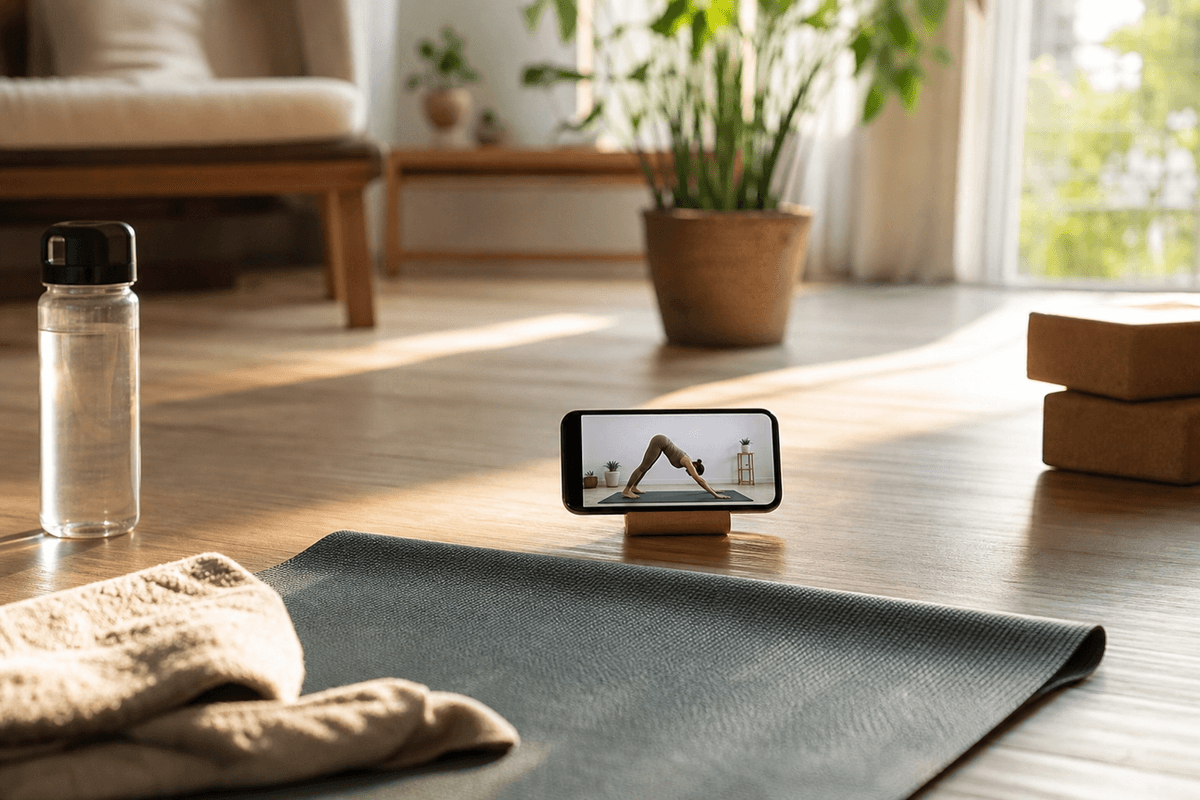
Short answer: Choose a class if you are a beginner, want your alignment corrected, or value community and accountability. Choose an app for low cost, total flexibility and privacy. Many people do best with both: learn the basics in person, then maintain and build with an app. No app can see your form.
Choose a class if you are a beginner, want your alignment corrected, or value community and accountability. Choose an app if you want low cost, total flexibility, and privacy, and you can be honest with yourself about form. Many people do best with both: learn the basics in person, then maintain and build with an app.
The deciding question is why you practice. If safety and correct technique matter, or you want the social energy, a class earns its cost. If convenience and habit are what you need, an app is superb value.
Neither is wrong. They are tools for different priorities, and a beginner in particular should weight the in-person option more than they might expect.
What does an app do well?
Cost, convenience, and habit-building.
A yoga app or online library costs a fraction of studio classes, often a modest monthly fee for unlimited sessions, and some good content is free. You practise any time, in ten minutes or ninety, at home, while travelling, in whatever you are wearing, with no booking or commute. That flexibility is genuinely powerful for consistency.
Apps also let you pick exactly what you want, a specific length, style, or focus, and repeat a class you liked. For maintaining a practice you already understand, or slotting yoga into a busy life, it is hard to beat. Our yoga benefits guide covers what the practice delivers regardless of how you access it, and our memberships guide covers the cost comparison.
The convenience is the whole point, and consistency is where most of yoga’s benefit comes from.
What can a class do that an app cannot?
Watch you, correct you, and keep you safe.
A live teacher sees your body and adjusts it in real time: a tweaked knee position, a cue to protect your lower back, a modification for your tight shoulders. An app cannot see you doing a pose slightly wrong for months, which is how small errors become strains. For safety and correct technique, this is the decisive difference.
A class also brings community, the quiet accountability of a booked time and other people, and the focused energy of a room, which many find keeps them practising when an app on the sofa does not. And you can ask questions. Our first yoga class guide covers walking in.
That real-time feedback and human presence is what your subscription fee is actually buying, and for some goals it is worth a lot.
Which is better for a total beginner?
Start with at least some in-person teaching if you can.
Beginners benefit most from a teacher’s eyes, precisely because you do not yet know what a pose should feel like or where you are compensating. Learning foundational alignment in person, even for a few classes, reduces the risk of ingraining bad habits or hurting yourself, and gives you a reference for what good form feels like.
If in-person classes are not accessible or affordable, a beginner-focused app course is far better than nothing, just progress cautiously, favour gentle beginner content, and never push into pain. Our yoga styles guide covers choosing a suitable style to start.
A common smart path is a handful of studio classes to learn the basics, then an app to practise what you learned affordably and often.
Which is better for an experienced practitioner?
Either, and often mostly an app with occasional classes.
Once you know proper alignment and your own body, an app becomes an excellent, cheap way to maintain a frequent practice on your own schedule, and you have the self-awareness to stay safe. Many experienced yogis practise largely at home with occasional studio classes to refine, learn, or enjoy the community.
The class still offers things an app does not, a teacher spotting a habit you have drifted into, a workshop on a tricky pose, the social side, so a mix tends to serve experienced practitioners well.
If cost is a concern at this stage, leaning on the app with occasional in-person tune-ups is a sensible balance.
What about safety and injuries?
The main argument for at least some in-person work.
The biggest risk with app-only yoga is doing poses with poor alignment, unseen and uncorrected, especially loading the neck, lower back, knees, or wrists. Without feedback, you may not know you are doing it until something hurts. If you have any injury, condition, or you are pregnant, this matters more, and a qualified teacher who knows your situation is safer than a generic video. Our pregnancy safety guide and practitioner credentials guide cover those cases.
If you go app-only, mitigate it: choose reputable instructors, start gentle, film yourself occasionally to check form, and never force a pose. Pain is a stop signal, not a challenge.
For most healthy people, a blend removes most of this risk.
The bottom line on class versus app
An app wins on cost, flexibility, and habit-building. A class wins on real-time correction, safety, community, and accountability. Beginners should get at least some in-person teaching, while experienced practitioners can lean on an app with occasional classes.
If the app route wins for you, our honest comparison of the yoga apps themselves covers Down Dog, Alo Moves, Glo, Peloton and free YouTube.
Choose by your priority, and remember that the cheapest option you actually keep doing beats the ideal one you do not. For many, the honest answer is both.
To find a yoga studio near you for the in-person side, start with our city wellness maps.