How to check a wellness practitioner's credentials
Some of the letters after a wellness practitioner's name are state licences you can verify in ninety seconds. Others are a certificate from a weekend course. Telling them apart is the whole skill.
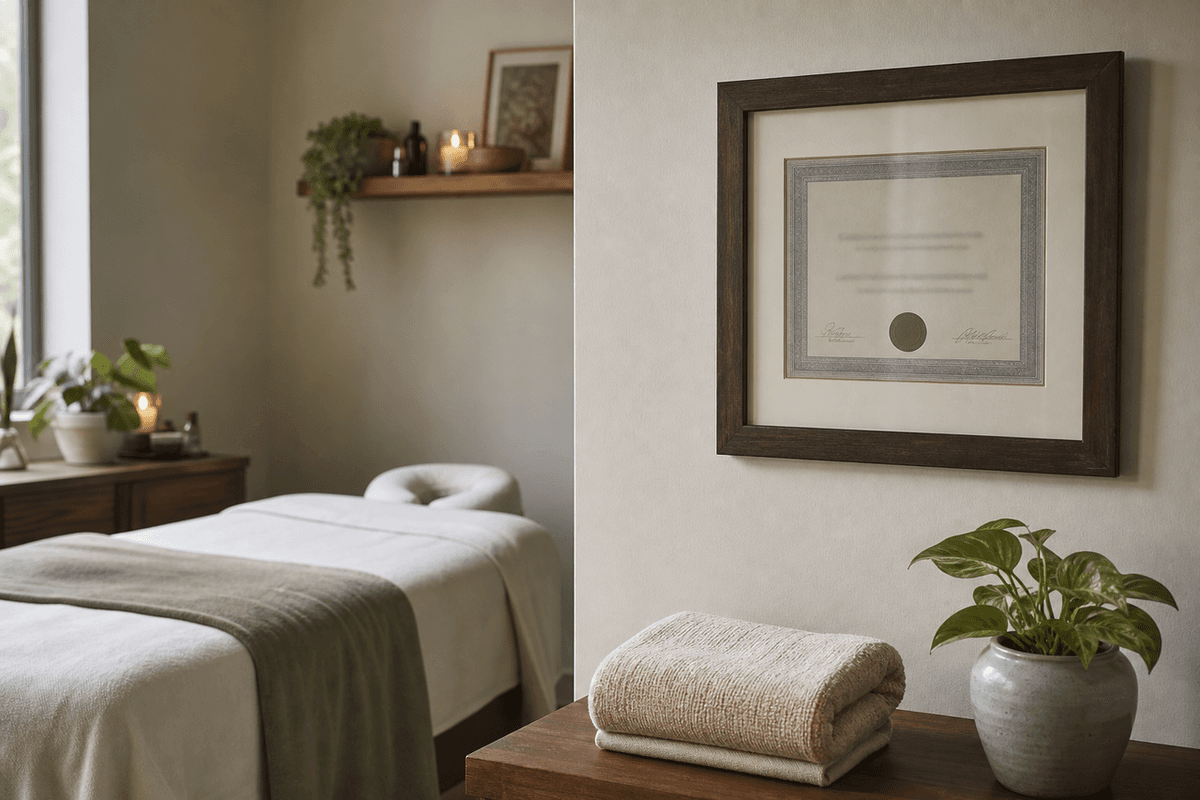
Short answer: Massage therapists (LMT) and acupuncturists (L.Ac.) hold real state licences you can verify on a state board site or the NCCAOM directory in about ninety seconds. Yoga’s RYT-200 is a voluntary registry, Pilates has no licence, and reiki or sound healing have nothing to check at all. Judge the training instead.
The single most useful thing to know is that wellness credentials fall into two very different buckets. Some are genuine state licences, backed by required training, exams, and a public register you can search in about ninety seconds. Others are voluntary certificates or registries that anyone can obtain by paying and attending, and that no government body oversees.
Both get printed on the same wall in the same font.
This is not a reason to be cynical about the whole field. It is a reason to know which letters carry weight for which practice, and where to look them up.
Which credentials are real licences?
Massage therapy, acupuncture, and anything clinical.
Massage therapists are licensed by the state in most of the US, usually as an LMT or LMBT. That means a minimum number of training hours, a background check, and typically the MBLEx exam. It is a real licence and it can be revoked. You can verify it on your state’s massage or health licensing board website.
Acupuncturists are licensed in most states, often shown as L.Ac. The usual path runs through a master’s-level programme and national board exams from the NCCAOM, which has a public directory. This is a serious clinical credential.
Physical therapists (DPT), nurses (RN), and doctors (MD/DO) are licensed professionals with public registers and real accountability. If someone is doing something medical to you, this is the tier you want.
For all of these: the state board website is the source of truth, not the certificate on the wall.
Which credentials are not licences?
Yoga and Pilates, and it surprises people.
Yoga teachers commonly list RYT-200 or RYT-500. Yoga Alliance is a voluntary registry, not a licensing body. There is no state licence to teach yoga anywhere in the US. RYT-200 means roughly 200 hours of training at a school that paid to be registered, and it is self-reported. It is a signal of some training. It is not a licence, and nobody can revoke your ability to teach yoga.
Pilates has no single governing licence either. Here the meaningful distinction is between a comprehensive certification, typically 450 or more hours through a recognised programme, and a weekend equipment course. Both people can call themselves a Pilates instructor. Our first Pilates class guide covers what good instruction actually looks like.
None of this means your yoga teacher is unqualified. Plenty are excellent. It means the letters tell you less than they appear to, so you have to look at the training itself.
What about energy and alternative modalities?
There is generally nothing to verify, and that is worth knowing plainly.
Reiki, sound healing, crystal work, and similar practices have no licensing body, no required training standard, and no exam. Certificates exist and can be earned in a day. Our reiki guide covers the evidence honestly.
That does not make a session worthless. People find real value in them, and a good practitioner holds space skilfully. But the credential is not evidence of anything, so judge the person, the room, and the honesty of their claims instead.
The red flag is not the absence of a licence. It is a practitioner in an unlicensed modality making medical claims, promising to treat a disease, or telling you to stop a prescribed treatment. That is when you leave.
How do you actually verify one?
Search the state board directly, and take two minutes.
Search for your state plus the profession plus “license lookup”, for example “Texas massage therapist license lookup”. You will land on a state board search where you enter the practitioner’s name and see their status, licence number, and any disciplinary history. For acupuncturists, the NCCAOM directory works nationally.
Ask them directly if you cannot find them. “Are you licensed in this state, and under what name?” is a completely normal question, and a licensed professional will answer it without blinking. People are sometimes registered under a legal name that differs from the one on the studio page.
An evasive answer to a plain question is itself the answer. Our studio checklist covers the equivalent questions for a venue.
Does the credential predict a good session?
Only partly, and this is the honest part.
A licence tells you someone met a minimum standard and is accountable to a board. It does not tell you they are good, attentive, or right for you. Some of the best bodyworkers have modest paperwork and decades of hands. Some fully licensed practitioners are going through the motions.
So treat credentials as a floor, not a ranking. For anything with a real licence, insist on the floor. Above it, judge by how they listen, whether they ask about your history, and whether they tell you when something is outside their scope.
The best signal in this whole field is a practitioner who says “that is not something I can help with, you should see someone else.”
The bottom line on checking credentials
Massage therapists and acupuncturists hold verifiable state licences. Yoga’s RYT is a registry, Pilates has no licence at all, and energy modalities have nothing to check. All of it looks identical on a wall.
Verify the licence where one exists, judge the training where one does not, and walk away from anyone making medical promises they are not licensed to make.
To find studios and practitioners near you, start with our city wellness maps.