Which class format for which goal: yoga, Pilates, barre, Lagree
Every studio format promises strength, tone, flexibility and stress relief in the same paragraph, which makes them impossible to choose between. Sorting by what you actually want narrows five options down to one or two very quickly.
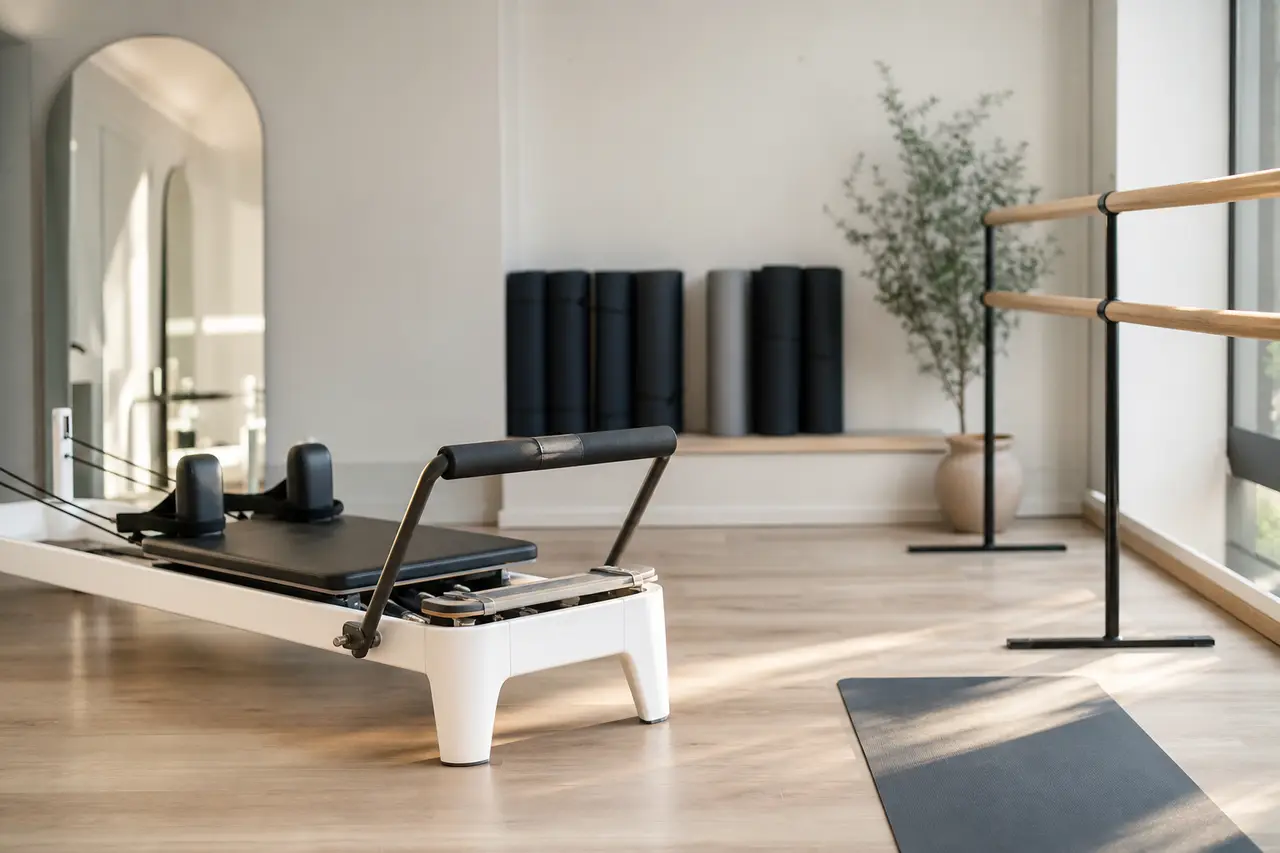
Short answer: None of these build significant strength; the loads are light, and that goal needs a weight room. Within the family, reformer Pilates suits back pain and coming back from injury, barre and Lagree suit conditioning and muscular endurance, and yoga suits stress, sleep and mobility. Machine classes run $30 to $60, mat and barre $20 to $40.
None of these formats builds significant strength, because the loads are light, and that goal needs a weight room. Within the family, reformer Pilates suits back pain and coming back from injury, barre and Lagree suit conditioning and muscular endurance, and yoga suits stress, sleep and mobility. Five formats, one marketing paragraph: yoga, mat Pilates, reformer Pilates, barre, and Lagree all promise long lean muscles, core strength, flexibility, and stress relief, which is why people choose by which studio is nearest and whether they liked the playlist.
The formats genuinely differ, but not along the axis the marketing uses. What separates them is where the resistance comes from, how adaptable each is to an injured body, and how much instruction the format requires.
Start from your goal and the list gets short.
Goal to class format at a glance
| Your goal | Best fit | Why |
|---|---|---|
| Back pain, no red flags | Reformer Pilates | Springs assist as well as resist; spine supported |
| Coming back from injury | Reformer, or a private session first | Most adaptable at the level of individual joints |
| Stress and sleep | Yoga | Breath and stillness are built into the format |
| Mobility and range | Yoga | Longest holds, widest range of positions |
| Muscular endurance, feeling worked | Barre or Lagree | High reps or continuous time under tension |
| Hardest workout in this list | Lagree | Deliberately intense, no rest between exercises |
| Cheapest entry, easiest to walk into | Barre or mat Pilates | No equipment to learn, larger classes |
| Actual strength or muscle | None of these; lift weights | Loads here are light by strength standards |
| Bone density | None of these; loaded resistance work | Needs progressive loading |
What actually separates them?
Where the resistance comes from.
Yoga uses your bodyweight in held positions, with breath and attention as an explicit part of the practice. It is the only one of the five where the mental component is not an afterthought. Our guide on what the yoga evidence supports covers the research, which is strongest for stress, mobility, and back pain.
Mat Pilates uses bodyweight with a focus on controlled, precise movement and core stability. Cheapest and most portable.
Reformer Pilates adds a spring-loaded carriage that both resists and supports you, which is the crucial property. Our comparison of reformer vs mat covers the equipment difference.
Barre uses bodyweight in small, high-repetition, pulsing ranges until the muscle fatigues, borrowed from ballet conditioning. Our guide on what a barre class is like covers the experience.
Lagree runs on a Megaformer, a reformer-derived machine, with slow continuous movement and no rest. It is the most intense of the five. Our guide on what a Megaformer class is like covers it.
Which is best if something hurts?
Reformer, clearly, and get assessed first if there are red flags.
The reformer’s springs can assist a movement as well as resist it, and the carriage supports your spine while you work. That combination makes it uniquely adaptable for people returning from injury or whose back does not tolerate loaded standing work, and it is why reformer work turns up in rehabilitation settings.
Barre and Lagree are harder to modify because they are bodyweight or continuous-tension formats in standing and plank positions. A good instructor offers options; the format itself is less adjustable.
Before any of them, if you have numbness, tingling, weakness, radiating pain, or pain lasting more than six weeks, get assessed rather than booking a class. Our guides on massage vs physical therapy and which bodywork for which complaint cover that boundary, and whether yoga helps back pain covers the evidence for the gentlest option.
The thing none of them do
Build significant strength.
This is the most useful sentence in this guide. The loads in all five formats are light by strength-training standards, and while they build muscular endurance, control, and mobility very well, they do not produce the strength or bone-density adaptations that progressive resistance training does.
That matters most if you are postmenopausal, older, or specifically want to get stronger, in which case a weight room or a properly loaded programme is the answer and these classes are a complement. Our guides on menopause and wellness and starting safely as an older adult cover why loading matters as you age.
The corollary: “long lean muscles” is not a thing. Exercise does not change muscle shape; that is genetics and body composition. Formats that lead with that claim are selling an outcome they cannot deliver.
Which feels hardest?
Lagree, then barre, and neither is the same as effective.
Lagree is deliberately brutal: slow controlled movement, continuous time under tension, no rest. Barre feels intensely hard in the moment through high-repetition burn. Reformer is more technical than gruelling. Yoga varies enormously by style.
Perceived difficulty is a poor proxy for whether something is doing what you want. A hard class you dread and quit after three weeks is worth less than a moderate one you keep doing.
If you tried reformer and found it too gentle, Lagree is the natural step up. Our comparisons of reformer Pilates vs Lagree and barre vs reformer Pilates cover those pairings, and barre vs Pilates and yoga vs Pilates cover the wider choice.
What about cost and access?
Machines cost more, and the pattern is the same everywhere.
Reformer and Lagree run higher because class size is capped by machine count, typically $30 to $60 a class. Barre, mat Pilates, and yoga are cheaper and take more people, roughly $20 to $40.
All five use the same commercial model: a cheap intro offer leading to a membership. Check the cancellation terms before committing, because these are among the harder memberships to exit. Our guides on whether memberships are worth it, how to cancel a wellness membership, and what to do if your studio closes cover the money side.
A ten-class package at an independent studio is usually better value and carries less risk than an annual membership.
How should you actually choose?
Try two, keep the one you will still be doing in three months.
Adherence beats optimisation by a wide margin. The best format is the one whose schedule, room, and culture you will keep turning up to, and that is not something a comparison can tell you.
Use the intro offers to sample two formats rather than committing to one, and go at the time of day you would realistically attend rather than the one that happens to be free.
If you are new and nervous, barre and mat yoga are the easiest to walk into cold, since there is no equipment to learn. Reformer benefits from an intro or private first session. Our guides on your first yoga class, your first Pilates class, and group class vs private session cover getting started.
FAQ: studio class formats
Is hot yoga better than regular yoga? The heat changes how it feels more than what it does. Our comparison of hot yoga vs regular yoga covers it, and sauna vs hot yoga covers the heat load.
Can I combine formats? Yes, and they complement rather than duplicate. Yoga plus a strength session is a better week than two of either.
Do I need grippy socks? For Pilates, barre, and Lagree usually yes. Check before your first class.
Which is best for weight loss? None of them, in isolation. Body composition is driven mostly by diet and overall activity, and any format you do consistently contributes more than the one with the best marketing.
The bottom line on class formats
Sort by goal. Back pain and injury point to reformer, stress and mobility point to yoga, wanting to feel worked points to barre or Lagree, and the cheapest entry points are barre and mat.
Nothing in this list builds significant strength or bone density, because the loads are light, so if that is the goal the answer is a weight room and these are the complement. Beyond that, pick the two you will actually keep attending and let adherence decide.