Cold plunge vs cryotherapy: which is actually better?
One is a tub of cold water, the other is a minus-110°C chamber that costs three times as much per minute. The research comparison is surprisingly one-sided.
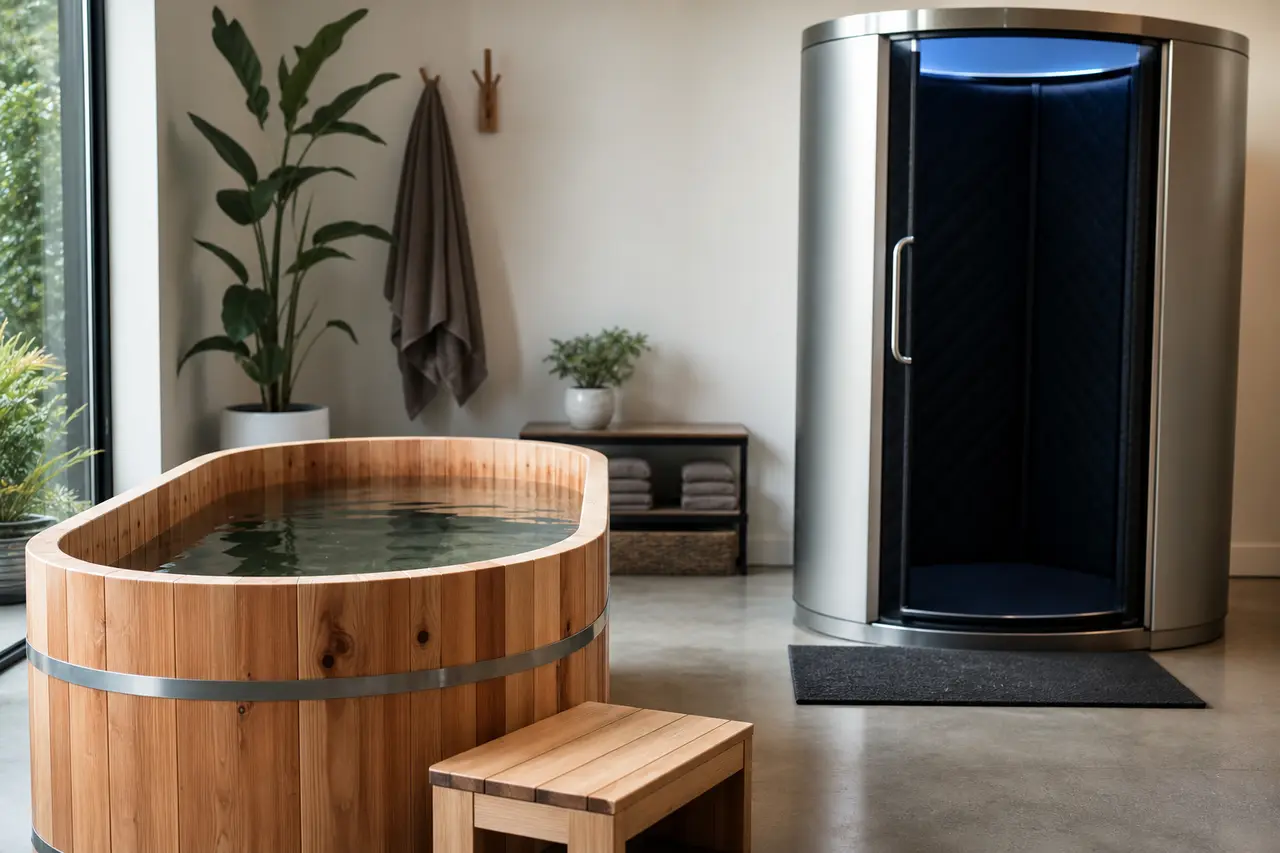
Short answer: Cold plunge, for most people. Cold-water immersion has meaningfully stronger evidence, while a 2015 Cochrane review found insufficient evidence that whole-body cryotherapy reduces muscle soreness at all. A plunge costs $10 to $40 against $40 to $90 for three minutes, and both deliver the same alertness afterglow.
For most people, a cold plunge is the better choice: the research on cold-water immersion is meaningfully stronger than the research on whole-body cryotherapy, a plunge costs less per session, and the water’s actual cooling of the body is part of why it works. Cryotherapy’s three-minute convenience is real, and some people simply prefer dry cold, but you are paying a premium for the version with the weaker evidence.
The counterintuitive part is that the colder-sounding option is the milder one. Water moves heat away from the body roughly 25 times faster than air does, so a tub at 50°F is a stronger stimulus than a chamber at -110°C.
Cold plunge vs cryotherapy at a glance
| Cold plunge | Whole-body cryotherapy | |
|---|---|---|
| Temperature | 39 to 59°F (4 to 15°C) water | -110 to -140°C air |
| Session length | 2 to 5 minutes | 2 to 3 minutes |
| What you wear | Swimwear | Gloves, socks, underwear, and dry skin |
| What actually cools | Whole body, deeply | Skin sharply, core barely |
| Price | $10 to $40, often bundled free with a sauna | $40 to $90, $25 to $50 on a membership |
| Evidence for soreness | Modest but real | A 2015 Cochrane review found it insufficient |
| Home version | Yes, from $150 to a few thousand | No |
| Hardest part | The first 30 seconds | Standing still while your skin stings |
What is each one actually like?
Cold plunge (cold-water immersion): you sit in water somewhere between 39°F and 59°F, typically for 2 to 5 minutes, immersed to the neck or chest. The cold is wet, heavy, and unavoidable, and the first 30 seconds are the hard part, because that is when the cold-shock response produces the gasp. Our guide on how to breathe during a cold plunge covers getting through it, and our temperature and time guide covers where the numbers came from.
Whole-body cryotherapy (WBC): you stand in a chamber of extremely cold air, often -110°C to -140°C, for 2 to 3 minutes, in gloves, socks, and dry skin, because any moisture on the skin is a frostbite risk. It sounds far more extreme, but dry air at those temperatures removes much less heat than cold water; skin temperature drops sharply while core temperature barely moves. Our cryotherapy explainer covers the chambers, and our guide to your first cryotherapy session covers the three minutes minute by minute.
It is intense on the skin and easy on the schedule, which is genuinely the product being sold.
What does the research say, head to head?
This is where the comparison stops being close.
Cold-water immersion has a real, if modest, evidence base: a Cochrane review by Bleakley and colleagues in 2012 found it reduces delayed-onset muscle soreness after exercise compared with rest, and later meta-analyses have broadly agreed the effect exists, albeit small.
Whole-body cryotherapy has the opposite problem. A Cochrane review by Costello and colleagues in 2015 concluded there was insufficient evidence to determine whether WBC reduces muscle soreness at all, and noted the safety data was thin too.
In studies directly comparing the two, cryotherapy has not shown an advantage over cold water; some work suggests immersion cools tissue more effectively, which is presumably the point of the exercise.
Neither is a health intervention beyond recovery and mood. The alertness spike, the catecholamine surge, the “I feel incredible” afterglow, both deliver that reliably, and our cold exposure and dopamine explainer covers what is behind it.
And one honest caveat cuts against both: research by Roberts and colleagues in the Journal of Physiology in 2015 found that routine post-training cold immersion can blunt long-term strength and muscle gains, so if building muscle is the goal, save the cold for rest days. Our guide on whether cold plunging after a workout blunts gains covers the timing that avoids it.
What do they cost in 2026?
A cold plunge session at a US studio typically runs $10 to $40, and it is often bundled free into sauna or contrast sessions, which is worth checking before paying for it separately. Our session cost guide has the fuller picture, including where memberships break even.
Whole-body cryotherapy runs $40 to $90 for about three minutes, with memberships bringing it down to $25 to $50 per visit. Per minute of actual cold exposure, cryotherapy is easily three to five times the price.
At home the gap becomes absolute. A cold plunge scales from a $150 stock tank and bagged ice to a few thousand for a chilled tub, covered in our home setups compared guide. There is no home version of whole-body cryotherapy, and anything sold as one is not the same thing.
How often should you do either?
Two to four times a week is the rhythm most regular users settle into, for either format, and the honest answer is that no trial has established an optimal frequency.
What matters more than frequency is timing around training, because of the strength-gain caveat above, and consistency over weeks rather than intensity in any one session. Chasing colder water or a colder chamber is the most common way people make the practice unpleasant enough to quit.
If you are pairing cold with heat, the sauna is the partner, and our contrast therapy guide covers the rounds. A cryo chamber fits into contrast far less naturally, because you cannot walk from one to the other with wet skin.
Who should skip each one?
Cold is a real cardiovascular stressor. The cold-shock response raises heart rate and blood pressure sharply, so cardiovascular conditions, uncontrolled high blood pressure and pregnancy all mean asking a doctor first rather than trying it and seeing. Our guide on who should avoid cold plunging covers the exclusions properly, and most of them apply to both formats.
Two things are specific to the chamber. Skin must be completely dry, and metal, damp clothing or sweat are how people get frostbite in what is otherwise an uneventful three minutes. And you should not be in one unattended, which is a reasonable question to ask before you book at a studio you do not know.
Two things are specific to the tub. Never plunge alone if you are new to it, and never after alcohol. Cold water plus an impaired ability to get yourself out is the combination that causes actual harm.
When does cryotherapy make sense anyway?
Honest cases exist.
You cannot tolerate cold water, and some people genuinely cannot. You need the two-minute in-and-out because the session has to fit between meetings. You have a skin condition that water or chlorine aggravates. Or you have a membership deal and simply enjoy it, which counts, because consistency beats optimization.
What does not justify the premium is the marketing, which tends to run well ahead of the evidence on metabolism, longevity and fat loss. Our guide on cold exposure and brown fat covers the metabolic claims, and our guide on spotting a nonsense wellness claim covers the pattern.
If the question is simply “which should I try first,” it is the tub.
FAQ: cold plunge vs cryotherapy
Is cryotherapy colder than a cold plunge? The air is far colder, and the cooling is not. Water moves heat away from the body roughly 25 times faster than air, so a 50°F tub is a bigger stimulus than a -110°C chamber.
Which has better evidence? Cold-water immersion. A 2012 Cochrane review supported it for post-exercise soreness; a 2015 Cochrane review found insufficient evidence for whole-body cryotherapy.
How much does cryotherapy cost? Usually $40 to $90 for a two to three minute session, or $25 to $50 a visit on a membership, against $10 to $40 for a plunge.
How long should a cryotherapy session be? Two to three minutes is the standard, and studios will not run them longer. Longer is not the variable that would help.
Can you do cryotherapy every day? Plenty of people do, within the safety exclusions. There is no evidence that daily beats two or three times a week.
Does either help you lose weight? No. The metabolic claims outrun the evidence considerably, and neither is a weight-loss tool.
Is there a home version of cryotherapy? Not a real one. A cold plunge scales down to a $150 tub and bagged ice; whole-body cryotherapy does not scale down at all.
Which is better for sore muscles? The plunge, on the evidence, with the caveat that routine cold right after lifting can blunt strength and muscle gains.
The bottom line on cold plunge vs cryotherapy
Choose the cold plunge: stronger evidence, lower price, a home version that actually exists, and the same afterglow. Save cryotherapy for curiosity, for a genuine intolerance of cold water, or for the days when three minutes is all you have.
If you are starting from zero, our ice bath and cold plunge guide covers safe temperatures and timing for a first session, our cold plunge vs cold shower comparison covers the free version, and our which cold format for which goal hub sorts every option, including the snow room, by what you are after. Then find real venues near you on our city wellness maps.