Craniosacral therapy: what it is, what a session is like, and what the evidence actually shows
One of the gentlest bodywork practices, and one of the most honestly difficult to evaluate. Here is what we know and don't know.
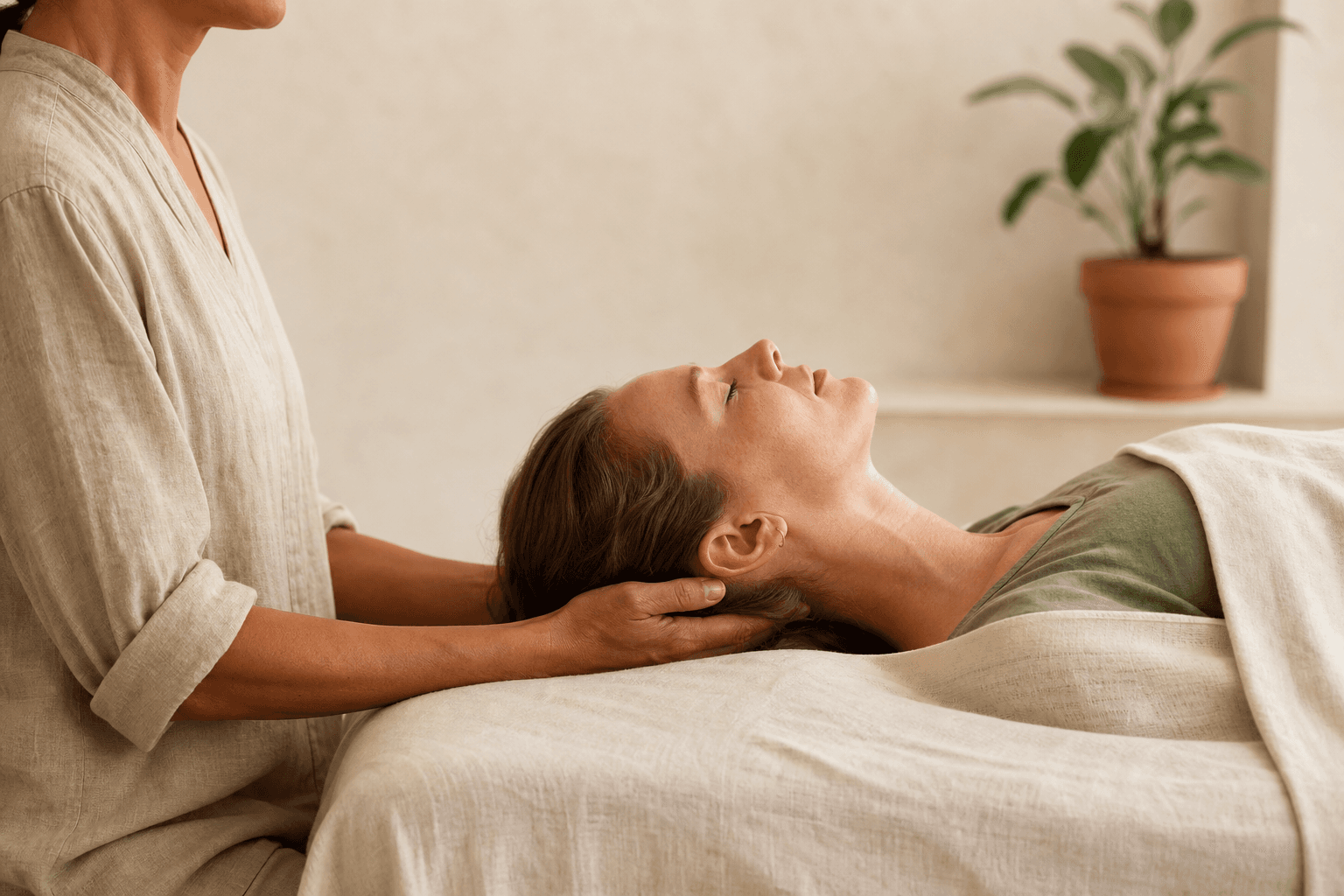
Short answer: Craniosacral therapy is bodywork using extremely light touch, about the weight of a nickel, on the skull, spine and sacrum, fully clothed, usually 60 minutes for $90 to $300. The deep relaxation it produces is real. The craniosacral rhythm it claims to read is not established, and practitioners agree poorly on it.
Craniosacral therapy (CST) sits in a genuinely unusual position in the bodywork world. The experience it offers, feather-light touch, deep stillness, a quality of profound rest many people have never encountered before, is described by practitioners and clients in near-identical terms across decades.
The proposed mechanism behind it, however, is disputed in ways that matter to anyone trying to make an informed decision. This guide does not wave that away.
What craniosacral therapy is
Craniosacral therapy is a form of hands-on bodywork in which a practitioner uses extremely gentle touch, typically described as no more than the weight of a nickel, applied to the skull, spine, sacrum, and surrounding connective tissue. The stated goal is to detect and gently influence what practitioners call the “craniosacral rhythm,” a subtle pulsation they say is distinct from heartbeat and breath, and to release restrictions in the membranes and fluid surrounding the brain and spinal cord.
The system was developed in the 1970s by osteopathic physician John Upledger, building on earlier cranial osteopathy work by William Sutherland in the early 1900s. Sutherland believed the bones of the skull move slightly throughout life and that this movement influences the cerebrospinal fluid (CSF) surrounding the brain and spinal cord.
Upledger expanded this into a formalized therapy with a teachable protocol, founded the Upledger Institute, and trained large numbers of practitioners worldwide.
CST is offered today by osteopathic physicians, physical therapists, occupational therapists, massage therapists, and others with varying levels of training. The Upledger Institute’s foundation courses are the most widely taught.
What a craniosacral session is like
You’ll remain fully clothed and lie on a treatment table, usually on your back. The room is typically quiet and dimly lit, more meditative in feel than a standard massage environment.
The practitioner will place their hands at different points over the course of the session: under the base of your skull (the occiput), along the sides of your head, at the sacrum (the triangular bone at the base of the spine), and sometimes at the feet, midback, or other areas. The touch is genuinely very light, many people are surprised that they can barely feel it.
The practitioner is ostensibly listening for the craniosacral rhythm and gently following or influencing it through subtly directional pressure. Sessions are quiet; you may be encouraged to notice sensations, follow whatever arises mentally or physically, or simply rest.
What people actually experience varies considerably. Some people feel warmth, pulsing, or a sense of movement in the areas being touched. Many feel a deep, unusual relaxation, not the loose heaviness of massage, but something closer to a meditative stillness. Some feel nothing in particular but emerge feeling more rested than when they arrived.
Some people have emotional releases, tears, memories, a sense of shifting, particularly if they come with trauma histories. Others experience nothing beyond a quiet lie-down.
Sessions typically run 60 minutes.
What the evidence says about CST
Here is the honest part, and it matters: the scientific evidence for craniosacral therapy is weak and contested in ways that parallel reiki and energy work, the experience is real, but the proposed mechanism has significant problems.
- Reasonable evidence for: CST appears to consistently produce a relaxation response, reduced heart rate, self-reported calm, parasympathetic activation. This is meaningful even if the mechanism is different from what practitioners claim. Some small studies and case reports support its use for reducing headache frequency in certain populations, and for reducing anxiety.
- Debated or mixed: Studies on CST for back pain, neck pain, and fibromyalgia show some positive results but are generally small, methodologically limited, and difficult to blind (since “sham CST” is hard to design convincingly). A Cochrane-style systematic review of CST for various conditions found that higher-quality studies generally show weaker effects, and the overall evidence is insufficient to recommend it as a treatment for specific conditions. Several well-designed inter-rater reliability studies, testing whether two practitioners independently measuring the “craniosacral rhythm” in the same patient agree, found poor agreement, which is a significant problem for the mechanism claim.
- Not established / overstated: The existence of the craniosacral rhythm as a distinct, detectable physiological phenomenon separate from heartbeat and breath has not been convincingly established. The claim that practitioners can reliably detect and influence CSF movement through light external touch is not supported by the best available evidence. Applications marketed for infant colic, childhood developmental conditions, autism, PTSD resolution, and serious neurological conditions go well beyond what evidence supports.
This is not a reason to dismiss the experience. What the relaxation response and a careful, unhurried hour of skilled touch provide is genuine, similar to what we see in somatic experiencing and TRE and other gentle somatic modalities. The honest position is: the session may give you something real; the proposed reason for how it works is not established.
Benefits people report from craniosacral work
People who try CST frequently describe:
- Unusual depth of relaxation, a quality of stillness that they find distinct from other bodywork
- Reduced headache frequency, including tension headaches and some migraine sufferers
- Improved sleep following sessions
- A sense of reduced mental “noise” or overwhelm
- Emotional shifts, a feeling of having processed something, often without being able to articulate exactly what
- Reduced jaw tension, face and neck pain in some individuals
- A gentler path to bodywork for people who are touch-sensitive, trauma survivors, or unable to tolerate more pressure-based modalities
These reports are real experiences. They deserve to be taken seriously while also being understood in the context of what is and isn’t evidenced.
Who CST is for, and who should skip it
CST may be worth exploring if you are highly stress-reactive, have difficulty with more active or pressured bodywork, are drawn to somatic or mindfulness-adjacent practices, or are dealing with headaches or nervous-system dysregulation and want a very gentle complement to your existing care.
Approach cautiously or avoid if you have:
- Recent skull fracture, traumatic brain injury, or active cranial conditions, the area of work is the skull and spine; any practitioner should be informed
- Severe psychiatric conditions without clinical guidance, the emotional depth of some CST sessions can be destabilizing for some people; coordinate with your mental health provider
- Blood clots, aneurysm, or vascular conditions affecting the brain or spine, consult your neurologist before booking
- Active infection in the central nervous system (meningitis, encephalitis)
- Recent spinal surgery, get clearance from your surgeon
Talk to your doctor if you have any neurological, vascular, or serious spinal condition before exploring CST.
For trauma-related applications specifically, clinically-supervised somatic modalities like somatic experiencing and TRE have a more developed evidence base and clearer practitioner training standards.
What a craniosacral session costs
CST is typically priced at or above the level of standard massage therapy:
- 60-minute session with a massage therapist trained in CST: $90, $150
- Session with a physical therapist or occupational therapist offering CST: $100, $200 (sometimes insurance-covered when part of a broader physical therapy plan)
- Session with an osteopathic physician: $150, $300+
- Retreat add-on or intensive: $120, $200 for a standard session
The practitioner’s primary credential matters for pricing: an osteopathic physician charging $250 is priced differently than a massage therapist who completed a weekend CST course. That distinction also matters for what you’re getting.
How to choose a good CST practitioner
CST training ranges from comprehensive (osteopathic physicians who studied cranial osteopathy) to a 2-day weekend workshop (offered to massage therapists with no prior training). The Upledger Institute’s curriculum goes from CST 1 (introductory, 24 hours) through advanced programs, with a practitioner certification requiring significantly more training. Ask specifically:
- What is their primary professional credential (LMT, PT, OT, DO)?
- How many hours of CST-specific training have they completed?
- Have they worked with people in situations similar to yours?
Be appropriately skeptical of practitioners who make specific medical claims, that CST will treat your child’s ear infections, resolve PTSD, or cure migraines. A practitioner who is clear-eyed about the limits of the evidence while still offering the session honestly is a better sign than one making dramatic promises.
Red flags: guaranteed cure language, claims that CST corrects neurological disease, or practitioners who conflate CST with energy healing without acknowledging the distinction.
FAQ: craniosacral therapy
Is there a real “craniosacral rhythm”? Practitioners believe they can feel a subtle pulsation distinct from heartbeat and breathing that reflects cerebrospinal fluid movement. Scientific testing of whether practitioners reliably agree on what they detect in the same patient has generally found poor agreement. The existence and clinical relevance of this rhythm as practitioners describe it is genuinely debated, this is the central scientific controversy around CST.
Is craniosacral therapy similar to reiki or energy healing? There is a family resemblance: both involve very gentle touch, deep quiet, and proposed mechanisms that are not confirmed by mainstream science. CST, however, has an anatomical rationale, it claims to work on actual physical structures (cerebrospinal fluid, cranial bones, dural membranes), rather than an energetic field. The practical experience of a session has similarities to what you’ll read in the reiki guide, but the theoretical frameworks are distinct.
Can CST help with infant colic or baby issues? CST is widely marketed for infants, particularly after difficult births. The evidence is very limited, and pediatric application requires specific training. If considering this for a child, consult your pediatrician first and work only with a practitioner with documented pediatric CST experience.
How many CST sessions does it take to feel a benefit? Practitioners commonly recommend a series of 3, 6 sessions to assess whether CST is resonating for you. Some people report feeling something meaningful in the first session; others require several before noticing a difference. If after 3, 4 sessions you feel nothing and notice no change, it may simply not be the right modality for you.
The honest summary on craniosacral therapy
Craniosacral therapy produces real experiences, often profound relaxation, occasional emotional release, and sometimes meaningful reduction in headache and stress symptoms. The proposed mechanism (influencing cerebrospinal fluid via light touch on the skull) is not well-supported by rigorous science, and the inter-rater reliability problems are a genuine issue for the theory.
What you are most likely receiving is the benefit of a skilled, attentive, extremely gentle somatic session in a calm environment, and that has genuine value, even if the explanation on the brochure doesn’t hold up to scrutiny.
Go in with realistic expectations, find a practitioner who is honest about the evidence, and treat it as a complement to care, not a replacement for it.