Thai massage & bodywork: a guide to the main styles and what each is for
Thai, deep tissue, Swedish, sports, lymphatic, how they differ and which to book.
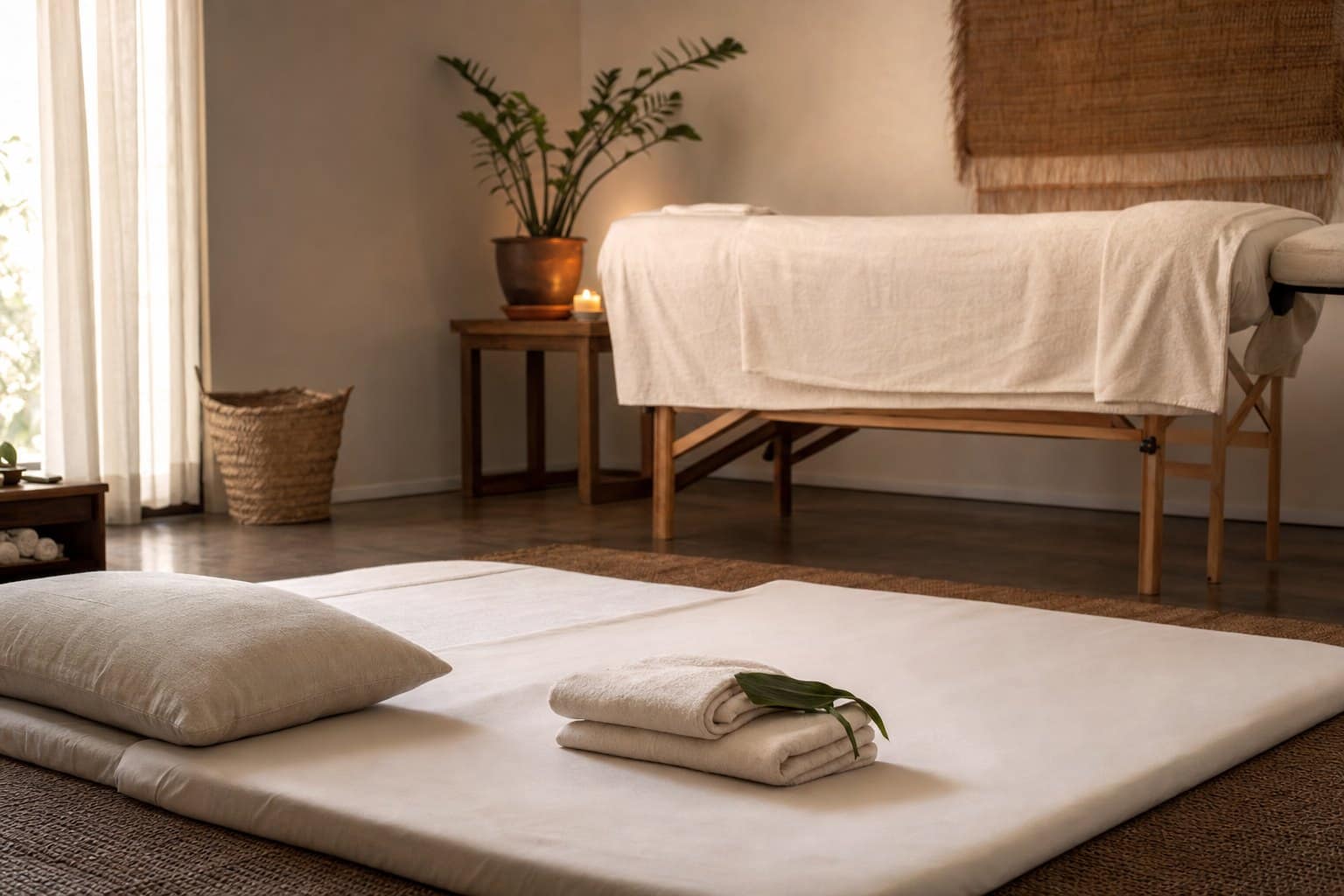
Short answer: Thai massage is assisted stretching and rhythmic compression, done fully clothed on a floor mat with no oil, for 60 to 120 minutes. Book it for stiffness and restricted mobility; Swedish for relaxation, deep tissue for chronic knots, sports around training, lymphatic drainage for swelling with medical clearance.
“Massage” is a single word covering at least a dozen meaningfully different experiences. Book the wrong style and you may leave sore when you wanted relaxation, or floaty when you needed your knots addressed. Getting the right fit starts with knowing what each method is actually designed to do, and what it won’t.
What it is
Thai massage is the most distinctive of the major styles: it’s done fully clothed on a floor mat rather than a treatment table, involves no oil, and combines rhythmic compression, acupressure along traditional energy lines (sen lines), and assisted passive stretching.
The practitioner uses hands, forearms, elbows, knees, and feet to move your body through a series of positions that feel, from the inside, like a guided, unhurried yoga session where someone else does most of the work. Sessions typically run 60, 120 minutes.
Traditional Thai massage originates in Thailand and is attributed to Jivaka Kumar Bhaccha, a physician in ancient India. It has been practiced for over 2,500 years and remains one of the most complete bodywork systems in the world, addressing joint mobility, muscular compression, and breath together rather than focusing on muscles alone.
What a session is like
You arrive dressed in comfortable, loose clothing. You lie on a padded mat on the floor while the practitioner works systematically from feet to head, applying rhythmic thumb pressure along the sen lines, mobilizing each joint with slow, confident movements, and using their body weight rather than brute strength for compression.
There is typically no conversation during the work itself, the session has a meditative quality for both practitioner and client.
The stretches progress: from gentle hip openers and hamstring releases early in the session to spinal twists, shoulder opening, and sometimes dramatic-feeling backbends by the end. A good practitioner monitors your breathing throughout, deepening the stretch on the exhale, backing off if you’re holding tension. The overall effect is less like being kneaded and more like being rearranged into ease.
Post-session, clients typically describe feeling simultaneously lighter and more grounded, with noticeably improved range of motion. Some residual tenderness in worked areas is normal, especially for first-timers or anyone with chronic tension.
The main bodywork styles compared
- Thai massage, clothed, floor mat, compression plus assisted stretching. Best for: stiffness, low energy, restricted mobility, or anyone who prefers active engagement over passive table work.
- Swedish massage, table work with oil, long gliding strokes (effleurage), kneading, and light percussion. The classic relaxation massage. Best for: general stress relief, introductory massage, and anyone who finds deep work too intense.
- Deep tissue, slower, more targeted pressure penetrating past the superficial muscle layer to address chronic tension, adhesions, and knots. Can be uncomfortable during the session; some post-session soreness is normal. Not synonymous with “as hard as possible”, a skilled deep-tissue therapist uses technique, not just force. Best for: chronic muscle tension, training soreness, postural strain.
- Sports massage, structurally similar to deep tissue but goal-specific: pre-event (activating, lighter), post-event (flushing, recovery), or maintenance (identifying and addressing tension patterns). Best for: athletes with training loads, those with sport-specific muscle use.
- Lymphatic drainage, extremely light, rhythmic, slow strokes following the lymphatic system’s anatomy. Feels almost imperceptibly gentle compared to other massage. Best for: post-surgical swelling, lymphedema management, immune support. Requires medical clearance for post-surgical applications.
What the evidence says
- Reasonable evidence for: Massage broadly reduces perceived pain, muscle tension, and stress markers (including cortisol and heart rate). There is good evidence for reduced lower-back pain, improved short-term range of motion, and faster recovery from delayed-onset muscle soreness. Thai massage specifically has several small-to-medium RCTs showing improvements in back pain, shoulder tension, and anxiety compared to rest or sham controls.
- Debated or mixed: Whether massage has durable structural effects on muscle adhesions or fascial tissue (versus temporary changes in nervous system tone and perceived tension) remains debated. The mechanism may be more neurological than mechanical, the effects are real, but the explanation is less settled than it’s often presented.
- Not established / overstated: Massage as a “detox” mechanism, the liver and kidneys handle metabolic waste, and massage does not meaningfully enhance their function. Claims that specific massage styles can treat structural disc problems, nerve impingement, or internal organ dysfunction are not supported.
Benefits people report
Beyond the obvious tension relief and relaxation, regular massage clients (particularly those with Thai or deep-tissue work as part of a training routine) report: sustained improvement in posture and range of motion over months; reduced frequency of tension headaches; faster recovery from athletic training; improved sleep quality; and a generally heightened awareness of where they carry habitual tension. Several people describe Thai massage in particular as one of the few experiences that makes them feel comprehensively worked-on, addressed from feet to head rather than spot-treated.
Who it’s for, and who should skip it
Good fit for: Anyone carrying chronic muscular tension; people whose work or training creates repetitive strain; those returning from athletic activity; people who prefer clothed or active bodywork (Thai); anyone wanting to build massage into a recovery or wellness routine.
Related approaches: For a deeper dive into the pressure-point philosophy underlying Thai work, shiatsu-massage-explained explores a closely related Japanese tradition working the same meridian-based framework. If you’re specifically dealing with training soreness or athletic recovery, deep-tissue-and-sports-massage-explained covers that end of the spectrum in more detail. reflexology-explained shares Thai massage’s focus on mapped pressure points and systemic response, applied exclusively to the feet and hands.
Approach with care or get clearance: Active inflammation, fever, open wounds, skin infections, blood clots or deep-vein thrombosis history (particularly for deep or compression work), recent surgery (lymphatic drainage may be appropriate with clearance; other styles usually not), osteoporosis (Thai stretching requires modification), and pregnancy (prenatal-trained practitioners can work safely in second and third trimester, but standard Thai stretching is not appropriate). Hypermobility belongs on that list too, and our guide to hypermobility and Ehlers-Danlos explains why leverage into range is the problem.
Honest note: Massage is a recovery and maintenance tool, not a cure for structural problems. If you have an injury that isn’t resolving, get a proper medical or physiotherapy assessment first, bodywork complements, it doesn’t replace, structural diagnosis.
What it costs
In the US, a 60-minute Swedish or deep-tissue session typically runs $70, $130 at a day spa or wellness center; $50, $90 at a dedicated massage therapy studio. Thai massage ranges from $60, $120 for 60 minutes at Thai-specific studios, sometimes higher at wellness hotels. Sports massage from a certified therapist averages $80, $140.
Lymphatic drainage is often priced higher ($100, $180) due to specialized training requirements. Membership models ($50, $80/month) at chains like Massage Envy bring costs down significantly for regular clients.
How to choose a practitioner
For Thai massage, look for practitioners trained in Thailand or through recognized lineages (Chiang Mai school, Sunshine Network, or similar). For deep tissue and sports, seek Licensed Massage Therapists (LMT) with documented additional training in the specific technique. For lymphatic drainage, the CLT (Certified Lymphedema Therapist) credential indicates proper training.
Ask about their experience with your specific concern before booking, a generalist may do fine for relaxation but a specialist matters for rehab, athletes, or medical indications. And communicate during the session: telling your therapist “a little less pressure there” or “that’s exactly the right spot” makes the session substantially more effective.
FAQ: thai massage & bodywork
Is Thai massage painful? Discomfort during compression and at the edge of a stretch is normal, a dull, satisfying ache in tight areas. Sharp pain, nerve sensations, or bruising are not normal and mean pressure or positioning needs to adjust. Speak up immediately if something feels wrong rather than enduring it.
How often should I get massage? For general maintenance and stress management, most people find monthly sessions sufficient. For active training, injury recovery, or chronic tension, bi-weekly sessions produce faster progress. Daily or multiple-times-weekly massage exists (at high-end retreats or in competitive athletics) but is not necessary and may cause desensitization.
Can I combine massage styles in one session? Yes, and many skilled therapists integrate elements naturally. A session that opens with Swedish-style effleurage, addresses specific knots with deep-tissue technique, and closes with some Thai-influenced joint mobilization is a coherent session, not a confused one. Tell the therapist your goals and let them sequence appropriately.
What should I do after a session? Hydrate well. Avoid intense exercise immediately after deep work. Plan for some quiet time if possible, the relaxation response is worth letting settle rather than rushing back into stimulation. Mild soreness 12, 24 hours after deep tissue or Thai work is normal and typically resolves faster with gentle movement than with rest.
The honest summary
Thai massage and bodywork styles are genuinely effective tools for what they’re designed to do, and being honest about that design is the key to satisfaction. Relaxation: Swedish. Chronic knots and training recovery: deep tissue or sports. Stiffness, mobility, and full-body reset: Thai. Lymphatic support with medical indication: drainage.
A good therapist adjusts to you regardless of style, speak up about pressure, preferences, and problem areas, and the session will be far better than one spent politely enduring the wrong approach.