Do weighted blankets actually work? What the evidence says
The idea is oddly convincing: heavy blanket, calmer body, better sleep. The research is real but modest, mostly about how you feel rather than how you sleep, and one detail decides whether it is safe for you at all.
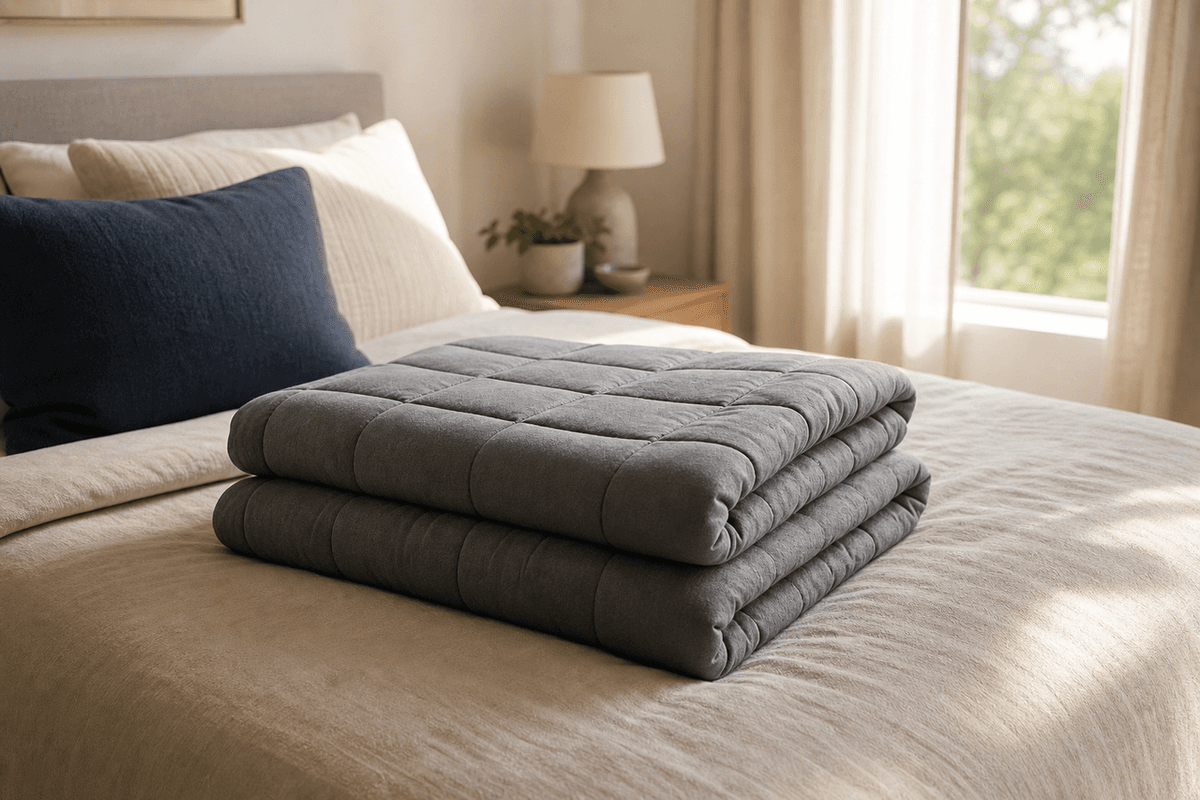
Short answer: Yes, modestly, and mostly for calm rather than for measurably better sleep. The evidence supports reduced anxiety and a stronger feeling of having slept well; objective changes to sleep itself are weaker. The proposed mechanism is deep touch pressure. Choose roughly ten percent of your body weight, and check the exclusions first.
Yes, modestly, and mostly for calm rather than for measurably better sleep. The better evidence shows weighted blankets can reduce anxiety and help people feel more relaxed and that they slept better. The evidence that they objectively change your sleep, how long or how deeply you actually sleep, is weaker.
That is not a dismissal. Feeling calmer and falling asleep more easily is a real benefit, and for anxious or restless people a weighted blanket can genuinely help. It just works more on the nervous system and the subjective experience than on your sleep architecture.
For most people it is a low-risk thing to try. For a few, it is one to avoid, which is the part worth reading.
How is it supposed to work?
Through deep touch pressure calming the nervous system.
The theory is deep touch pressure, or deep pressure stimulation: firm, even, gentle pressure across the body appears to shift the nervous system toward its calmer, rest-and-digest state, lowering arousal. It is the same principle behind a firm hug, swaddling an infant, or the calming pressure devices used with some anxious people and animals.
A weighted blanket applies that broad, even pressure while you lie under it, which is meant to downshift a keyed-up nervous system toward relaxation and sleep.
The mechanism is plausible and consistent with how deep pressure affects the body. Whether it delivers a large effect in practice is the honest question, and there the answer is modest.
What does the evidence on weighted blankets show?
Decent for anxiety, softer for objective sleep.
The stronger findings are around anxiety and calm. Studies have found weighted blankets can reduce self-reported anxiety, and a randomized trial by Ekholm and colleagues (2020) in people with insomnia and psychiatric conditions found the weighted blanket group reported better sleep and less daytime fatigue than a control blanket.
The pattern across the research is that people consistently feel calmer and report sleeping better, while objective measures of sleep show smaller or less consistent changes. So the reliable effect is on subjective experience and anxiety, and the objective-sleep effect is weaker.
For a tool whose main job is helping you feel calm enough to sleep, that is a reasonable result. Just hold the claim as modest-and-real, not dramatic. Our recovery trackers guide covers the same gap between feeling and measuring.
How do you choose the right weight?
Around ten percent of your body weight is the usual guide.
The common recommendation is a blanket roughly ten percent of your body weight, so about 15 pounds for a 150-pound adult, give or take. It should feel like reassuring, even pressure, not like being pinned or struggling to move.
Too light and you feel nothing meaningful, too heavy and it becomes uncomfortable or restrictive rather than calming. If you are between weights, sizing down is usually the safer choice for comfort.
Comfort is individual, so if you can try one before buying, do. And if it makes you feel trapped or too hot rather than soothed, it is simply not for you, which is common and fine.
Who should avoid a weighted blanket?
Several groups, and this matters more than the benefits.
Do not use a weighted blanket for young children, especially infants and toddlers, because of the genuine risk of suffocation and entrapment if they cannot move out from under it. This is the most important caution.
Adults with certain conditions should check with a doctor first, including sleep apnea or other breathing disorders, low blood pressure, poor circulation, claustrophobia, or any condition that limits your ability to move the blanket off yourself. If you cannot easily remove it, it is not safe for you.
For a healthy adult who finds the pressure comforting, it is low-risk. But the safety cautions are the part not to skim. Our practitioner credentials guide is a reminder to take real sleep or breathing problems to a clinician.
Is it worth buying?
For the right person, yes, as a low-cost calming aid.
If you are anxious, restless at bedtime, or find firm pressure soothing, a weighted blanket is a reasonable, one-off purchase with modest real evidence behind it, and no ongoing cost. It is closer to a comforting sleep aid than a treatment.
What it is not is a cure for insomnia or a substitute for addressing anxiety or a sleep disorder properly. If your sleep or anxiety is genuinely disruptive, that deserves real attention beyond bedding. Our sleep-related sauna guide covers another gentle sleep lever, and neither replaces good sleep habits.
Treat it as a pleasant, plausible aid you might love, not a guaranteed fix.
The bottom line on weighted blankets
Weighted blankets have modest but real evidence for reducing anxiety and helping you feel you sleep better, with weaker evidence for objectively changing sleep. Choose around ten percent of your body weight, and never use one with young children or if you cannot easily move it off.
For an anxious or restless adult, it is a low-risk thing to try. Just keep expectations calm-sized, not miraculous.
To find calming wellness options near you, start with our city wellness maps.
Two more objects sold on the same promise get the same treatment: acupressure mats and mouth taping, where the safety picture matters more than the benefit claim.