Do acupressure mats actually work? The honest answer
A plastic mat covered in thousands of small spikes, sold on ancient theory and sleep claims. The sensation is real and reliable. The research behind the claims is small, weak, and mostly unblindable.
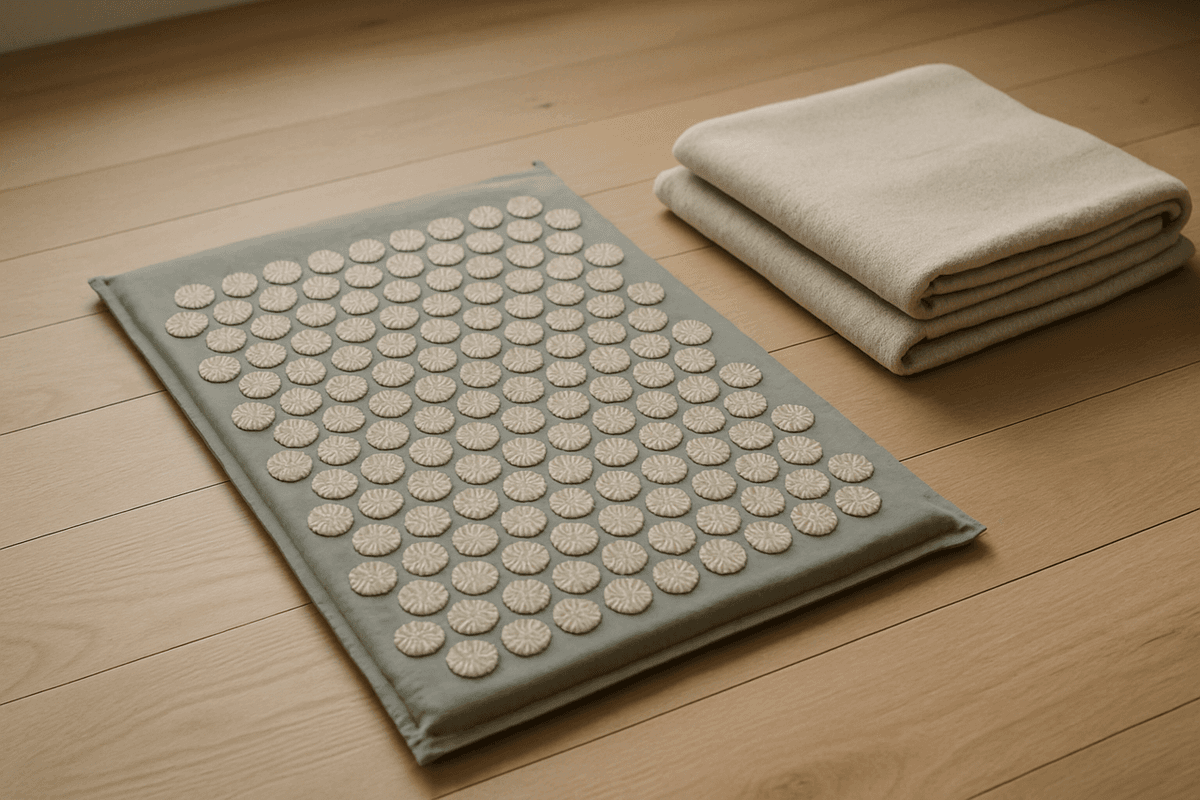
Something happens, and it is not the something on the box. Lie on an acupressure mat and you get a strong, consistent sensory experience: sharp and slightly alarming for a few minutes, then a spreading warmth, then a distinctly relaxed feeling when you get up. Almost everyone reports a version of it.
What is not reliable is the evidence underneath the claims. There are a handful of small trials on back pain and on sleep, generally without credible blinding, with mixed results. That is a thin base, and dressing it up would be dishonest.
So the verdict sits in an unusual place. The mat is a legitimate relaxation tool with a fanciful explanation attached, and at this price the risk of trying it is mostly your first five minutes.
What actually happens when you lie on one
Intense, then warm, then calm, in a predictable arc.
The mat is foam or cotton studded with hundreds of small plastic discs, each ringed with sharp points. Your weight spreads across thousands of contact points, so no single spike breaks skin, but the combined pressure is intense at first.
Most people describe the first two to five minutes as the hard part. Then the sharpness fades into heat, as skin blood flow to the pressed area rises and your back looks pink and feels flushed.
The end state is what people come back for: a heavy, loose, slightly buzzy relaxation. It is real and repeatable, and it is the strongest thing this product has.
What the research does and does not show
Little of it, small, and hard to blind.
The published work on acupressure mats is limited. There are small studies on nonspecific back pain and on sleep quality, and the picture is mixed rather than convergent.
The deeper problem is structural. You cannot blind a participant to a bed of spikes, so everyone knows which group they are in and expectation does unmeasured work in every result. Our guide on spotting a nonsense wellness claim covers why unblindable comfort interventions produce the most flattering numbers.
That is not a verdict of “does nothing.” It is a verdict of “we cannot say how much, or beyond what a pleasant twenty minutes would do anyway.”
Acupressure mat claims at a glance
| Claim | What the evidence supports | Verdict |
|---|---|---|
| Feels intense, then warm, then relaxing | Consistently reported by users | Reliable |
| Increases blood flow to the skin under it | Visible flushing, immediate | Supported, local and short-lived |
| Helps you relax or wind down | Consistent with a relaxation response | Plausible, mechanism is ordinary |
| Eases nonspecific back or neck tension | A few small trials, mixed, unblinded | Weak, possible |
| Improves sleep | Small studies, inconsistent, unblindable | Weak |
| Works by stimulating acupressure points | Points are not selectively targeted | Not supported |
| Releases toxins or drains lymph | No credible evidence | Not supported |
| Treats or cures a medical condition | Nothing supports this | Not supported |
The acupressure framing versus the plain explanation
The plain explanation is better, and it does not need the theory.
Traditional acupressure claims to work by pressing specific points along specific channels, chosen for a specific complaint. Whatever you make of that framework, a mat does not do it. It presses the whole surface of your back indiscriminately, with no selection at all.
The ordinary explanation covers everything people report. Intense but harmless sensory input floods your attention. You are forced to lie still for twenty minutes, which most of us never do on purpose. Then a relaxation response follows. That is enough.
This is the same argument we make about Epsom salt baths and about hot springs: the practice is worth doing, and the proposed mechanism is the overclaimed part. For the theory on its own terms, our explainers on acupuncture, shiatsu massage, and ear seeding are better places to look, because those involve a practitioner choosing where to press.
Detox and lymphatic drainage claims deserve no hedging at all, for the reasons in our piece on the lactic acid myth.
How to use one if you decide to try
Short sessions, build tolerance, let it be boring.
Most people start on a bed or carpet with a thin t-shirt between skin and spikes, then work down to bare skin as tolerance builds. Lowering yourself flat and staying still is far more comfortable than shifting around.
Ten to twenty minutes is the range people settle on, and longer is not better. It works best as an evening wind-down cue, not a treatment session. Some use the pillow attachment for the neck and shoulders, though our guide for desk workers covers cheaper habits that do more.
Expect the first session to be unpleasant and the third to be fine. If it is still awful after several attempts, it is not for you.
Who should check with a clinician first
Anything involving skin, sensation, or clotting.
Check first if you have broken, irritated, or infected skin, a rash, or any wound in the contact area. Check first if you have poor circulation or reduced sensation, especially diabetic neuropathy, because the safety argument rests entirely on feeling what is happening to your skin.
Also worth a conversation: bleeding disorders or blood thinners, since bruising and skin breaks matter more, and pregnancy, where the advice is to ask rather than assume. Never let a child use one unsupervised.
None of this is medical advice, and the list is not exhaustive. It is a cheap product with a real physical edge, and anyone it is unsuitable for should know that.
What to do instead, depending on your goal
Match the tool to the outcome.
For falling asleep more easily, a weighted blanket has a better, though still modest, evidence base for that claim specifically. For persistent back pain rather than end-of-day tension, that belongs with a clinician.
For recovery after training, our weekly recovery routine guide puts sleep and easy movement ahead of every purchase, and whether vibration plates actually work covers the other home device sold on stretched research.
For feeling better without spending money, our list of wellness that costs nothing delivers most of what twenty still minutes deliver, minus the spikes.
FAQ: acupressure mats
Does an acupressure mat actually relieve back pain? Possibly, for ordinary end-of-day tension, but the evidence is weak. The few small trials are mixed and cannot be blinded, so the mat cannot be separated from relaxation and expectation. Persistent back pain belongs with a clinician.
Is a Shakti mat different from a generic acupressure mat? Shakti is the brand name most people search for, which is why the branded and generic terms both exist. We have not tested any mat and we only recommend what we would send a friend to, so we make no brand pick. Mats differ in spike count, sharpness, and filling, which changes comfort more than mechanism.
How long should you lie on an acupressure mat? People typically land between ten and twenty minutes. Start shorter, keep a shirt on at first, and build up. There is no evidence that longer sessions do more.
Does it release toxins? No. Nothing about lying on plastic spikes removes anything from your body. The warmth and flushing are increased blood flow to the skin, a local circulatory response, not a detox process.
The bottom line on acupressure mats
An acupressure mat reliably produces a strong sensory experience that ends in genuine relaxation, and that is worth something. What it lacks is a research base capable of supporting the pain, sleep, or detox claims printed around it, and the acupressure framing does not survive contact with how the product works.
Call it what it is: an unusually cheap way to make yourself lie still for twenty minutes while your nervous system downshifts. Buy the experience, not the theory.
To find recovery studios and wellness venues near you, start with our city wellness maps.