Red light & infrared therapy: what the science supports (and what it doesn't)
Photobiomodulation, panels, and infrared saunas, separating the real benefits from the hype.
Short answer: Red light therapy uses 630 to 850nm light absorbed by cells, and the modest evidence covers skin texture, muscle soreness, pattern hair loss and some osteoarthritis pain. Fat loss, detox and hormone claims are not supported. It is not an infrared sauna, which works by heat, and results need eight to twelve weeks.
Red light therapy has become one of the fastest-growing categories in wellness devices, and one where the marketing has badly outrun the science. The actual research is genuinely interesting in a few narrow areas. The sweeping claims about detox, fat loss, and hormonal optimization are not. Here’s the grounded version of both.
What red light therapy is
Red light therapy (also called photobiomodulation or low-level laser therapy) uses specific wavelengths of red and near-infrared light, typically in the 630, 850nm range, delivered via panels, handheld devices, or treatment beds. At these wavelengths, light penetrates the skin at varying depths and is absorbed by mitochondria in cells, which may stimulate energy production (ATP synthesis) and reduce inflammatory signaling.
This is mechanistically distinct from an infrared sauna, which uses infrared heat to raise core body temperature and induce sweating, the mechanism there is thermal, not photochemical. Some facilities combine both in one unit, which creates marketing confusion. If the claim is about cellular light absorption, that’s photobiomodulation.
If it’s about sweating and heat response, that’s the sauna. See our therapeutic sauna guide for what the heat side of the equation actually does.
The wavelength and power density of the device matter enormously. Consumer panels sold online vary widely in actual output, and many underdose at the claimed distance.
What a red light session is like
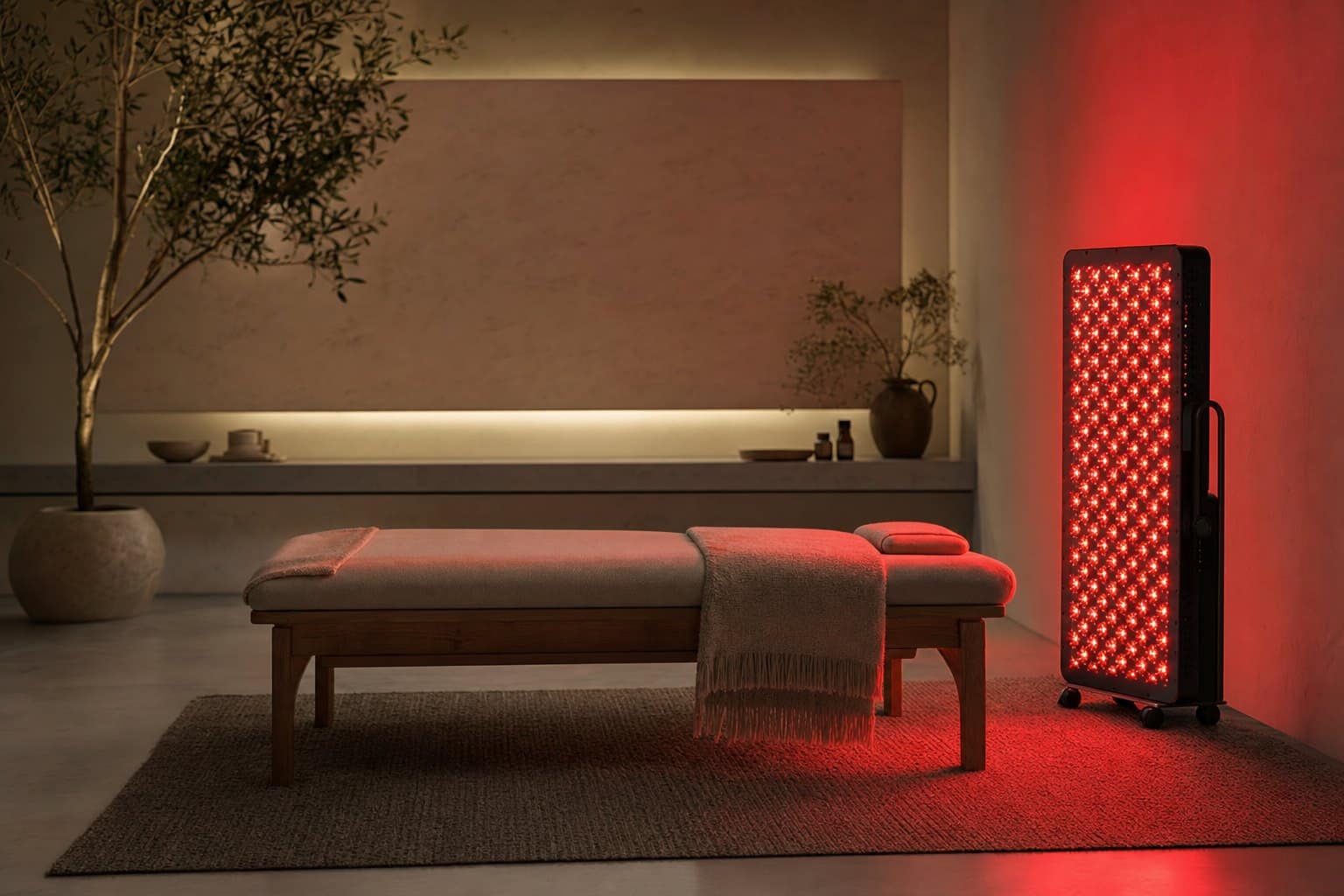
In a dedicated wellness space or spa, a red light therapy session typically runs 10, 20 minutes. You stand or lie a specific distance from the panel (typically 6, 24 inches depending on the device’s instructions and the target area), with skin exposed to the light.
Eye protection is usually provided or recommended, especially for facial treatment. There’s no heat sensation, no sensation at all in most cases, just the visual glow of the panel.
At-home panels are used the same way, typically once daily or every other day, over several weeks. Results, when they occur, are gradual, not immediate. The session itself is passive: you’re not sweating, exercising, or doing anything that “feels like” wellness is happening. That absence of sensation is one reason the category attracts exaggerated marketing, the device has to fill the gap.
What the evidence says about photobiomodulation
- Reasonable evidence for: Improved skin texture, mild fine lines, and superficial wound healing in controlled trials; modest reduction in muscle soreness and faster recovery after exercise (several meta-analyses support this, though effect sizes are moderate); some positive evidence for specific FDA-cleared devices treating androgenetic alopecia (pattern hair loss); potential for reducing joint pain in osteoarthritis, with mixed but generally positive trial outcomes.
- Debated or mixed: Optimal dosing parameters (wavelength, power density, session duration, skin distance), much of the research uses inconsistent protocols, making cross-study comparisons difficult; whether effects from clinical-grade devices translate to consumer panels; how meaningful the anti-inflammatory effects are compared to exercise, sleep, or nutrition changes.
- Not established / overstated: Fat loss or body contouring (a few low-quality studies exist; the mechanism is not established and the effect sizes are clinically meaningless); “detoxification” (red light doesn’t move toxins; that’s largely a made-up mechanism in this context); testosterone or hormone optimization beyond speculative animal studies; treating serious diseases including cancer; the “mitochondrial supercharging” framing used in most marketing copy goes well beyond what any individual study shows.
Benefits regular users report
Regular red light users, particularly those using it consistently for skin or muscle recovery, report: reduced post-workout soreness and faster return to training; gradual improvement in skin tone and fine lines over 8, 12 weeks of consistent use; some reduction in localized joint stiffness. These match reasonably well with the research signal.
The people most satisfied tend to be those with clear, limited goals (skin texture, recovery) rather than those chasing systemic transformation.
Who red light is for, and who should skip it
Red light therapy is low-risk for most healthy adults when used as directed. It’s a reasonable add-on for: people focused on skin health who want an evidence-adjacent option beyond topicals; athletes using it as a recovery complement alongside cryotherapy or other modalities; those with mild joint pain who want a passive, side-effect-minimal tool.
Avoid or get medical clearance first if you: have active cancer or a history of photosensitive conditions; take photosensitizing medications (certain antibiotics, retinoids, NSAIDs); have thyroid conditions and plan to target the neck area; are pregnant (insufficient safety data). Always use eye protection, staring directly into high-power near-infrared LEDs can cause retinal damage.
Red light therapy does not replace hyperbaric oxygen therapy for serious wound healing or recovery indications, those are entirely different mechanisms and evidence categories, and HBOT operates under medical supervision for a reason.
What panels and sessions cost
Spa or wellness center session: $25, 75 per session. At-home consumer panel (mid-range): $200, 600 for a panel treating a few body areas. Full-body panels: $1,000, 3,000+. Clinical-grade devices: $5,000, 30,000+ (these are what most research uses). The gap between research-grade and consumer-grade is real and often underdisclosed. Most consumer panels deliver lower irradiance than the devices used in clinical studies; results may be proportionally modest.
How to choose a device or provider
If using a spa or wellness center: ask what wavelengths the device operates at (look for 630, 660nm red and 800, 850nm near-infrared), what the power output is, and how they determine session length and distance. A provider who can’t answer those questions is operating from marketing, not protocol.
If buying a device: look for published irradiance data (mW/cm²) at the recommended use distance, not just wattage. Reputable brands publish independent third-party test results. Prioritize consistent use over 8, 12 weeks before evaluating results, one week tells you nothing.
FAQ: red light & infrared therapy
Is red light therapy the same as an infrared sauna? No. A sauna uses infrared heat to warm the body, the benefit mechanism is temperature-related (cardiovascular response, sweating, stress adaptation). Red light panels use specific wavelengths of light to stimulate cells, no significant heat is involved. The therapeutic sauna guide covers what sauna actually does.
How long before I see results on skin? Most skin studies show meaningful improvements at 8, 12 weeks of consistent use (typically 3, 5 sessions per week). Expecting visible change in days is a sign of marketing influence, not biology.
Are expensive panels worth the money over cheap ones? The quality gap is real. Budget panels often underdeliver on irradiance, use lower-quality LEDs that shift in wavelength over time, and lack accurate distance-to-skin calibration. A mid-range panel from a transparent brand usually outperforms a cheap one. But a $3,000 home panel doesn’t perform like a $15,000 clinical device either.
Can I use red light on my face daily? Most protocols suggest daily or every-other-day use for 10, 20 minutes per area. More is not better, there’s evidence of a dose-response curve that flattens or even inverts at high doses. Follow the device manufacturer’s protocol and don’t assume longer sessions produce better outcomes.
The honest summary on red light therapy
Red light and infrared therapy has real, if modest, evidence behind it, primarily for skin texture, muscle recovery, and certain joint and hair applications. The research base is genuine; the marketing framing around it is often not. Treat it as a consistent, low-risk add-on for specific goals rather than a systemic health upgrade.
Prioritize devices with published irradiance data, realistic timelines, and realistic expectations, and don’t confuse the light panel with an infrared sauna.