Pilates: reformer vs mat, and what it's actually good for
Core, control, and rehab, what Pilates does, how reformer and mat differ, and who it suits.
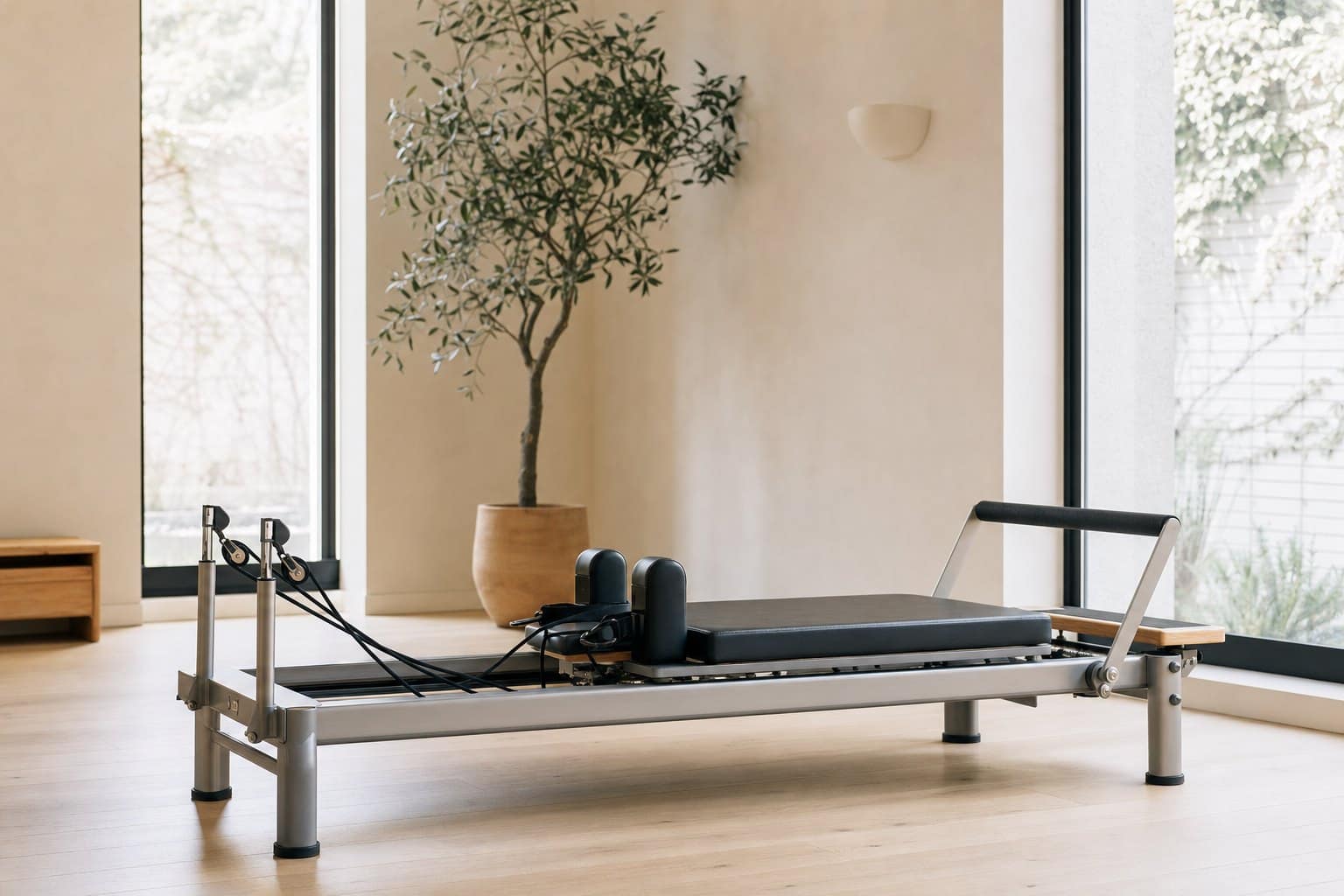
Short answer: Reformer is more versatile and faster to learn on; mat is cheaper and teaches most of the fundamentals. Pilates builds core and stabilizer strength, posture and control, with good evidence for chronic lower-back pain. It covers neither cardio nor serious muscle building, so treat it as one layer.
Pilates is having a genuine moment, and the marketing has gotten well ahead of the substance. It’s not a fat-burning class, not quite yoga, and not just something people do after knee surgery. It’s a precision movement method that rewards you for paying attention, and it’s one of the more transferable fitness investments you can make.
What Pilates is
Pilates is a low-impact method centered on core strength, muscular control, posture, and precise, deliberate movement. Joseph Pilates developed it in the early twentieth century, initially for dancers and rehabilitation patients, and that origin shows: the whole system is built around moving well, not just moving a lot. The defining quality is control, every repetition is meant to be intentional, not just completed.
The “core” in Pilates means more than abs. It includes the deep stabilizers of the spine, the pelvic floor, the hip muscles, and the muscles around the shoulder blades. Strengthening those stabilizers is what makes Pilates valuable for rehab, posture, and injury prevention, and it’s why people who’ve never felt sore from a plank will be surprised at what a beginner Pilates class demands.
What a mat and reformer session is like
A typical mat class runs 45, 60 minutes. You work on a mat, often with small props like a resistance ring, a small ball, or a foam roller. The instructor cues you through sequences, leg circles, rolling exercises, bridges, side-lying series, and the pace is measured rather than aerobic. You will feel muscles you didn’t know you had.
A reformer session is usually private or semi-private and runs 50, 60 minutes. The reformer is a spring-loaded carriage on rails with a footbar, straps, and adjustable resistance. You lie, sit, kneel, or stand on it for exercises that would be impossible on a mat.
The springs create both assistance (useful for rehab) and resistance (useful for loading). The sensation is unusual at first, smooth, supported, but deeply challenging when the instructor adjusts the springs.
Group reformer classes (the trendy boutique format) are typically 45, 55 minutes and move faster than private sessions. They’re fun and a good workout once you know the basics, but a handful of private or small-group intro sessions first will make them far more effective and safer.
What the evidence says about Pilates
- Reasonable evidence for: Pilates reliably improves core strength, functional movement, postural alignment, and flexibility with regular practice. There is good evidence for its use in chronic lower-back pain rehabilitation, multiple meta-analyses show it outperforms general exercise for that population. It is widely used in physiotherapy and sports medicine for exactly this reason.
- Debated or mixed: Whether Pilates builds significant muscular hypertrophy or substantially improves cardiovascular fitness compared to other training methods, probably not. The evidence suggests it complements other training rather than replacing strength or cardio work for most people.
- Not established / overstated: Claims that Pilates “lengthens” muscles (muscles don’t lengthen in any structural sense from Pilates) or that it is uniquely superior to all other forms of exercise for general fitness. The “long and lean” body type marketing is mostly body-type marketing, not a physiological outcome of the method.
Benefits regular practitioners report
People who stick with Pilates consistently report: less lower-back pain, better posture without consciously trying to stand tall, improved body awareness during other activities (lifting, running, sitting), and a sense of control and coordination they didn’t have before. Reformer clients in particular often note that movements that were impossible or painful at the start become accessible over months.
It’s also genuinely adaptable, modifications exist for almost every injury or limitation, which is part of why it travels so well across life stages, from prenatal to post-surgical recovery to older adults maintaining balance and functional strength.
Who Pilates is for, and who should skip it
Great fit: Desk-bound bodies dealing with postural strain; people in physical therapy or post-surgery recovery (with clearance); pre- and postnatal individuals working with a certified instructor; athletes who need injury prevention or stabilizer work; anyone who finds high-impact exercise inaccessible or uncomfortable.
Pairs well with: If you want to round out your movement practice, yoga-styles-explained offers useful comparison for flexibility and breathwork goals, while aerial-yoga-explained shares Pilates’ focus on control and body awareness in a completely different format. For people interested in re-educating movement patterns at a neurological level, feldenkrais-method-explained is a related and often complementary approach.
Proceed with care or get clearance: Active disc herniations, recent abdominal surgery, osteoporosis (some exercises involve spinal flexion, an experienced instructor can modify), or third-trimester pregnancy without a prenatal-certified instructor. Always disclose injuries before your first session. Our guides to wellness with osteoporosis and scoliosis cover what to ask an instructor, and our guides to hypermobility and diastasis recti cover two more cases where the instructor’s answer matters.
Honest caveat: Pilates is not a standalone program for fat loss, serious muscle building, or cardiovascular fitness. Treat it as the control-and-stability layer of a broader routine, not the whole thing.
What reformer and mat classes cost
In the US, mat group classes typically run $15, $35 per session (or included in gym memberships). Boutique reformer group classes average $30, $55. Private reformer sessions with a certified instructor run $70, $150 depending on location and the instructor’s experience. Introductory packages are usually the best entry point, most studios offer a discounted trial of 3, 5 sessions.
How to choose the right format
Start with a few private or semi-private reformer sessions if budget allows, the one-on-one instruction builds technique fastest and makes group classes significantly more effective later. If budget is the constraint, a beginner mat class with a good instructor is a solid alternative; mat work is harder than it looks and teaches most of the fundamentals.
Online and app-based Pilates is a legitimate option for mat work once you have the basics down. Without foundational instruction, however, form breaks down quickly and you lose much of the benefit (and increase injury risk). The investment in a few proper sessions early pays off.
When evaluating instructors, look for certification from a recognized body (Stott, BASI, PMA, or similar), and ask whether they have experience with your specific needs, rehab, prenatal, or athletic, if applicable.
FAQ: reformer and mat Pilates
Is reformer Pilates worth the extra cost? For most people, yes, particularly in the first months. The spring resistance lets an instructor give you more feedback about alignment and load, and the variety of exercises is much wider than mat. Once you have strong fundamentals, mat work sustains much of the benefit at a fraction of the price.
How is Pilates different from yoga? Both improve body awareness, flexibility, and core strength, but the emphasis differs. Pilates is more explicitly focused on stabilizer strength and controlled mechanical movement; yoga incorporates more flexibility, balance, breathwork, and often a philosophical dimension. Many people do both and find them complementary rather than overlapping.
How quickly will I see results? Most people notice postural awareness and some reduction in back discomfort within 4, 6 weeks of twice-weekly practice. Measurable strength and mobility improvements typically emerge at 8, 12 weeks. The old “10 sessions to feel a difference, 30 to change your body” maxim is approximately accurate for consistent practitioners.
Can Pilates replace physical therapy? It is not physical therapy, and it is not a substitute for proper medical assessment of injuries. Many physiotherapists incorporate Pilates exercises into rehabilitation, but a Pilates instructor is not qualified to diagnose or treat injuries. If you’re in active rehab, work with your physio first and involve a Pilates instructor as a supplement.
The honest summary on Pilates
Pilates is excellent for what it’s actually designed to do: build core and stabilizer strength, improve posture and movement control, support rehabilitation, and keep bodies functioning well across decades. Reformer is more versatile and generally faster to learn on; mat is accessible and effective once you know the form.
Neither is magic, and neither alone covers cardio or serious hypertrophy. Treat Pilates as a foundational layer in a complete movement practice and it will pay off.
And if the reformer side wins and you are eyeing a machine of your own, our honest look at whether a home reformer is worth it runs the break-even math. If what you actually want is something harder on the same kind of machine, our reformer Pilates vs Lagree comparison covers the Megaformer version and why it is a workout rather than a method.