Scoliosis: can yoga, Pilates or massage help?
Ask whether yoga helps scoliosis and you are really asking two things: whether it changes the curve, and whether it changes how the back feels. The wellness industry answers the second and lets you hear the first.
Two different questions hide inside “does yoga help scoliosis”. One is about the curve. The other is about how the back feels. For how the back feels, yoga, Pilates and massage are reasonable, in the same way they are for any stiff or achy back. For the curve itself, the only conservative approaches with trial evidence are scoliosis-specific exercise delivered by a trained physiotherapist and, in growing adolescents, bracing. A studio class or a massage does not change a curve, and nobody should be sold one on that promise.
The distinction matters most for a child or teenager who is still growing, because that is the only window in which a curve can be steered, and it is a clinician’s job to watch it on a schedule. “Let’s try yoga first” is the one sentence in this whole area that can do harm.
This is general information, not medical advice. The section on when scoliosis is a clinician’s question sits further down, and everything else here assumes you have read it.
What scoliosis actually is
A sideways curve, with a twist in it.
Seen from behind, a spine with scoliosis bends to one side instead of running straight, and the vertebrae along the curve also rotate. The rotation is why a rib hump or a raised shoulder blade shows when someone bends forward, and why the problem is three-dimensional rather than a simple lean. It is measured on an X-ray as the Cobb angle, and that measurement, tracked over time, is what clinicians make decisions on.
The common form is adolescent idiopathic scoliosis, which appears around the growth spurt, has no identified cause, and in most cases stays small. Some curves progress while the child is still growing, which is why monitoring during growth is the whole game.
Adult degenerative scoliosis is a different story: a curve that develops later in life, usually in the lower back, as discs and joints wear unevenly. It behaves more like the ordinary back pain in our guide to what actually helps lower back pain than like the adolescent condition, with the added possibility of nerve symptoms.
Two words people search deserve a sentence each. Dextroscoliosis means the curve’s convex side, the bulge, points to the right, which is the usual direction in the upper back. Levoscoliosis is the mirror image, convex to the left, and in the upper back it is the less common direction, which is one reason a clinician looks more closely at it rather than a reason for you to worry.
What massage can do for a scoliotic back
Comfort and mobility, honestly named.
The muscular tension around a curve is real, not imagined, and soft tissue work eases it in the same way it eases any guarded back. People often feel looser and taller for a day or two afterwards, and that feeling is worth having. Our piece on what massage does for recovery covers what that effect is and is not.
What it does not do is move bone. A vertebra rotated by a structural curve is not a knot to be released, and a therapist who talks about correcting or reducing your curve is describing something hands cannot do.
Tell the therapist you have scoliosis, where the curve is, whether you wear a brace, and whether you have had surgery, since fused segments and rods change where and how they work. Ask for moderate pressure to begin with and adjust from there. Anyone offering a class, a treatment or a gadget for scoliosis should be able to say whether they mean the curve or the comfort, and our guide to which bodywork suits which complaint is built on that same sorting.
What yoga can and cannot do
Plausible for the ache, unproven for the curve, and one study everyone quotes.
For how the back feels, a gentle, regular practice is a reasonable choice, for the reasons set out in our piece on whether yoga helps back pain: consistent movement, less guarding, and a calmer relationship with a sore back.
The study that gets quoted is Fishman and colleagues in Global Advances in Health and Medicine in 2014, a serial case report in which a single side-plank pose, held daily on the convex side of the curve, was associated with reduced curves in a small series of adults and adolescents. It is interesting. It is also tiny and uncontrolled, with no comparison group and no way to separate the pose from everything else that changes over months, including growth. Read it as a hypothesis worth testing rather than proof, and note that which side is convex is something an X-ray tells a clinician, not something a class can guess.
The practical caution is about depth. Poses that load the spine heavily or twist it deeply deserve a teacher who has been told about the curve and knows what to do with that information. Our guide to yoga styles explained helps you pick a gentler style to start from.
Pilates and the “core” question
Helpful for how the back feels, and not the same thing as scoliosis-specific exercise.
Pilates builds control and endurance in the muscles around the trunk, and for a back that aches because it is working unevenly, that is useful.
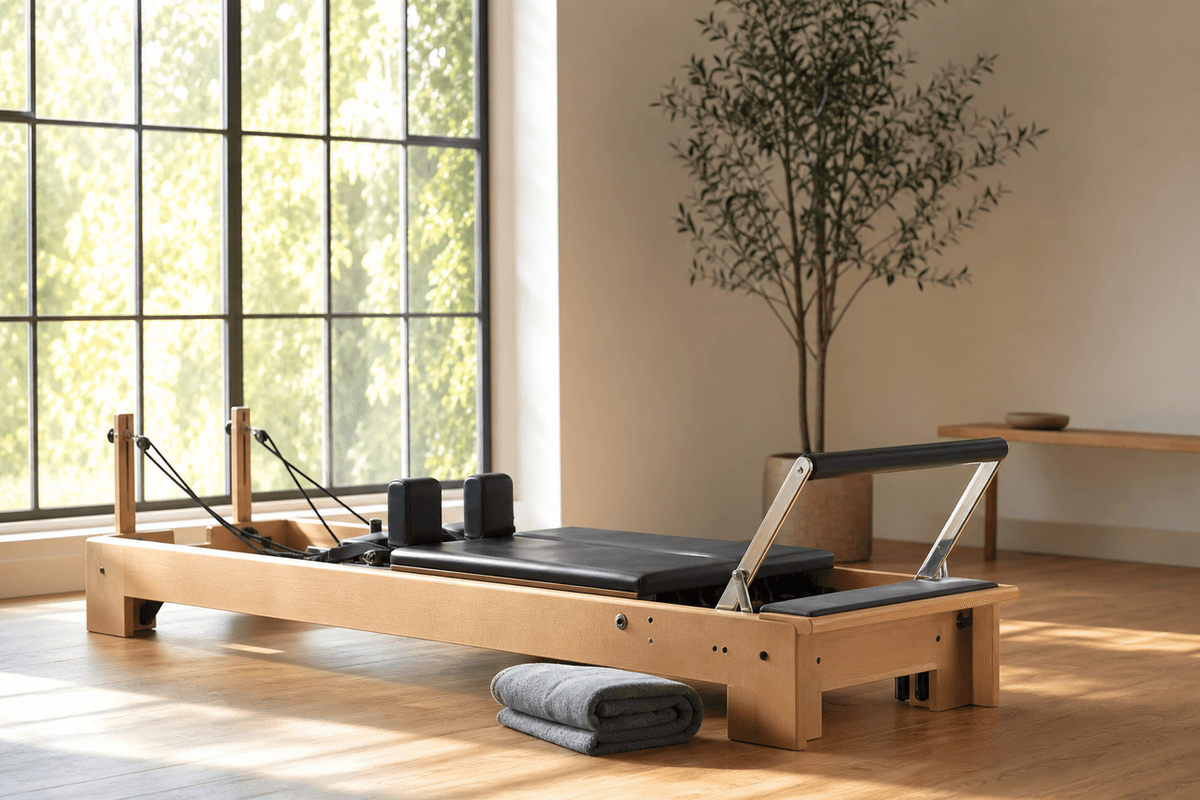
What a general Pilates class is not is a curve-specific program. The exercises are the same for everyone in the room, and the value is fitness and comfort rather than correction. Whether that happens on the reformer or on a mat, as our reformer versus mat comparison covers, matters far less than who is teaching.
The useful ask is an instructor with scoliosis experience, who knows which movements to modify and will not promise you a straighter spine.
What scoliosis-specific exercise and Schroth actually are
Physiotherapy, individually prescribed, and not a class you drop into.
Scoliosis-specific exercise is a family of physiotherapy methods in which the exercises are designed around the individual’s curve pattern, combining corrective postures, breathing aimed at the collapsed side of the ribcage, and training to hold the corrected position in daily life. The Schroth method is the best studied of them. It is delivered by clinicians trained in it, one to one or in small supervised groups, and it looks nothing like a studio class.
The international SOSORT guidelines, published by Negrini and colleagues in Scoliosis and Spinal Disorders in 2018, frame conservative care during growth as observation, scoliosis-specific exercise and bracing, chosen by curve size and how much growth remains. That is the frame a clinician is working from.
The trial evidence is real and modest. A randomized trial by Schreiber and colleagues in Scoliosis in 2015 found that Schroth exercises added to standard care improved quality of life and back muscle endurance in adolescents with idiopathic scoliosis over six months, and the same trial’s curve outcomes, reported by Schreiber and colleagues in PLOS ONE in 2016, showed better Cobb angle outcomes than standard care alone. The caveats are the usual ones: a small, closely supervised program over six months, which cannot tell you what those curves look like years later. Our comparison of massage and physical therapy explains why only one of those is a plan.
Adolescents, growth and bracing
The decision is clinical, the evidence is strong, and the trap is delay.
For a growing adolescent with a curve that is progressing, a brace is the conservative treatment with the strongest evidence. The trial is Weinstein and colleagues in the New England Journal of Medicine in 2013, which found that bracing significantly reduced the progression of high-risk curves to the surgical threshold, and that the benefit rose with the number of hours the brace was worn.
Whether a particular child needs one is a decision based on the size of the curve and how much growth is left, made by a clinician looking at the X-rays, and we take no position on any individual case.
The wellness trap here is not that yoga or Pilates are harmful. It is that they take time, and time is the one thing a growing spine does not give back. A season spent trying a class instead of keeping the scheduled appointment can spend the window in which a brace would have worked.
Scoliosis options at a glance
| Option | What it can honestly change | Best for |
|---|---|---|
| Massage | Muscle tension, soreness, how the back feels for a day or two | Adults and adolescents wanting comfort alongside proper care |
| General yoga | Stiffness, guarding, general fitness | Adults with a stable curve and an informed teacher |
| Pilates | Trunk control and endurance, how supported the back feels | Adults wanting a regular practice, with an experienced instructor |
| Scoliosis-specific exercise (Schroth and similar) | Muscle endurance, quality of life, modest curve outcomes in trials | Growing adolescents under a trained physiotherapist, some adults |
| Bracing | Progression of a growing curve | Adolescents whose clinician recommends it |
| Observation with scheduled X-rays | Nothing directly, and it catches change in time | Every growing child or teenager with a curve |
| Posture gadgets, correction massage, apps | Nothing about the curve | Nobody, at any price |
What is oversold
Anything that promises a straighter spine without a clinician in the room.
Posture correctors and straps are the cheapest example. A structural curve with rotation in it is not a slouching habit, and a strap pulling the shoulders back changes nothing beneath it. Apps and home programs promising curve reduction sell the same story with a subscription.
“Curve correction” massage does not describe anything hands can do. Chiropractic claims to reduce a curve through adjustments are not supported by the kind of trial evidence that bracing and Schroth have, and manipulation of a spine with an unassessed curve is not a place to start. Our read on whether neck manipulation is safe sets out how we weigh manipulation claims in general. Our guide to spotting a nonsense wellness claim is the filter for the rest.
The most expensive version is any provider who suggests skipping or delaying the scheduled X-ray because their method is working. That is not an alternative approach. It is the reason to leave.
When scoliosis is a clinician’s question
Some of this is never a wellness question, and the growing spine is the clearest case.
Any curve in a child or teenager who is still growing belongs with a clinician, who will monitor it on a schedule and decide, on evidence, whether anything beyond observation is needed. Wellness practitioners can work alongside that. They cannot replace it, and a good one will say so.
A curve that appears to be changing, whether clothes fitting unevenly, one shoulder or hip riding higher, or a rib prominence becoming more visible, is a reason to move the appointment forward rather than book a treatment.
Back pain with numbness, weakness in the legs, or any change in breathing needs assessment promptly, whatever your age. So does a visible new asymmetry in an adult, because a curve that appears or grows in adulthood has a cause worth finding.
If you book bodywork alongside proper care, check whoever you see using our credential-checking guide. We only recommend what we would send a friend to, and here that means a clinician first and a studio second.
FAQ
Can massage straighten scoliosis? No. Massage eases the muscular tension around a curve, which is worth having, and it does not move a rotated vertebra. Any therapist promising curve reduction is describing something hands cannot do.
Is yoga safe with scoliosis? For most adults with a stable curve, a gentle practice with a teacher who knows about the curve is reasonable. Deep twists and heavy loading deserve modification, and a growing adolescent’s curve should be monitored by a clinician regardless of what class they attend.
Does Pilates help scoliosis? It can help how the back feels, by building control and endurance around the trunk. It is not scoliosis-specific exercise, and a general class does not change a curve.
What is the Schroth method for scoliosis? A physiotherapy approach in which exercises and breathing are tailored to the individual’s curve pattern and taught by trained clinicians. Small trials found benefits in muscle endurance, quality of life and curve outcomes over six months when it was added to standard care.
The bottom line on scoliosis
Two questions hide inside this one. For how a scoliotic back feels, yoga, Pilates and massage are reasonable, for the same reasons they suit any stiff or achy back, and a teacher or therapist who has been told about the curve is the useful ask.
For the curve itself, the list is short: scoliosis-specific exercise delivered by a trained physiotherapist, with modest trial evidence, and bracing in growing adolescents, with strong trial evidence. Everything else sold as correction is comfort at best and delay at worst.
A curve in a growing child or teenager is monitored by a clinician on a schedule, and nothing in a studio replaces that appointment.