Shiatsu massage: what it is, what a session is like, and what the evidence shows
Japan's finger-pressure bodywork, deeply grounding, genuinely relaxing, with an honest look at where the evidence lands.
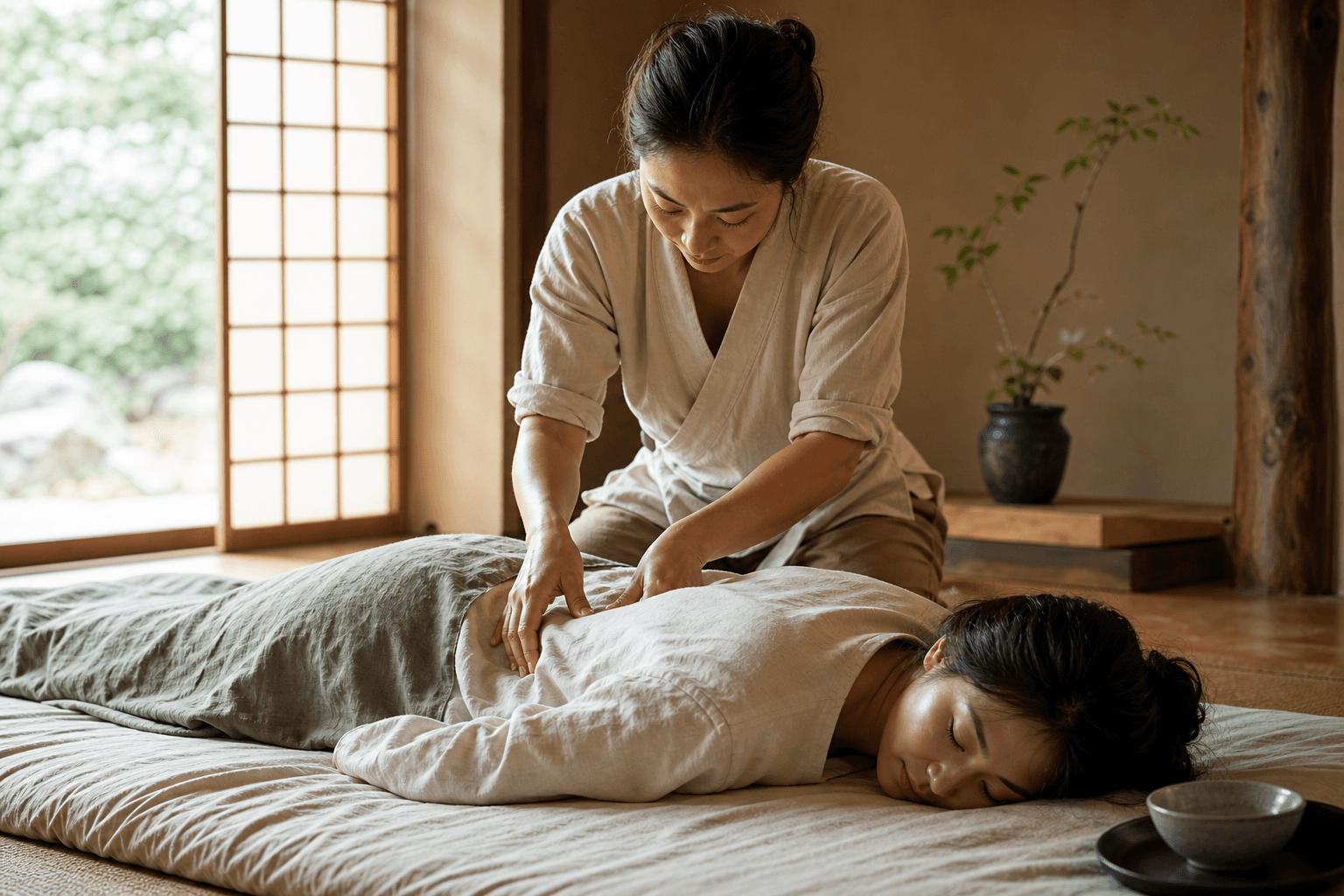
Short answer: Shiatsu is Japanese finger-pressure bodywork: sustained thumb, palm and elbow pressure along meridian lines plus passive stretches, received fully clothed on a floor mat for 60 to 90 minutes. Evidence supports stress, sleep and back-pain relief; the meridian mechanism itself is contested. Expect $80 to $140 for an hour.
Shiatsu is often described as Japanese acupressure massage, which captures part of it but not all of it.
It is a full-body practice rooted in traditional East Asian medicine that works through rhythmic pressure, stretching, and body positioning, and unlike many massage modalities, it is typically received fully clothed on a floor mat rather than on a table. If you have never tried it, the experience can be surprising in the best way.
What shiatsu is
Shiatsu (literally “finger pressure” in Japanese) developed in Japan in the early 20th century, synthesizing traditional Chinese medicine concepts, particularly the meridian system, which maps pathways through which “ki” (the Japanese word for qi, or life energy) is said to flow, with influences from Western anatomy and physiotherapy. Tokujiro Namikoshi and Shizuto Masunaga are the two practitioners whose schools most shaped the modern practice, with Masunaga’s approach (Zen Shiatsu) placing particular emphasis on hara diagnosis and extended meridian pathways.
The practice involves applying pressure with thumbs, fingers, palms, elbows, knees, and sometimes feet to specific points and areas along the meridians. Unlike acupuncture, no needles are used. The pressure is often sustained rather than sliding, held for several seconds at each point, and is combined with passive joint rotations and assisted stretches.
The traditional explanation is that pressure along meridians influences the flow of ki, correcting imbalances that manifest as physical symptoms. Modern practitioners often frame it more in terms of nervous system regulation, fascial release, and proprioceptive input, the same physical effects that other forms of bodywork produce, described without the energetic framework.
Both framings can coexist; what you experience in the session is real regardless of which model explains it.
What a shiatsu session is like
You’ll arrive wearing loose, comfortable clothing, yoga pants and a t-shirt are ideal. Unlike most massage, you do not undress. The session takes place on a padded mat on the floor (called a futon in this context), which gives the practitioner more leverage and allows a different range of body positioning than a table permits.
The practitioner will often begin with a brief assessment, sometimes including palpation of the abdomen (hara) in Zen Shiatsu traditions, where the condition of internal organs is thought to be readable through abdominal tension patterns. Then the bodywork begins.
You’ll feel sustained thumb or palm pressure applied to points along your back, legs, arms, neck, and sometimes the face and head. The pressure is firm but rarely sharp, most people describe it as deeply satisfying, similar to the feeling of someone pressing on exactly the right spot.
In between pressure sequences, the practitioner will guide your limbs through gentle rotations and stretches, which can feel remarkable for the hips, shoulders, and spine.
Sessions typically run 60 to 90 minutes. Many people become very still and quiet during shiatsu, it induces a particular kind of grounded relaxation, less floaty than some massage styles, more like being anchored. Some people fall asleep. It is common to feel a pleasant heaviness for several hours afterward.
What the evidence says about shiatsu
- Reasonable evidence for: Reduction in perceived stress and anxiety, multiple controlled studies support shiatsu’s effectiveness as a relaxation intervention, with measurable reductions in cortisol and self-reported stress. Reduction in lower back pain, there is good preliminary evidence, consistent with what we see for massage generally. Some evidence for reducing menstrual pain and discomfort. Improved sleep quality, several small trials show positive effects on sleep, particularly in older adults.
- Debated or mixed: The meridian mechanism itself, whether pressing on specific traditional points produces different effects than equivalent pressure applied elsewhere, has not been consistently demonstrated in controlled settings. Studies that control for the “where” of pressure (specific meridian points vs. nearby non-points) generally find modest or inconsistent differences. This is a parallel debate to what happens in acupuncture research, where the needle location effect is also contested. Whether shiatsu outperforms other forms of massage for most outcomes is unclear; much of the benefit may come from the general therapeutic effects of skilled touch and parasympathetic activation.
- Not established / overstated: Shiatsu as a treatment for specific internal conditions, claims that it can treat digestive disease, hormonal imbalance, or chronic illness beyond symptom management are not supported by quality evidence. The idea that ki imbalances cause disease in a way that is detectable and correctable through manual pressure is a traditional claim without modern scientific backing.
Benefits people report from shiatsu
People who receive shiatsu regularly consistently describe:
- A distinctive sense of groundedness and calm that persists well beyond the session
- Reduced muscle tension throughout the back, neck, and hips
- Improved flexibility and joint mobility, particularly in the spine and shoulders, from the passive stretching component
- Better sleep the night following a session
- Reduced menstrual cramps and PMS symptoms (a commonly reported benefit)
- Fewer tension headaches among people who receive regular sessions
The fully clothed, floor-based format also makes shiatsu accessible to people who are uncomfortable undressing for massage, or who have cultural or personal preferences against that.
Who shiatsu is for, and who should skip it
Shiatsu suits a wide range of people: those dealing with chronic tension and stress, people who enjoy a more grounded and less oily bodywork experience, those curious about Eastern bodywork traditions, and people who find conventional massage too passive. The stretching component makes it particularly good for people with reduced flexibility or habitual postural tension.
Skip it or check with your doctor first if you have:
- Osteoporosis or fragile bones, firm pressure and assisted stretching carry risk if bone density is low
- Active infection, fever, or skin conditions in treatment areas
- Recent surgery or acute injury, especially to joints that the practitioner would be mobilizing
- Blood clots or vascular conditions in the limbs
- Pregnancy, shiatsu can be adapted for pregnancy, but certain points are traditionally contraindicated during pregnancy (particularly in the legs and lower back); work only with a practitioner who has prenatal training
Talk to your doctor if you have any joint instability, cardiovascular condition, or are taking blood thinners before booking.
If you’re interested in other Asian bodywork traditions with a similar blending of pressure and stretching, Thai massage and bodywork is the closest relative, more active and movement-based, but sharing the same roots in meridian thinking and passive stretching.
What a shiatsu session costs
Shiatsu is typically priced similarly to other therapeutic massage modalities in the US:
- 60-minute session: $80, $140
- 90-minute session: $110, $180
- At a dedicated shiatsu or Japanese wellness center: sometimes $100, $200 for extended sessions with detailed intake
Retreat settings that include shiatsu typically charge $100, $160 for a standard session. Shiatsu is less widely available in general spa chains than Swedish or deep tissue, so finding a practitioner may require some searching; dedicated shiatsu studios or practitioners trained in a specific school (Namikoshi, Zen Shiatsu) are the best starting point.
How to choose a good shiatsu practitioner
In the US, shiatsu is not separately licensed from massage therapy in most states, a licensed massage therapist can offer it, but meaningful training in shiatsu goes well beyond basic licensing. Look for:
- Completion of a formal shiatsu program (500+ hours is a reasonable minimum for serious practitioners; the American Organization for Bodywork Therapies of Asia, AOBTA, maintains a register of practitioners who meet a training standard)
- Clarity about which school or lineage they trained in (Namikoshi, Masunaga/Zen Shiatsu, or others), a practitioner who can’t answer this question likely has only surface-level training
- An intake process that covers your health history, areas of concern, and goals
Red flags: a practitioner who does not ask about your health history, one who makes specific medical claims about correcting internal disease, or one who cannot explain the session structure clearly.
For comparison, reflexology is another pressure-based practice that works through mapped points, on the feet and hands specifically, and is available more widely, though it’s a distinct practice with different scope.
FAQ: shiatsu massage
Is shiatsu the same as acupressure? They are related but not identical. Acupressure is a broader term for pressure applied to traditional acupuncture points. Shiatsu includes acupressure elements but is also a full-body system with specific schools, meridian pathway work, and a movement/stretching component that acupressure alone does not encompass.
Will I be sore afterward? Mild muscular soreness is possible if the session included significant work on tight areas, similar to what you might feel after deep tissue massage. More commonly, people feel relaxed and slightly heavy rather than sore. If you’re new to shiatsu, tell your practitioner, who can calibrate pressure accordingly.
Can shiatsu help with anxiety or insomnia? The evidence here is among the stronger claims for shiatsu, multiple small studies show reductions in anxiety measures and improvements in sleep quality. It is not a clinical treatment for anxiety disorders, but as a regular wellness practice it may contribute to better nervous-system regulation over time.
How is shiatsu different from a regular massage? Three things distinguish it: you stay clothed, the session happens on a floor mat rather than a table, and the technique emphasizes sustained point pressure and passive stretching rather than gliding strokes. The pacing is generally slower and more deliberate, and the overall effect tends to feel more grounding than a conventional table massage.
The honest summary on shiatsu
Shiatsu is a well-developed, genuinely therapeutic bodywork practice with real evidence for stress reduction, relaxation, and pain management, and more contested evidence for the specific meridian mechanisms behind it. Like many traditional modalities, the experience and the benefits it produces are real; the traditional explanatory framework is culturally meaningful but not scientifically confirmed.
For someone who wants a grounded, fully clothed bodywork session that combines sustained pressure with assisted stretching, it is a distinctive and worthwhile experience, particularly if you’re drawn to the Japanese wellness aesthetic or looking for something different from the standard spa table format.
The at-home object sold on this idea is the spiked mat, and our read on whether acupressure mats actually work separates the real effect from the meridian framing.