Wellness with epilepsy: breathwork, water, heat and sleep, honestly
Deep forceful breathing, the sunrise session after a late ceremony and the candlelit soak with nobody around are sold as good for everyone. For someone with epilepsy they are the exact list of provocations, and the safe options are the ones the industry treats as ordinary.
Short answer: Most people with epilepsy are well controlled on medication, and nearly all of a wellness menu is open to them. The specific risks are hyperventilation-style breathwork, which neurologists use deliberately to provoke seizure activity, retreat schedules that cut sleep, flashing lights for a photosensitive minority, and above all water alone.
Epilepsy is a tendency to recurrent seizures, and most people who have it are well controlled on medication. Nearly everything in a wellness venue is open to them. The specific risks are intense breathwork, retreat schedules that cut sleep, flashing lights for a minority and, above all, water alone, because drowning during a seizure is the documented danger.
Look at that list. Forceful breathing, the sunrise session after a late ceremony, the candlelit soak with nobody around: the industry sells these as good for everyone. For this reader they are the provocations, and the ordinary things, a walk, a massage, a sauna with a friend, are the safe ones.
This is general information, not medical advice. Seizure control is the protective factor, and your diagnosis and medication belong to a neurologist.
What epilepsy actually is
Many types, mostly controlled.
Epilepsy is not one disease but a tendency of the brain to produce recurrent seizures, which range from a few seconds of blankness to the convulsion most people picture. Type, cause and triggers differ from person to person, so a blanket rule is nearly always wrong. Most people with epilepsy have their seizures controlled by medication, and that control is what makes the rest of this piece mostly reassuring, because it decides which precautions below are real for you.
Breathwork, the one to think hardest about
Hyperventilation is a test clinics use to bring seizures on.
Our breathwork safety guide puts a seizure history on its clearance list for the intense styles. The reason: fast, deep, sustained breathing drives carbon dioxide out of the blood, and low carbon dioxide makes the brain more excitable. Guaranha and colleagues in Epilepsia in 2005 studied hyperventilation as a seizure-activation procedure during video-EEG monitoring: neurologists use it to make seizure activity show on a recording. The manoeuvre a facilitator calls a breathing journey is one an EEG technician calls activation.
Slow, paced breathing, longer exhales, box breathing, the calming side of pranayama, leaves your blood chemistry alone. The line runs around the fast, forceful styles, which our read on whether the Wim Hof method works covers. Tell the facilitator beforehand and expect the slow version.
Water, the documented risk
Baths, hot tubs, float tanks and pools: never alone.
A seizure in water can put your face under the surface with nobody to lift it, and Bell and colleagues in Neurology in 2008 found that the risk of drowning is substantially higher in people with epilepsy than in the general population, including in bathtubs. Shallow does not mean safe. What drowns you is not depth but time face down.
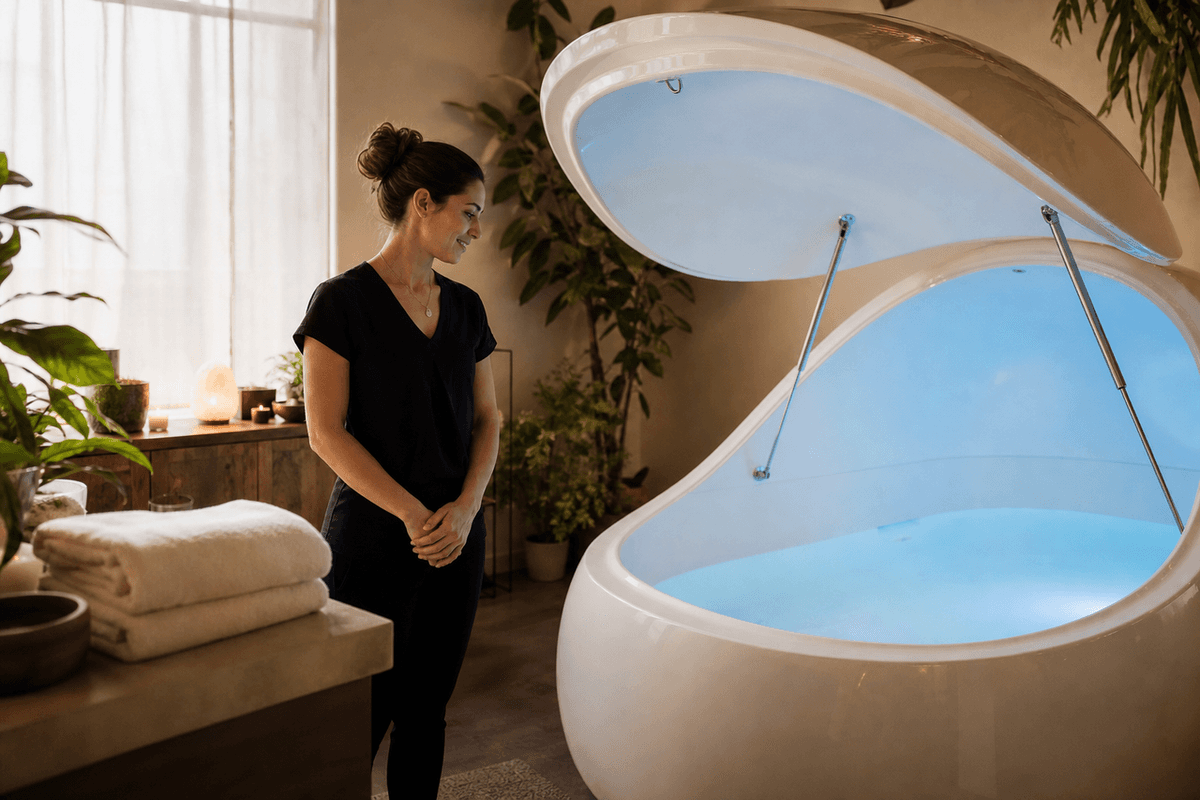
Our float tank guide says to talk to your doctor if your epilepsy is not controlled, and this is why: a float tank is a shallow, dark bath in a closed room, sold on the promise of an undisturbed hour. The salt keeps a relaxed body on the surface, not a convulsing one face up.
The rule is not never, it is never alone: a bath with the door open and someone in the house, a hot tub with company, a float centre that knows and will check on you rather than seal you in for the hour.
Sleep and retreat schedules
The dawn session after the late ceremony is a trigger.
Sleep deprivation lowers the seizure threshold, and Malow in Epilepsy Currents in 2004 reviewed the relationship between lost sleep and seizures. A retreat timetable is often built to take sleep away: a sunrise practice, a late ceremony, a fire circle past midnight, all after a flight that moved your clock.
Plan the retreat around your sleep: arrive a day early if there is a time zone to cross, skip the dawn session after a late night, and choose a programme that leaves a real night between the last thing and the first. Our ranking of what actually helps you sleep applies with extra force.
Lights and sound
It is the light, not the gong.
Fisher and colleagues in Epilepsia in 2005, the Epilepsy Foundation working group review of photic and pattern-induced seizures, describes photosensitivity as affecting a minority of people with epilepsy and sets out the flash rates and patterns that provoke it. That minority usually knows, because an EEG tests for it.
On a wellness menu that means strobes, flickering light shows and some projections in immersive rooms. Seizures set off by sound itself are rare, and our sound bath guide tells that small group, and the strobe-sensitive, to skip. For everyone else, bowls and gongs in a dim room are fine. Ask what the room does with light.
Heat, dehydration and alcohol
Usually fine with control and company.
Sauna, steam and hot yoga are generally fine with well-controlled epilepsy, provided someone knows you are in there and your neurologist has said yes. Heat is not a classic trigger, but a sauna is a hot room with a hard bench, a poor place to have a seizure alone, and a hot tub is water. Our guide to feeling faint in a sauna applies.
Dehydration and alcohol are the quieter triggers, and both are common on a hot day at a spa with a bar. Missed doses are among the commonest of all, and travel is when they happen. Keep medication in hand luggage and ask your neurologist about the clock change.
Movement and massage
Encouraged, with supervision where a seizure mid-activity is dangerous.
Capovilla and colleagues in Epilepsia in 2016, the International League Against Epilepsy task force report on sports and exercise, encourages physical activity and sorts activities by what would happen if a seizure struck in the middle of them. Yoga, Pilates, a gym class and a run come out fine. Water, heights and anything with a motor need supervision or restriction, because the question is what happens mid-seizure: a yoga mat is a soft landing, a paddleboard is not.
Massage is fine. Tell the therapist what your seizures look like and what to do, which is usually to keep you from falling off the table, not to hold you still.
Epilepsy and wellness at a glance
| Practice | Fine as is | Needs adjusting | Avoid |
|---|---|---|---|
| Breathwork | Slow, paced styles | Intense styles, neurologist’s okay first | Forceful hyperventilation, anything near water |
| Baths, hot tubs, float tanks | With someone present who knows | How a float centre checks on you | Any water alone, however shallow |
| Sauna, steam, hot yoga | Control, company, a clinician’s okay | Hydration, getting out slowly | Alone, dehydrated or after drinking |
| Sound baths, light shows | Bowls and gongs in a dim room | Ask what the room does with light | Strobe and flicker, if photosensitive |
| Yoga, Pilates, gym, massage | Encouraged, therapist told | Heights, anything to fall from | Nothing specific |
What is oversold
Cures, replacements and gadgets.
Anything offered as a cure is the first thing to walk past: diet retreats sold as reversing epilepsy, detox programmes, “seizure-free” supplement protocols. None of them controls seizures, and a venue that hints its practice could replace your medication has told you all you need to know. The dietary treatments used in some epilepsies belong to a neurology team.
“Seizure-safe” gadgets are the subtler pitch. Detection devices can have a place in a care plan, but that is your neurologist’s call, and none makes water alone safe. Our guide to spotting a nonsense wellness claim filters the rest.
What belongs to your care team
Medication, travel, and what companions should do.
Your diagnosis, your medication and any change to it are your neurologist’s, as is driving and travel advice and the retreat plan: doses across time zones, what to carry and tell the organisers. Ask for a written note of what companions should do during a seizure: protect you from the fall and hard edges, never hold you down or put anything in your mouth, note when it started, and know when to call for help.
See a doctor before booking anything for a first seizure, a change in the pattern of the ones you know, a seizure that runs far longer than usual or repeats without recovery between, or an injury during one. Vet whoever you see with our credential-checking guide. We only recommend what we would send a friend to: a venue that asks about your seizures first.
FAQ
Is breathwork safe with epilepsy? Slow, paced breathing is. The intense styles use the manoeuvre EEG clinics use to provoke seizures, so ask your neurologist first and tell the facilitator.
Can I use a float tank or hot tub with epilepsy? Often, with someone present who knows and your neurologist’s agreement. The documented danger is drowning during a seizure, shallow water included, so never alone.
Is a sauna safe with epilepsy? Usually, with good control, company and water to drink. Dehydration and alcohol lower the threshold, so the bar needs more care than the sauna.
Are sound baths safe with epilepsy? In a dim room, generally yes. Photosensitivity affects a minority, and for them strobe and flicker are the problem, so ask what the room does with light.
The bottom line on epilepsy
Epilepsy is a tendency to seizures, and with good control nearly everything in a wellness venue is open to you. Exercise, slow breathing, meditation, massage and a sauna with a friend are all fine.
The risks are the things the industry sells hardest: intense breathwork, the manoeuvre clinics use to provoke seizures, timetables that cut sleep, strobe for the photosensitive minority, and above all water with nobody near. Heat, dehydration, alcohol and a missed dose are the quieter ones.
Tell every venue, never soak or float alone, and take a first seizure, a changed pattern, a long or repeated seizure or an injury to your care team.