Your first sound bath: what to expect
You lie on the floor while someone plays bowls and gongs, and somehow an hour later you feel deeply calm. Here's what's actually going on, without the mysticism.
Short answer: You lie on the floor under a blanket for roughly 45 to 60 minutes while a facilitator plays singing bowls, gongs and chimes, and you just listen. Nothing is asked of you. The calm comes from lying still with a single non-verbal thing to follow, not from healing frequencies. Bring warm layers.
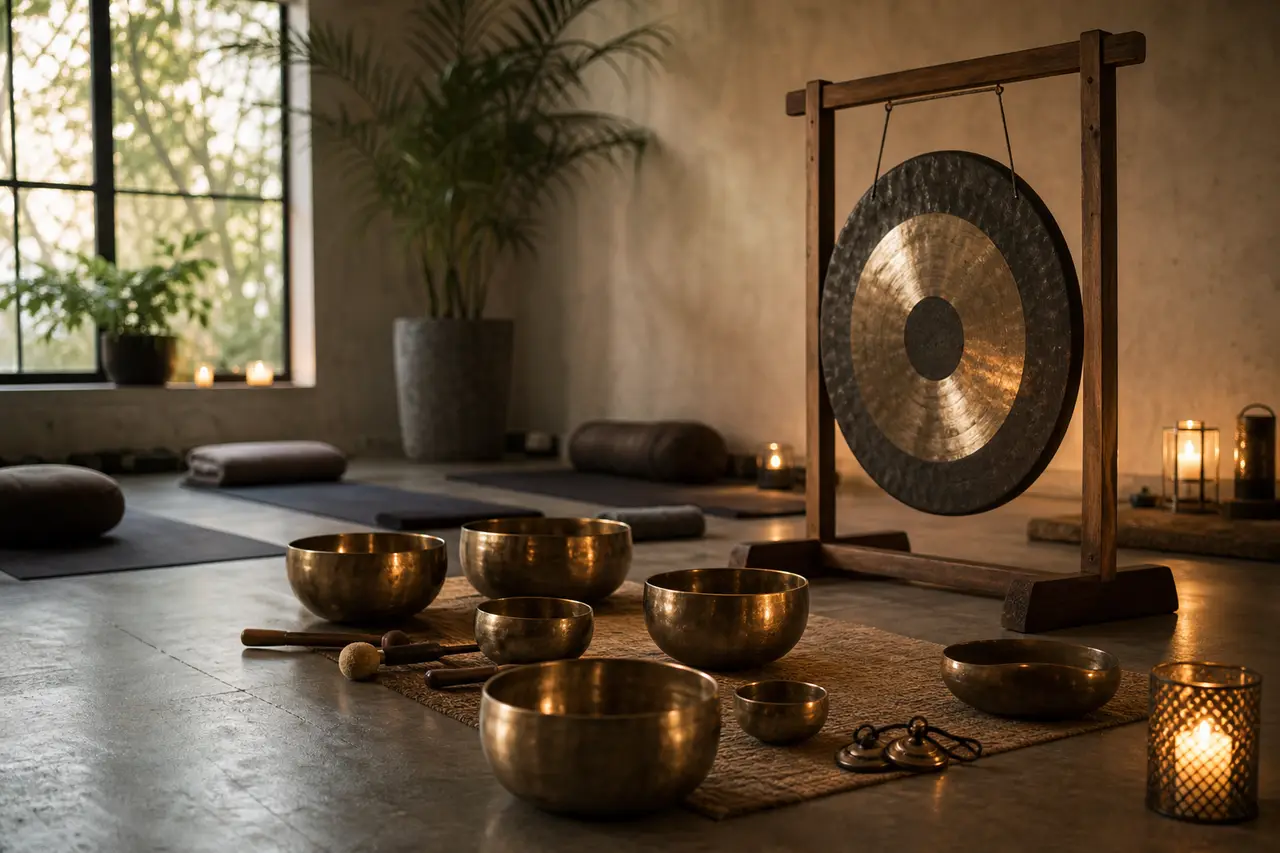
A sound bath is a group session where you lie on the floor, comfortable and covered, while a facilitator plays resonant instruments, crystal or metal singing bowls, gongs, chimes, for roughly 45 to 60 minutes, and you simply listen.
Expect to feel a bit self-conscious at first, then progressively calmer as the sustained tones give your busy mind something simple to rest on. Most people leave relaxed, some doze off, and a few feel unexpectedly emotional.
The honest version: it is a guided rest set to immersive sound, and the calm is real even though the “healing frequency” claims are not well supported.
What actually happens at a sound bath?
You arrive, grab a mat, and get comfortable lying down, usually with a blanket, an eye pillow, and a bolster under the knees; wear soft layers because your body temperature drops when you are still.
The facilitator dims the lights and begins playing, moving between instruments so the room fills with overlapping, sustained tones and vibrations you can sometimes feel in your chest. There is nothing to do, no posture to hold, no breathing to follow unless offered. You lie there and let the sound wash over you. That is the entire practice, and its simplicity is the point.
Why does it calm you down?
Not because specific frequencies retune your cells, a claim with little evidence, but because of something more ordinary and real: lying still, closing your eyes, and giving your attention a single, continuous, non-verbal thing to follow is a very effective way to interrupt rumination and drop into a relaxed state.
It is close to a guided meditation with a richer anchor. The sustained tones are easy to rest on precisely because they do not demand analysis.
Our sound bath benefits explainer covers what the evidence does and does not support, and the short version is that the relaxation is genuine and the mystical claims are oversold.
What should you bring and wear?
Most studios provide mats and props, but bring an extra layer or a blanket and warm socks, since you will cool down lying still for an hour. Wear comfortable clothes with no tight waistband. Arrive a few minutes early so you are not rushing in, use the bathroom first, and silence your phone completely.
If you have a favorite eye mask, bring it. Beyond that, come with no expectations; people who arrive trying to have a profound experience are the ones most likely to spend the hour frustrated.
Who is it for, and who might skip it?
Sound baths suit almost anyone who can lie still comfortably for an hour and wants a low-effort way into deep relaxation, and they are a gentle entry point for people who find seated meditation hard. They are very low-risk.
A few cautions: extremely loud gong-heavy sessions can be uncomfortable if you have sound sensitivity or misophonia, and if you have a condition affected by intense low-frequency vibration, ask the facilitator about the instruments used. Otherwise, the worst likely outcome is that you find it boring.
The bottom line on sound baths
Lie down, get warm, close your eyes, and let an hour of sustained sound carry your attention. That is a sound bath, and it is a legitimate, low-effort relaxation practice, not a frequency-based cure.
If you like the stillness but want to go deeper into quiet, a float tank session removes even the sound, and our meditation for beginners guide covers building the calm as a daily habit.