Acupuncture: what a session is like, and what the evidence honestly shows
Needles, qi, and the research, what acupuncture helps with, what it doesn't, and what to expect.
Short answer: Acupuncture has reasonable evidence for chronic pain and for chemotherapy and post-operative nausea, and little beyond that. A session runs 45 to 75 minutes, with 5 to 20 hair-thin needles left in for 15 to 30 minutes. Expect $75 to $150 privately, $25 to $60 at community clinics.
Acupuncture is one of the most-studied traditional practices in the world, and one where the honest answer to “does it work?” turns out to be complicated in an interesting way. The experience tends to be deeply calming; the evidence is real for specific things and overstated for many others.
What acupuncture is
Acupuncture is a practice from Traditional Chinese Medicine in which very thin, sterile needles are inserted at specific points on the body. Traditionally, these points lie along invisible channels called meridians, and the needling is said to balance the flow of “qi”, life force energy.
Modern Western-trained practitioners and researchers generally set aside the qi framework and instead describe the effects in terms of nervous system activation, connective tissue stimulation, and changes in pain signaling. Both frameworks get used in practice today; the needles and the outcomes are the same.
What an acupuncture session is like
A first appointment typically begins with a 10, 20 minute intake: the practitioner asks about your health history, symptoms, sleep, digestion, and stress. In traditional practice they may look at your tongue and take your pulse at several positions on the wrist, both are diagnostic in TCM.
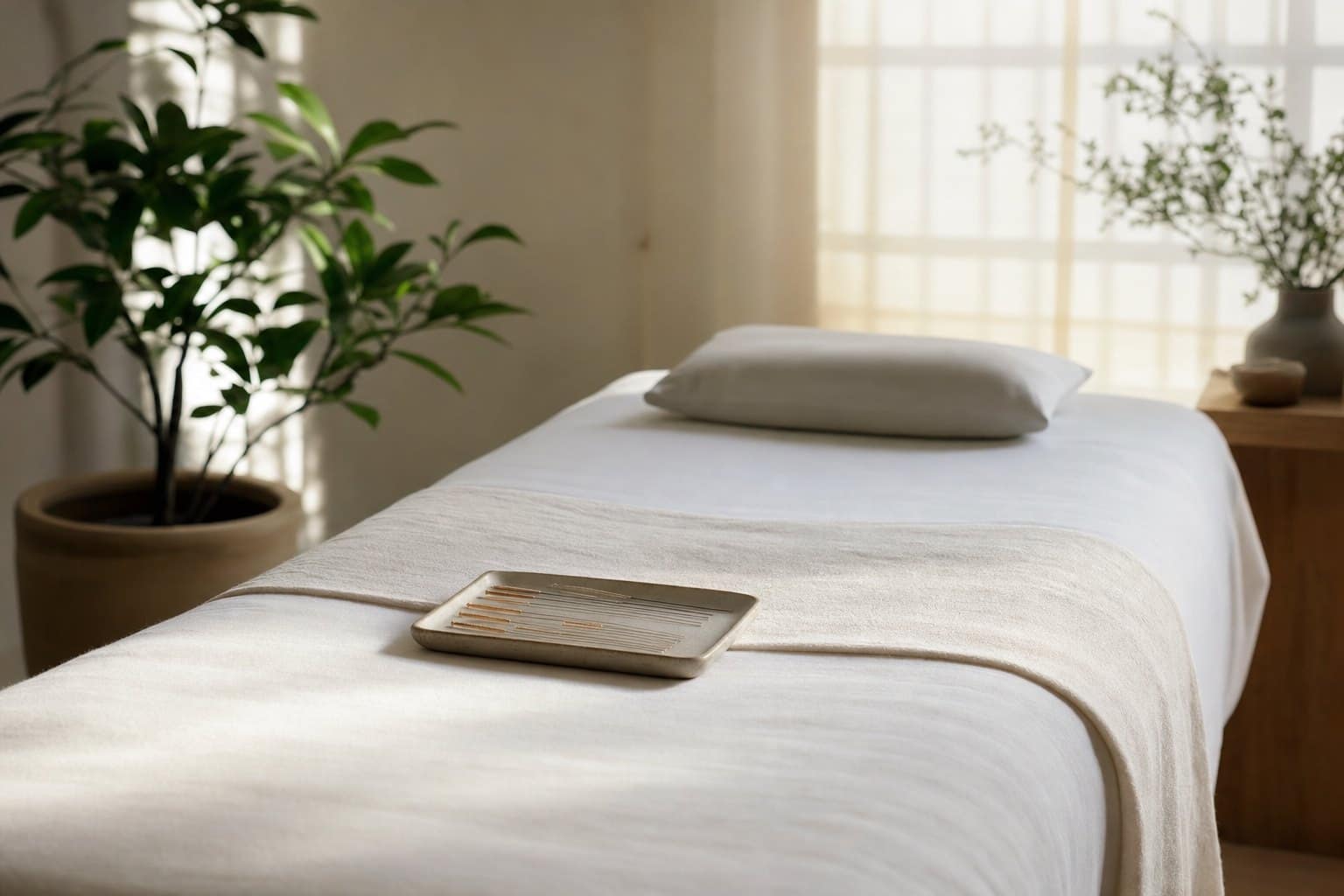
You then lie on a padded table, usually face-up. The practitioner inserts between 5 and 20 hair-thin needles, so fine that most people feel only a tiny prick or nothing at all.
Once inserted, you might feel a dull, heavy, or achy sensation around the needle point; this is called “de qi” and is considered a sign of engagement in traditional practice. It’s not painful in the way an injection is, but it’s not nothing either.
The needles stay in for 15, 30 minutes while you rest. The room is usually dim and quiet. A significant number of people fall asleep. After removal there are no marks in most cases. You leave feeling relaxed, sometimes slightly floaty; occasional mild soreness at needle sites for a day is normal. Sessions typically run 45, 75 minutes total.
What the evidence says about acupuncture
- Reasonable evidence for: chronic pain, particularly low back pain, neck pain, knee osteoarthritis, and tension-type headaches or migraines. Also strong evidence for chemotherapy-related nausea and post-operative nausea. These are the areas where acupuncture has moved from “alternative” to “adjunct” in clinical guidelines.
- Debated or mixed: how much benefit comes from the needling itself versus the powerful placebo and therapeutic-relationship effect. Many large trials show acupuncture outperforming no treatment, but the gap between real and “sham” acupuncture (needles in non-traditional points) is often smaller than expected, which suggests some effect is genuinely from the needles, and some is from the ritual and attention.
- Not established / overstated: treating internal organ disease, guaranteed fertility outcomes, clearing “toxins,” or reversing serious illness. These claims circulate widely and are not supported by good evidence.
Benefits people report from acupuncture
Beyond the studied outcomes, regular users frequently report:
- Reduced stress and anxiety, many people find weekly acupuncture is their most relaxing hour; whether this is the needles or the enforced stillness is genuinely unclear
- Better sleep, particularly when the sessions target insomnia-adjacent complaints
- Headache reduction, one of the better-documented real-world benefits
- Reduced reliance on NSAIDs for chronic pain, many chronic pain patients use it as a way to lower medication use under medical supervision
- General sense of balance, subjective and hard to measure, but consistently reported
Who acupuncture is for, and who should skip it
Good fit: People with chronic pain, frequent tension headaches or migraines, chemotherapy-related nausea, or those who want a drug-free complementary option alongside conventional care. Also genuinely good for people who simply want a slow, quiet hour that produces real relaxation.
Use with caution or skip if:
- You have a bleeding disorder or are on anticoagulants (blood thinners), clearance from your doctor first
- You have a pacemaker (some practitioners use electrical stimulation with needles; this is contraindicated)
- You are pregnant, certain acupuncture points are traditionally avoided in pregnancy; make sure your practitioner knows
- You have severe needle phobia, the experience can be managed, but it’s worth discussing upfront
Acupuncture is generally low-risk when performed by a trained licensed practitioner with single-use sterile needles. Infection risk is real but very low with proper technique.
What acupuncture costs
Expect $75, $150 per session at a private licensed acupuncturist in most US cities. Community acupuncture clinics (group rooms, recliners) typically charge $25, $60 on a sliding scale. Some health insurance plans cover acupuncture for specific diagnoses (low back pain in particular); check your plan. A typical initial series is 6, 10 sessions; maintenance often drops to once or twice a month.
How to choose a good acupuncturist
- Licensing: In the US, look for an L.Ac. (Licensed Acupuncturist) or a Doctor of Oriental Medicine (D.O.M.). Some MDs and chiropractors also practice acupuncture with varying levels of training, ask about their specific acupuncture training hours.
- Single-use needles only: non-negotiable. Any reputable clinic opens new sterile packets in front of you.
- Clear communication: a good practitioner listens to your goals, sets realistic expectations, and doesn’t promise cures.
- Avoid anyone who: claims to treat cancer, serious infectious disease, or any condition with needles alone; pushes you to buy large prepaid packages upfront; or dismisses conventional medicine entirely.
Related practices that share some theoretical roots: cupping therapy is often offered alongside acupuncture in TCM clinics; gua sha is another TCM bodywork technique with overlapping evidence patterns. For a different pressure-based approach without needles, see shiatsu massage.
If you are deciding between booking this and booking a massage, our acupuncture vs massage comparison sorts it by problem: diffuse tension and same-day stress relief point to hands, specific chronic pain points to needles.
FAQ: acupuncture
Does acupuncture hurt? Not in the way most people fear. The needles are much finer than medical needles, closer to a hair in diameter. Most people are surprised by how little they feel. The “de qi” sensation (dull ache or heaviness) can be intense at some points.
How many sessions before I notice something? Chronic conditions often take 4, 6 sessions to show clear benefit; acute or recent pain can sometimes shift in 1, 2. Most practitioners recommend assessing after 6 sessions.
Can I use acupuncture alongside conventional treatment? Yes, and this is how most evidence-backed protocols work, acupuncture as an adjunct to, not replacement for, standard care. Always tell your doctor you’re doing it.
Is community acupuncture as effective as private sessions? The evidence is limited, but clinical outcomes in community settings appear comparable for most conditions. The main differences are less privacy and less detailed TCM intake. It’s an excellent way to try it affordably.
The honest summary on acupuncture
Acupuncture is a calming, low-risk practice with genuine evidence for pain relief and nausea, and a significant body of overstated claims beyond that. The research suggests real effects, with a meaningful placebo component that may be part of how any therapeutic relationship works.
Try it for what it’s shown to help; enjoy the deep relaxation regardless; and keep expectations grounded for anything beyond the studied indications.
A related trend worth the honest read: our explainer on ear seeding covers the auricular version being sold as self-care.