Do blue light glasses work? Eye strain vs sleep
Two completely different promises get sold on one pair of lenses, and they deserve two different answers. One is weak enough to skip. The other rests on real physiology that the product barely touches.
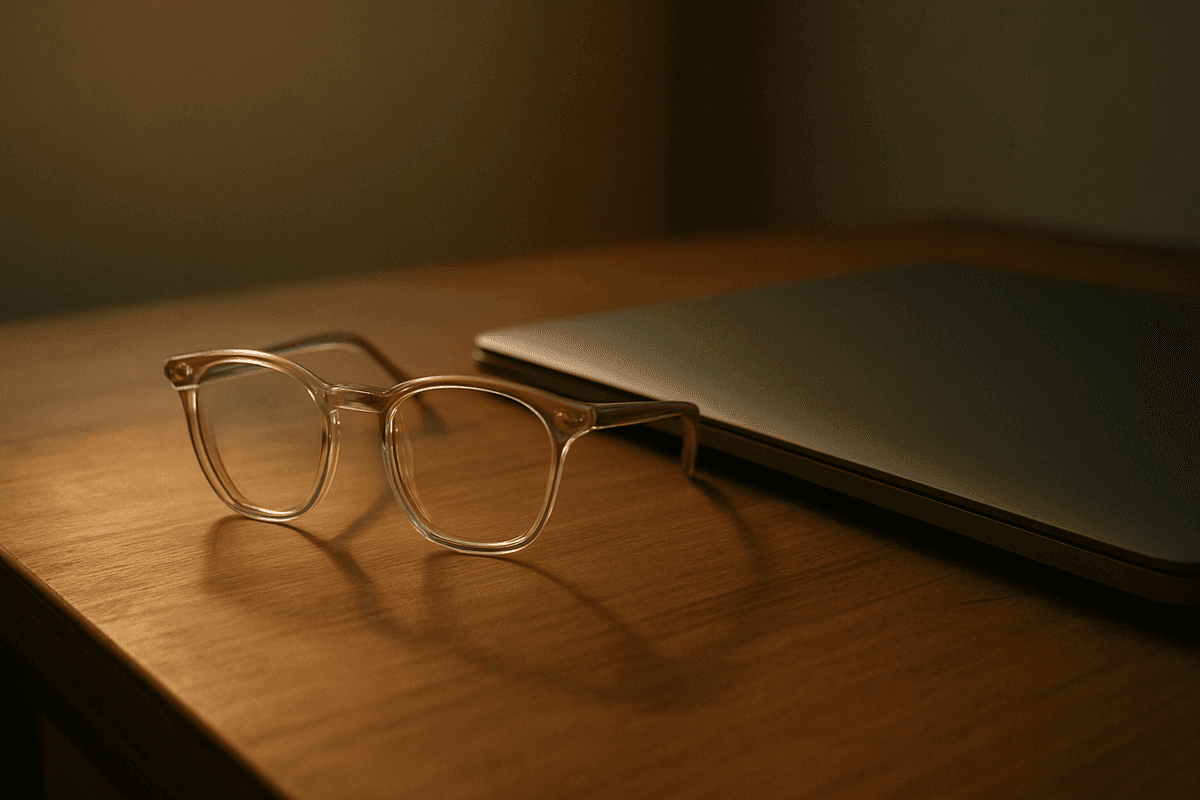
Blue light glasses are sold on two claims that need pulling apart, because they are not equally supported. For tired, sore eyes after a day of screens the evidence is weak: trials comparing blue-filtering lenses with plain clear lenses have generally found no meaningful difference, because blue light was never the cause of that symptom. For sleep the picture is more interesting. Evening light does shift your body clock, so the mechanism is real, but the leap from it to “these lenses will fix your sleep” is one the trial results do not support.
So the verdict is not a flat no. They are cheap and harmless, and if they make your evening feel calmer, you are not being fooled about how you feel. The problem is the claim on the box, not the object on your face.
What blue light actually is, and where you get it
Blue light is the short-wavelength, higher-energy end of the visible spectrum. It is a normal component of white light, which makes it a normal component of daylight.
Here is the fact that reframes the whole category: the sun is overwhelmingly your largest source of it. An overcast afternoon outdoors exposes you to vastly more than a laptop at arm’s length ever will. If screen-level blue light were damaging eyes, the far larger outdoor dose would send a much louder signal. Daytime blue light is also useful, being one of the main cues keeping your body clock anchored to the day.
This is the pattern from our guide to spotting a nonsense wellness claim, where a real biological word does the sales work. Blue light is real. That does not make the claim true.
The eye strain claim, which is the weak one
The symptoms are real, and blue light is not causing them.
Digital eye strain is a genuine cluster: dryness, aching, burning, blurring by evening, sometimes a dull headache. It is not imagined, and not trivial five days a week.
The causes are mechanical and environmental rather than spectral. You blink far less when concentrating, which dries the eye’s surface. You hold a sustained near-focus for hours. You deal with glare, harsh lighting, and dry conditioned air, possibly with an outdated prescription or none at all.
None of that is a wavelength problem, which is why filtering a wavelength has not solved it in testing. Trials comparing blue-filtering lenses against ordinary clear lenses for eye strain have generally shown no meaningful advantage for the filter. Where people do report improvement, it is hard to separate from wearing any new glasses and expecting relief.
The sleep claim, taken seriously
This one deserves a fairer hearing than skeptics usually give it.
The physiology is solid. Evening light, particularly short-wavelength light, affects the timing of your circadian system and can suppress melatonin. That is established laboratory science, not marketing. Light is the primary signal your body uses to decide that night has begun.
The trouble is everything between that mechanism and the product. Research showing strong melatonin suppression uses bright, controlled exposure, and a screen at normal viewing distance is a much dimmer stimulus. Consumer lenses filter only part of the relevant spectrum, and how much varies enormously between an almost-clear lens and a deep amber one. Trial results for these lenses as a sleep aid are mixed.
So the physiology is real, and a consumer pair’s contribution to it is small and unproven. Dimming the room and finishing screens earlier cut your evening light load far more than a lens does, and cost nothing, which is the category our guide to wellness that costs nothing is full of.
No lens touches the content problem either. An endlessly scrolling screen keeps you awake through arousal, not wavelength, which is why digital detox framing lands with people who own a pair.
What the claims are worth
| Claim | What the evidence supports | Verdict |
|---|---|---|
| Reduces digital eye strain | No meaningful benefit over clear lenses in trials | Not supported |
| Evening light affects sleep timing | Well established physiology | Real, but about light generally |
| These lenses improve your sleep | Mixed results, small effects where found | Weak and unproven |
| Prevents retinal damage from screens | Screen output sits far below daylight exposure | Not supported |
| Cures headaches, improves focus | No good supporting evidence | Not supported |
| Tinted lenses prescribed for a condition | A clinical use, decided case by case | Different thing entirely |
What actually helps each problem
For the eyes, the fixes are boring, which is usually a good sign. Take breaks that let your focus travel somewhere far away. Blink deliberately. Move the screen back and slightly below eye level, soften the light to kill glare, and use drops if your eyes are dry.
Then get your prescription checked. A surprising share of persistent screen discomfort is an uncorrected refractive error doing extra work all day, and that exam beats the glasses as a use of the money. Duration and lack of variation drive it too, the same way they do for desk workers with a stiff neck and shoulders.
For sleep, work on light quantity rather than light color. Lower room brightness in the evening, keep the last stretch before bed dim, and get bright light in the morning, which anchors the clock from the other end. That morning cue is central to our guide for shift workers.
Steady sleep and wake times, a cooler room, and a wind-down that is not a screen all beat a lens. For aids with better support behind them, see our reads on weighted blankets, heat before bed, and massage for sleep.
When to see an optometrist instead
Some symptoms are not a screen habit question, and no eyewear bought online will resolve them. Book an eye exam for persistent headaches, blurring that does not clear with rest, double vision, changes in your vision, eye pain, or if you have never had your eyes tested as an adult.
Worth knowing too: tinted or filtering lenses are legitimately prescribed for certain conditions, including some forms of light sensitivity. That is a clinical decision made for one person, and a different thing from a consumer pair marketed to everyone with a laptop. Persistent sleep trouble is a clinician’s question too.
FAQ
Do blue light glasses damage your eyes or make them worse? No, there is no good reason to think wearing them causes harm. The concern is substitution: someone keeps wearing them while the actual causes of their discomfort go unaddressed.
Is night mode on my phone better than the glasses? It is the same idea applied at the source, with the same limits. Shifting the screen warmer is free and fine, but the evidence that it meaningfully improves sleep is thin. Cutting brightness and total evening screen time does more.
If they feel like they help me, should I stop wearing them? No. If your evening feels calmer with them on, keep them. We only recommend what we’d send a friend to, and a cheap, harmless object someone likes is fine to own. Just don’t let it stand in for the changes carrying the real effect, the same gap between feeling and measuring we cover in recovery trackers.
The bottom line on blue light glasses
Split the claim in two and it resolves cleanly. For digital eye strain the case is weak: blue light is not what makes your eyes ache, and filtering it has generally not beaten clear lenses in testing. Breaks, blinking, distance, lighting, and an up-to-date prescription are what help, and a real vision problem belongs with an optometrist, the way any persistent complaint belongs with someone whose credentials you have checked.
For sleep, the physiology is real while the product is oversold. Evening light does affect your body clock, but a lens filtering part of the spectrum from a dim screen is a small intervention next to dimming the room and stopping earlier.
A pair costs little, so wear them if you like them. They are just not the fix they are sold as, and the things that would fix it you already have.