Does a SAD lamp work? What the trials show, how long to use one and who should check first
Light therapy for winter depression has decades of trials behind it. Here is what they found, the routine NIMH describes, the side effects, and why a red light panel is not the same thing.
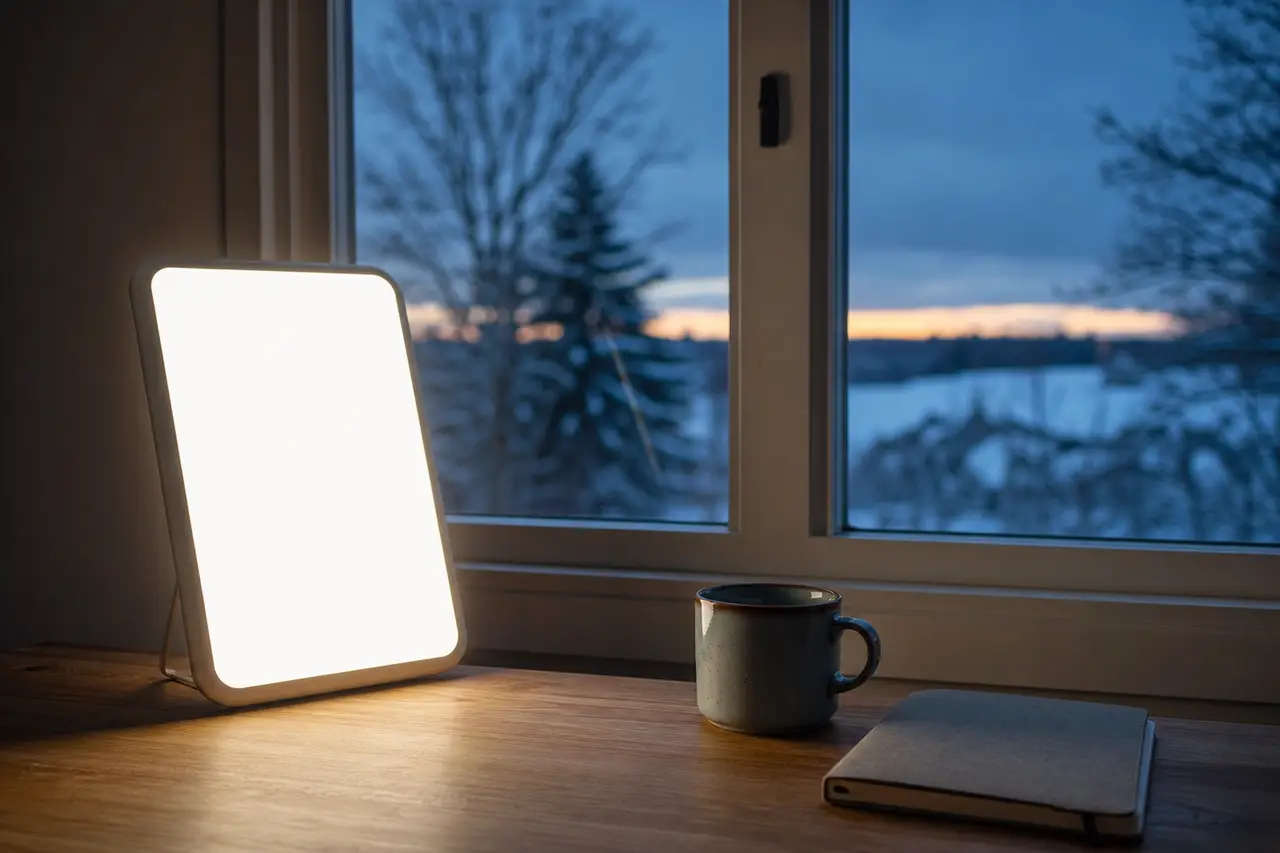
Short answer: For winter depression, yes. In randomized trials a bright light box beat placebo: a 2020 meta-analysis of 19 trials found it eased depression scores and raised the share of people who responded, though most of the trials were small. The routine the National Institute of Mental Health (NIMH) describes is a 10,000 lux light box for about 30 to 45 minutes a day, usually first thing in the morning, from fall to spring. MedlinePlus says that if light therapy is going to help, it should do so within 3 to 4 weeks. A red light therapy panel is a different device, and people on some medicines, with eye disease or with bipolar disorder should talk to a doctor first.
Seasonal affective disorder (SAD) is depression that follows the seasons. In most cases it starts in late fall or early winter and lifts in spring and summer, and it is more common the farther north you live, according to NIMH. A SAD lamp, or light box, is the treatment built for it: NIMH calls light therapy “a mainstay for treating winter-pattern SAD” since the 1980s.
This is general information, not medical advice. If your mood is low enough to worry you, talk to a doctor. If you are thinking about suicide, call or text 988, the Suicide and Crisis Lifeline.
What a SAD lamp is
A SAD lamp is a very bright box of white light that you sit in front of, not a lamp you look into. NIMH describes it as a light box of 10,000 lux, “about 20 times brighter than ordinary indoor light,” that “filters out the potentially damaging UV light, making this a safe treatment for most.”
The light is meant to make up for the daylight you lose in the darker months. You sit near it with your eyes open while you eat breakfast, read or work.
Does a SAD lamp work?
For winter-pattern SAD, the trials say yes, with a caveat about their size.
- The 2020 meta-analysis. Pjrek and colleagues pooled 19 randomized trials of bright light (1,000 lux or more) against dim light or sham devices. Bright light lowered depression scores (18 trials, 610 patients) and made a response to treatment 42% more likely (16 trials, 559 patients). The authors conclude that bright light “can be regarded as an effective treatment for SAD,” but note that the trials were small to medium in size and carried a moderate to high risk of bias.
- The 2005 review. In Golden and colleagues’ meta-analysis in the American Journal of Psychiatry, bright light and dawn simulation for SAD both reduced depression, with effect sizes the authors call “equivalent to those in most antidepressant pharmacotherapy trials.”
- Depression outside winter. In a 2016 trial in JAMA Psychiatry, 122 adults with nonseasonal major depression used a 10,000 lux light box for 30 minutes each early morning for 8 weeks. Light alone and light combined with an antidepressant both beat placebo: 50% of the light group and 76% of the combination group responded, against 33% on placebo.
What has not been shown is prevention. NIMH says people with a history of SAD “might benefit” from starting treatment before the fall. But a 2019 Cochrane review found only one randomized trial of light used to prevent SAD, with 46 people, and rated its evidence very low quality: too little to say whether starting early prevents an episode.
How long to use a SAD lamp, and what time of day
| Question | What the sources say |
|---|---|
| How bright? | 10,000 lux (NIMH) |
| How long? | About 30 to 45 minutes a day (NIMH); about 30 minutes (MedlinePlus) |
| How far away? | About 2 feet (60 cm) from the box (MedlinePlus) |
| What time? | Usually first thing in the morning (NIMH); early morning, “to mimic sunrise” (MedlinePlus) |
| Eyes? | Open, but do not look straight into the light (MedlinePlus) |
| Which months? | From fall to spring (NIMH) |
| How soon does it work? | Within 3 to 4 weeks if it is going to help (MedlinePlus) |
MedlinePlus adds that some people use light therapy all year, with fewer minutes in spring, summer and fall, and that you should follow your own provider’s instructions.
Morning matters. In a 2001 study in the Archives of General Psychiatry, morning light shifted the body’s melatonin rhythm earlier and evening light shifted it later. In the larger sample of 80 patients, early-morning light beat both late-morning and evening sessions.
Side effects, and who should check first
Light therapy’s side effects are mild next to most medicines, but there are some.
- Common side effects. MedlinePlus lists eye strain or headache, and mania, rarely. A 2005 review by Michael and Jiuan Su Terman found the side-effect profile favorable compared with medicines, but tells clinicians to watch for hypomania and over-activation, especially in the first few days.
- Medicines that make you sensitive to light. MedlinePlus says people taking medicines that make them more sensitive to light, “such as certain psoriasis medicines, antibiotics, or antipsychotics,” should not use light therapy. NIMH says people on medicines that increase sensitivity to sunlight may need another treatment or should use light therapy under medical supervision. Our FDA label index shows which common medicines’ labels warn about sun sensitivity; a pharmacist can check yours.
- Eye conditions. NIMH names “certain eye diseases” as a reason for caution, and MedlinePlus recommends a checkup with your eye doctor before you start. The reassurance comes from a small study: in 50 patients examined before and after 10,000 lux light therapy, eye examinations found no changes after 2 to 8 weeks, and none in the 17 who had used it for 3 to 6 years.
- Bipolar disorder. NIMH notes that SAD is more common in people with bipolar disorder, especially bipolar II, and light can rarely trigger mania. Light can still be part of treatment: in a 2018 trial, 46 adults with bipolar depression who were on a stable dose of antimanic medication used 7,000 lux light or a dim red placebo light at midday; 68.2% of the bright light group reached remission against 22.2%, and no one switched into mania. That was a supervised trial, so with bipolar disorder, use a light box only as part of a plan with your psychiatrist. Our guide to wellness with bipolar disorder covers saunas on lithium and sleep.
SAD lamp vs red light therapy
They are different devices for different jobs. A SAD lamp is bright white light that reaches your eyes while you sit near it, used to treat winter depression. A red light therapy panel shines red and near-infrared light onto your skin, and the FDA has cleared light devices for uses such as wrinkles, acne, hair growth and pain, which our guide to infrared saunas vs red light therapy goes through.
The color matters for SAD. A 2025 network meta-analysis of 17 trials with 773 patients compared light colors for SAD: white light ranked most effective, followed by green, blue and, last, red. In the bipolar trial above, dim red light was the placebo.
Other treatments for SAD
NIMH groups the treatments into four kinds that can be used alone or together:
- Light therapy, as above.
- Psychotherapy. A version of cognitive behavioral therapy adapted for SAD (CBT-SAD) runs as two weekly group sessions for 6 weeks.
- Antidepressants. The FDA has approved an extended-release form of bupropion that, NIMH says, can prevent seasonal episodes in many people when taken daily from fall through early spring.
- Vitamin D. NIMH says studies of vitamin D for SAD “have produced mixed results.”
A doctor can help you weigh them. For other evidence on mood, see our guides to saunas and depression and cold water and depression.
FAQ: SAD lamps
Does a SAD lamp really work? For winter-pattern SAD, randomized trials say yes: a 2020 meta-analysis of 19 trials found bright light lowered depression scores and made a response 42% more likely than placebo. The trials were mostly small, so the size of the benefit is uncertain, and light therapy is a treatment to use with a doctor’s advice, not instead of it.
How long should you sit in front of a SAD lamp? NIMH describes about 30 to 45 minutes a day with a 10,000 lux light box; MedlinePlus describes about 30 minutes, sitting about 2 feet (60 cm) from it. Follow your provider’s instructions if they differ.
What is the best time of day to use a SAD lamp? First thing in the morning. In a 2001 study, early-morning light worked better than late-morning or evening light, and evening light shifted the body’s melatonin rhythm later.
How long does a SAD lamp take to work? MedlinePlus says symptoms should improve within 3 to 4 weeks if light therapy is going to help.
Can a SAD lamp make you feel worse? Possible side effects include eye strain, headache and, rarely, mania. Clinicians are told to watch for hypomania and over-activation in the first few days, so call your doctor if your mood or sleep changes sharply.
Is a SAD lamp the same as red light therapy? No. A SAD lamp is bright white light used to treat winter depression; a red light panel shines red and near-infrared light on the skin. In a 2025 analysis of SAD trials, white light ranked most effective and red light last.
Can you use a SAD lamp if you take medication? Check first if you take a medicine that makes you sensitive to light. MedlinePlus says people on certain psoriasis medicines, antibiotics or antipsychotics should not use light therapy, and NIMH says some may need medical supervision. A pharmacist can tell you whether your medicine is one of them.
Should you start using a SAD lamp before winter? NIMH says people with a history of SAD might benefit from starting before the fall, and MedlinePlus says treatment usually starts in the fall or early winter. But the one randomized trial of light used to prevent SAD was too small to show whether it works.
The bottom line on SAD lamps
For winter depression, a bright white light box is one of the best-studied treatments outside of medicine and talk therapy: about 10,000 lux, about 30 minutes, first thing in the morning, from fall to spring, with results expected within a few weeks. Check with a doctor first if you take a medicine that makes you sensitive to light, have an eye condition or have bipolar disorder, and do not mistake a red light panel for a SAD lamp.