Your first Pilates class: what to expect
It looks gentle from the doorway and then your abdominals are shaking four minutes in. Here is what actually happens, what to book, and why nobody is watching you.
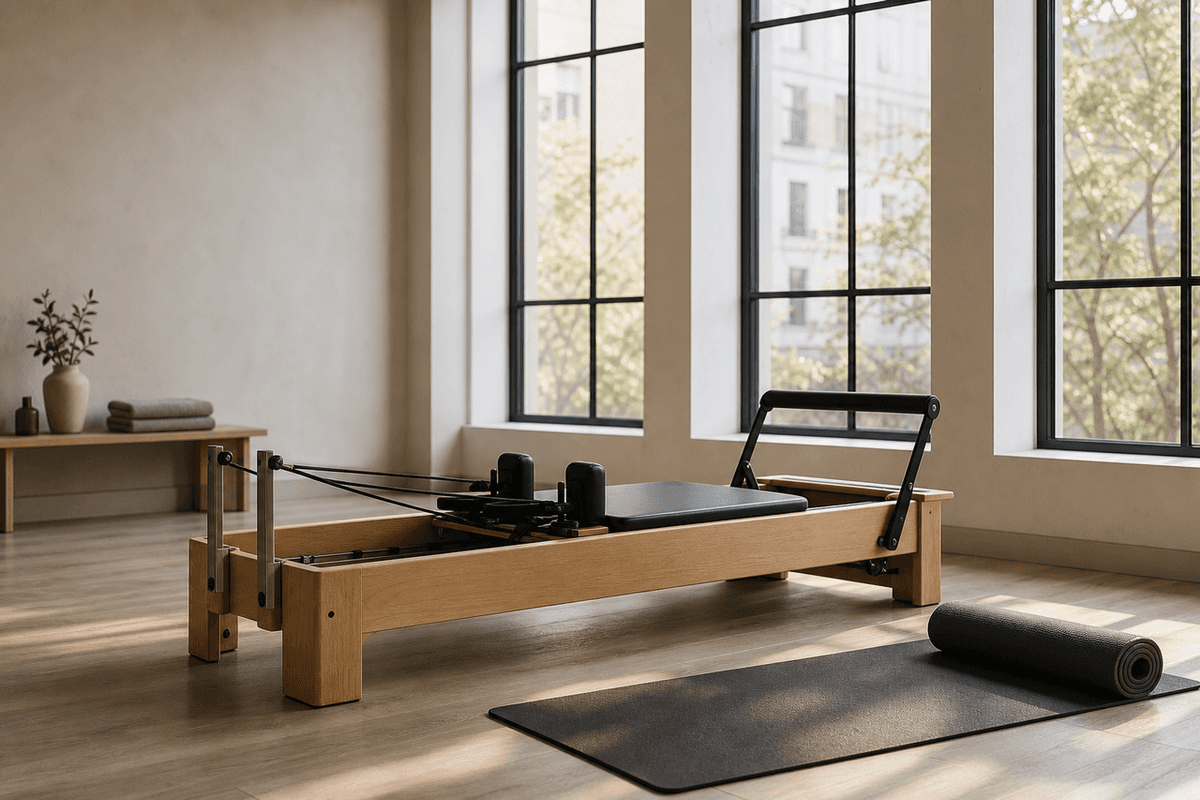
Short answer: Book a beginner mat or intro reformer class, not one labelled all levels, wear fitted clothes, bring grip socks and arrive ten minutes early to tell the instructor you are new. Expect small, slow movements to be far harder than they look, and soreness a day or two later. Flexibility is not a prerequisite.
Book a beginner mat class or a dedicated intro reformer class, not a general reformer class labelled all levels. Wear fitted clothes, bring grip socks, and arrive ten minutes early to tell the instructor it is your first time.
Expect small, slow, controlled movements that are dramatically harder than they look, and expect your abdominals to be shaking well before you thought they would.
You do not need to be flexible, strong, or coordinated to start. That is the point of starting.
Should your first class be mat or reformer?
Either works, but book the beginner version of whichever you choose.
Mat Pilates uses your bodyweight on a mat, sometimes with a small ring or band. It is cheaper, less intimidating, and there is no machine to figure out. The catch is that without the machine’s support, some exercises are genuinely harder for a beginner body.
Reformer Pilates uses a sliding carriage with springs. It looks like a medieval contraption and puts people off, but the springs can actually assist you, which often makes it more accessible, not less. The catch is that a general reformer class moves fast and assumes you know the setup.
The rule that matters more than the choice: book something explicitly labelled beginner, intro, or fundamentals. Our reformer versus mat guide covers the difference in more depth, and if the studio near you offers Lagree on a Megaformer, our reformer Pilates vs Lagree comparison explains why that is a much harder first class.
What actually happens in the class?
Less than you expect, and it costs more than you expect.
You will spend a lot of the hour lying down. The instructor will talk about your breath, your ribs, your pelvis, and your deep abdominal muscles, and will ask you to move a very small distance very slowly while keeping everything else still.
That restraint is the whole method. The difficulty is not in the range of the movement, it is in refusing to cheat with momentum or your bigger muscles. This is why strong people are often humbled in their first class, and why it looks like nothing from the doorway.
You will not be jumping around or getting sweaty in a cardio sense. You will still be shaking.
What should you wear and bring?
Fitted clothes and grip socks, and that is nearly it.
Wear something reasonably close-fitting. Baggy t-shirts end up over your face when you are upside down, and the instructor genuinely needs to see your spine and hips to correct you. Leggings or fitted shorts and a top that stays put are ideal.
Grip socks are required at most reformer studios and expected at plenty of mat ones. They stop you sliding on the carriage and they are a hygiene rule. Studios usually sell them at the desk if you forget, but check first so you are not surprised.
Bring water. Leave the shoes at the door. Our studio checklist covers the general questions worth asking a new studio before you book.
Do you need to be fit or flexible first?
No, and waiting until you are is how people never start.
Pilates was developed partly as rehabilitation work, and the beginner version of every exercise assumes a normal body with normal limitations. Flexibility is not a prerequisite, it is one of the things that slowly improves.
If you have an injury, a disc problem, a recent surgery, or you are pregnant, say so before class rather than during. A competent instructor will modify on the spot, and most exercises have three or four versions. This is normal and not a fuss.
If they cannot or will not modify, that is a studio problem, not a you problem.
Will you be sore, and how often should you go?
Probably, in places you did not know existed.
Expect delayed soreness a day or two later, often deep in the abdominals, the inner thighs, and the sides of your torso. That is normal for a first class and it fades quickly as you adapt.
Twice a week is the honest sweet spot for actually feeling a difference within a month or so. Once a week maintains and progresses slowly. The classic Joseph Pilates line, that you feel the difference in ten sessions and see it in twenty, is marketing but not a bad expectation to hold.
Do not judge the whole method on one class. The first one is mostly you learning the vocabulary.
How does it compare to yoga?
Different goal, similar room.
Yoga leans toward flexibility, breath, and a contemplative or spiritual thread depending on the style. Pilates is more clinical and core-focused, with precision and control as the organising idea and no spiritual layer. Our yoga versus Pilates guide covers which to start with.
If you liked a yoga class but wanted less philosophy and more structure, you will probably like Pilates. If the opposite, you know your answer. Our first yoga class guide covers the other door.
The bottom line on your first Pilates class
Book a beginner or intro class, wear fitted clothes, bring grip socks, tell the instructor you are new, and be ready for small movements to be genuinely hard.
Nobody in the room is watching you. They are all busy trying to keep their ribs down.
To find a Pilates studio near you, start with our city wellness maps.