Private vs communal sauna: which is actually worth paying for?
These are sold as the same product at different prices, and they are not the same product. One buys you a room; the other buys you several hours and a rhythm you cannot get in a booked cabin.
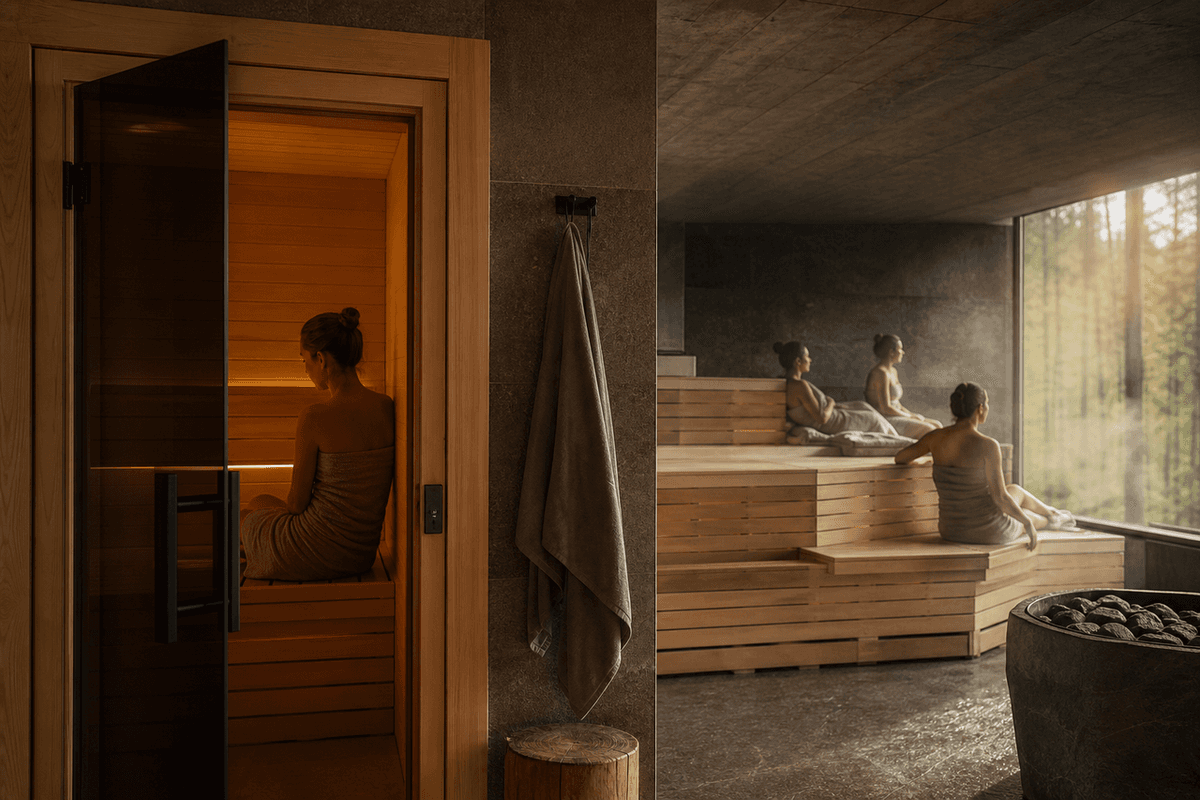
Short answer: A private cabin buys certainty, privacy and a fixed slot of 30 to 60 minutes. A communal bathhouse buys hotter, steadier heat, tiered benches, an included cold plunge and the two to four hours a proper three-round cycle needs. Per hour of actual use, communal is usually the cheaper of the two.
The two dominant models in US recovery are a booked private cabin for 30 to 60 minutes, and a communal bathhouse you enter for several hours. Studios present these as the same thing at different price points. They produce quite different experiences.
The private cabin sells convenience, privacy, and certainty. The communal room sells time, better heat, and the ability to move between hot and cold without watching a clock.
Which is worth paying for depends entirely on what you are trying to get, and the per-hour maths is less obvious than the headline prices suggest. We don’t take placement fees, so nothing below points you anywhere.
What does a private cabin actually buy you?
Certainty and privacy, in a fixed slot.
You book a time, you get a room to yourself or your group, nobody else is in it, and you know exactly when it starts and ends. For a lot of people that removes every barrier to going at all, which is worth real money.
It also suits specific situations well: a first session when you have no idea what you are doing, a body you would rather not be seen in a towel in, a conversation you want to have privately, or a tight window between other commitments.
The trade-offs are heat and time. Small cabins, particularly infrared ones, often run cooler and lose heat quickly when the door opens, and a 30-minute slot including changing is closer to 20 minutes of actual sitting. Our infrared vs traditional sauna comparison covers what that difference in heat means.
What does a communal bathhouse buy you?
Time, better heat, and a rhythm.
A large communal sauna holds temperature far better, is usually genuinely hot, and often has tiered benches so you can choose your intensity by sitting higher or lower. That is a meaningfully better sauna than most private cabins.
More importantly, you get hours rather than minutes, and typically a cold plunge, a cool room, showers, and somewhere to sit between rounds. That lets you do three or four rounds with proper cooling in between, which is how the practice is actually meant to work and is not possible in a booked half hour.
The costs are social and logistical: other people, sometimes crowded, sometimes noisy, occasionally nude depending on the venue, and a longer time commitment. Our guide to your first bathhouse or Korean spa covers what to expect.
Private and communal at a glance
| Private cabin | Communal bathhouse | |
|---|---|---|
| Typical session | 30 to 60 minutes, booked | 2 to 4 hours, or all day |
| Heat quality | Variable, often cooler, drops on door opening | Usually hotter and more stable, tiered benches |
| Rounds possible | One, maybe two | Three or four with proper cooling |
| Cold plunge included | Sometimes, sometimes extra | Usually part of the flow |
| Privacy | Complete | None to partial |
| Cost per hour | Higher | Usually lower despite a bigger ticket |
| Best for | First timers, tight schedules, privacy | Getting the actual practice, unhurried resets |
| Worst for | Doing a full hot-cold cycle | A 40-minute window between meetings |
Which is actually cheaper?
Per hour, communal usually wins.
The headline prices mislead because you are buying different amounts of time. A private cabin priced per half hour looks cheaper than a bathhouse day pass, and then you get 25 usable minutes against three or four hours.
Divide by the time you actually get and the ranking often flips. The bathhouse is also more likely to include the cold plunge, showers, and a cool room in the base price, where private studios frequently charge separately for the plunge.
Watch the add-ons in both models: towel rental, locker fees, robe rental, first-visit fees, and whether the plunge is included. Our guide to what a sauna or cold plunge session costs has the ranges, and whether memberships are worth it covers the maths on going regularly.
Does privacy change the hygiene question?
It changes what you should be checking, not how much.
People assume a private cabin is cleaner because fewer people use it. What matters more is turnaround: whether staff actually clean between back-to-back bookings, and whether a private plunge tub gets its water treated properly given it serves far fewer people through the same volume.
Communal spaces have more users but usually more visible, continuous maintenance, professional water treatment on the plunge, and staff present. The failure mode is different rather than worse.
In both cases the checks are the same: water clarity, smell, the state of the wood and grout, and whether showers work. Our guides on choosing a studio and reading reviews and spotting fake ones cover what to look for.
So which should you book?
Match it to the goal, not the price.
Book private if it is your first time and you would otherwise not go, if you have a hard time limit, if you want to talk to someone, if you are self-conscious, or if you are bringing children and want control over the environment. Our guide on sauna with kids and teens covers that case.
Book communal if you want the actual practice: multiple rounds, real heat, a proper cold plunge, and unhurried time between. It is also the better value once you go regularly, and the better choice when travelling if you have the hours. Our guide on finding a studio in a new city covers vetting one.
A reasonable pattern for many people is private to start and communal once you know what you are doing, since the barrier that private solves mostly disappears after two or three visits.
FAQ: private and communal saunas
Is a private infrared cabin a real sauna? It is a real heat session, at a milder temperature and with a different feel. If you want the hot, dry, high-bench experience, a communal traditional room is a different thing.
Can I get a proper contrast cycle in 30 minutes? Not really. One round of heat then a plunge is possible; three rounds with proper cooling is not. Our guide on the right order for contrast therapy covers the sequencing.
Are bathhouses always nude? No. Many US bathhouses are swimwear-required or mixed-policy by area. Check before you go rather than assuming either way.
Is a private room worth paying for as a couple? Often yes, for conversation and comfort. Just know you are buying privacy rather than a better sauna.
The bottom line on private vs communal
A private cabin buys certainty, privacy, and a fixed slot, which is genuinely valuable if it is what gets you through the door. A communal bathhouse buys hotter and more stable heat, an included cold plunge, and the hours needed to do multiple rounds properly.
Per hour of actual use, communal is usually the cheaper of the two despite the larger ticket. Start private if the barrier is nerves or time, and move to communal once you want the practice rather than the room.