Sauna and cold plunge with kids and teens: what's actually safe
Finnish children grow up in saunas, which suggests heat is not inherently unsafe for them. Cold plunging is a different question with far less behind it, and the two deserve different answers.
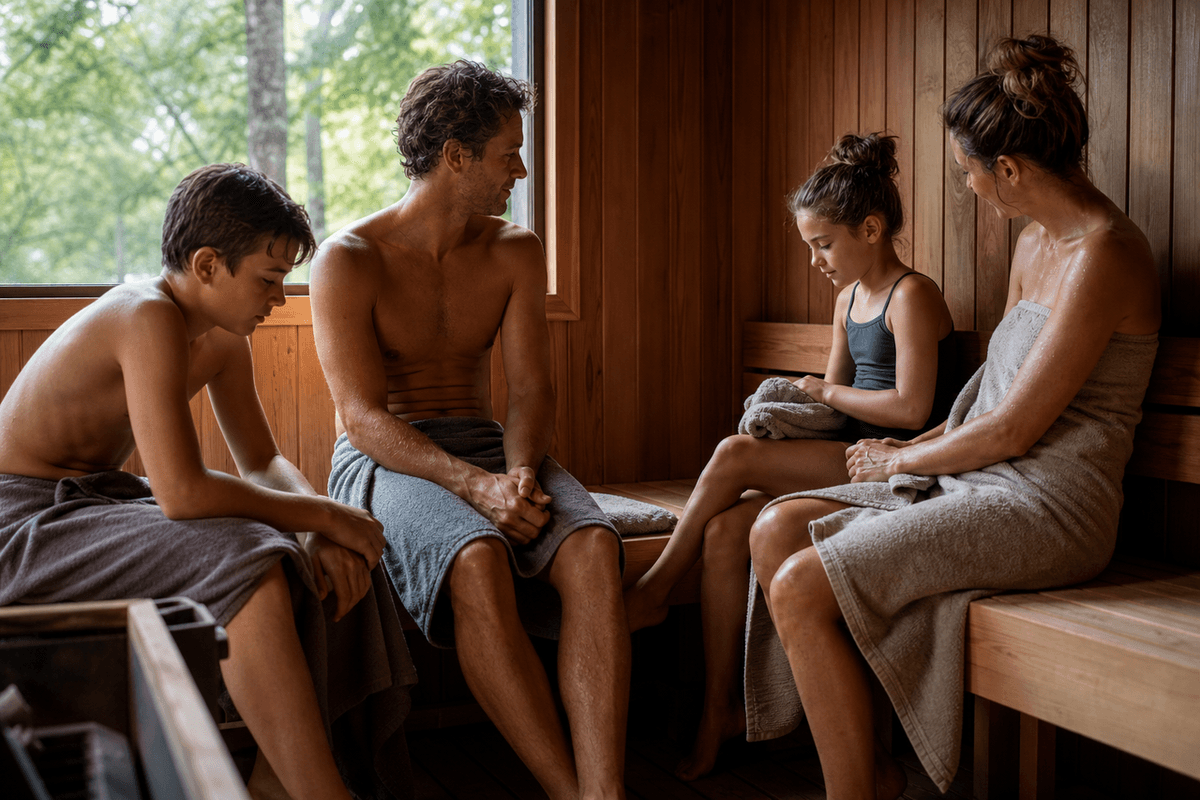
Short answer: Short, cooler, lowest-bench sauna sessions of a few minutes are normal practice with children in Finland and are well tolerated. Cold plunging has essentially no research base in minors, and studios typically set 16 or 18 as a floor. Children overheat faster and signal less, so dose and supervision matter more than age.
Heat and cold deserve separate answers here. Short, mild sauna sessions with children are normal practice in the countries with the deepest sauna traditions, and there is no evidence that a brief, supervised, low-bench sit harms a healthy child. Cold plunging is a much thinner case, and the honest answer is that almost nobody has studied it in minors.
The complication is that children are not small adults thermally. They heat up faster, have less sweating capacity relative to their size, and are considerably worse at telling you when something is wrong.
So the useful guidance is less about a magic age number and more about how you run the session. We don’t take placement fees, so nothing below is written to get your family through a door.
Is a sauna safe for children?
Generally yes, if it is short, cooler, and supervised.
Finland has close to one sauna per two people and children are part of that from a young age, often from toddlerhood, sitting on the lowest bench for a few minutes at a time. The clinical review by Hannuksela and Ellahham in The American Journal of Medicine in 2001 describes sauna bathing as well tolerated by healthy people including children, with the caveats attached to duration and heat rather than to age itself.
What that practice looks like in reality is very different from an adult session. Lowest bench, where the air is many degrees cooler. A few minutes rather than fifteen. Out at the first sign of discomfort, without any culture of pushing through.
There is no formal minimum age that a paediatric body has issued, which is itself informative. The variable that matters is the dose, not the birthday.
Why do kids overheat faster than adults?
More surface area, less sweat, and worse self-reporting.
Children have a higher body surface area relative to their mass, so they absorb heat from the environment faster than an adult in the same room. Their sweating capacity is lower and less efficient, particularly before puberty, which is the main mechanism for shedding that heat.
They are also worse at noticing and reporting the early signals. An adult recognises the flat, slightly nauseous feeling that means it is time to leave. A child in an unfamiliar, exciting environment with a parent who is clearly enjoying it will often stay put and say nothing.
That combination is the whole safety story. It is not that heat is uniquely dangerous to a child’s physiology, it is that the safety margin is narrower and the person inside it is not going to warn you. Adult supervision is doing the work that self-awareness usually does.
What about cold plunging and ice baths?
Much less evidence, and a stricter answer.
There is essentially no research base on deliberate cold-water immersion in children and adolescents, and the absence is not the same as a green light. The cold shock response, the involuntary gasp and rapid breathing on entry, is a real hazard even in adults, and it is the mechanism behind most cold-water drownings.
A child who gasps underwater or panics in a tub is a different kind of incident from an adult who finds it unpleasant. Our guide to how to breathe during a cold plunge explains why that first thirty seconds is the risky part.
The practical position most studios take, and a reasonable one, is that cold plunging is for older teenagers at the earliest, with a parent present, brief, and never as a dare or a challenge. Younger children swimming in cool water is a different and normal thing; a deliberate ice bath is not.
Heat and cold for kids at a glance
| Sauna | Cold plunge | |
|---|---|---|
| Evidence base in minors | Long cultural practice, described as tolerated in clinical reviews | Essentially none |
| Typical practice | Lowest bench, a few minutes, from young childhood in sauna cultures | Generally later teens, if at all |
| Main hazard | Overheating faster than an adult, poor self-reporting | Cold shock response, gasp reflex, panic |
| Supervision | Required, in the room, watching not chatting | Required, within arm’s reach |
| Stop signal | Any discomfort, flushing, quiet withdrawal | Any distress, immediately |
| Medical clearance | For any heart, seizure, or heat-related condition | For any heart or respiratory condition |
What are the practical rules for a family session?
Short, low, hydrated, and out on request.
Keep sessions to a few minutes rather than a standard adult round, and use the lowest bench, where the air can be twenty to thirty degrees cooler than the top. Go in already hydrated and drink afterward, because children dehydrate quickly and rarely ask for water in time.
Stay in the room and actually watch. Flushed skin, unusual quietness, sudden tiredness, or a child who stops chatting are all reasons to leave immediately, and leaving early should be treated as completely normal rather than as giving up.
Skip the cold plunge afterward for younger kids and keep the cooldown to a cool shower or simply sitting in the cool room. Our guides to what to wear and bring and first sauna etiquette cover the practical side, and how to choose a studio covers hygiene, which matters more with children.
When should you check with a doctor first?
Any heart, seizure, or heat-regulation condition.
Talk to your paediatrician before taking a child into heat if they have a congenital heart condition, an arrhythmia, a seizure disorder, cystic fibrosis, or any condition affecting sweating or temperature regulation. The same applies to some medications, including certain anticholinergics and stimulants that reduce sweating or raise core temperature.
Also skip the session entirely if the child is unwell, feverish, or dehydrated. Heat on top of a fever is a bad combination and there is no upside to it. Our guide on whether to sauna when you’re sick covers the reasoning.
For teenagers who train seriously and want cold for recovery, there is a separate issue worth knowing: cold immediately after resistance training can blunt the adaptations they are training for. Our guide on whether a cold plunge after a workout blunts gains covers it.
What about studio policies?
Most set an age minimum, and it varies widely.
Recovery studios, bathhouses, and gyms in the US typically set their own age minimums, often 16 or 18 for cold plunge and sometimes lower for sauna with a parent, and these are insurance decisions as much as safety ones. Many will not admit under-18s at all.
Traditional bathhouses and Korean spas frequently have family or family-hours policies and are more accustomed to children being present, which usually makes them a more comfortable first experience. Our guide to your first bathhouse or Korean spa explains how those spaces work.
Call ahead rather than turning up, because a refused entry with a disappointed child is an avoidable trip. You can browse day experiences by city to find places worth calling.
FAQ: kids and teens
What age can a child start using a sauna? There is no official minimum. In sauna cultures children join very young, on the lowest bench for a few minutes. The dose and supervision matter far more than the age.
How long should a child stay in? Much shorter than an adult, a few minutes at most to start, and out at the first sign of discomfort. Never treat the timer as a target.
Is an infrared sauna better for kids? The heat is milder, which helps, but the same rules apply: short, supervised, hydrated. Our infrared vs traditional comparison covers the differences.
Can a teenager do a cold plunge? Older teenagers, supervised, briefly, and never as a competition or a dare. There is very little research here, so caution is the honest default rather than an abundance of it.
The bottom line on kids, heat and cold
Short, cool, low-bench sauna sessions with children are a long-standing practice and are widely considered tolerated in healthy kids, provided an adult is watching and the session ends the moment anything feels off. Children overheat faster and complain later, which is the entire reason the rules are stricter.
Cold plunging is a different case with almost no evidence in minors, and later teens with supervision is the sensible floor. When in doubt with either, shorter and cooler costs you nothing.