Mobile massage vs going to a studio: which is worth it?
Having a therapist come to you removes the commute, the parking and the getting-dressed-again problem. It also removes the equipment, and one of those trade-offs matters far more than the price difference.
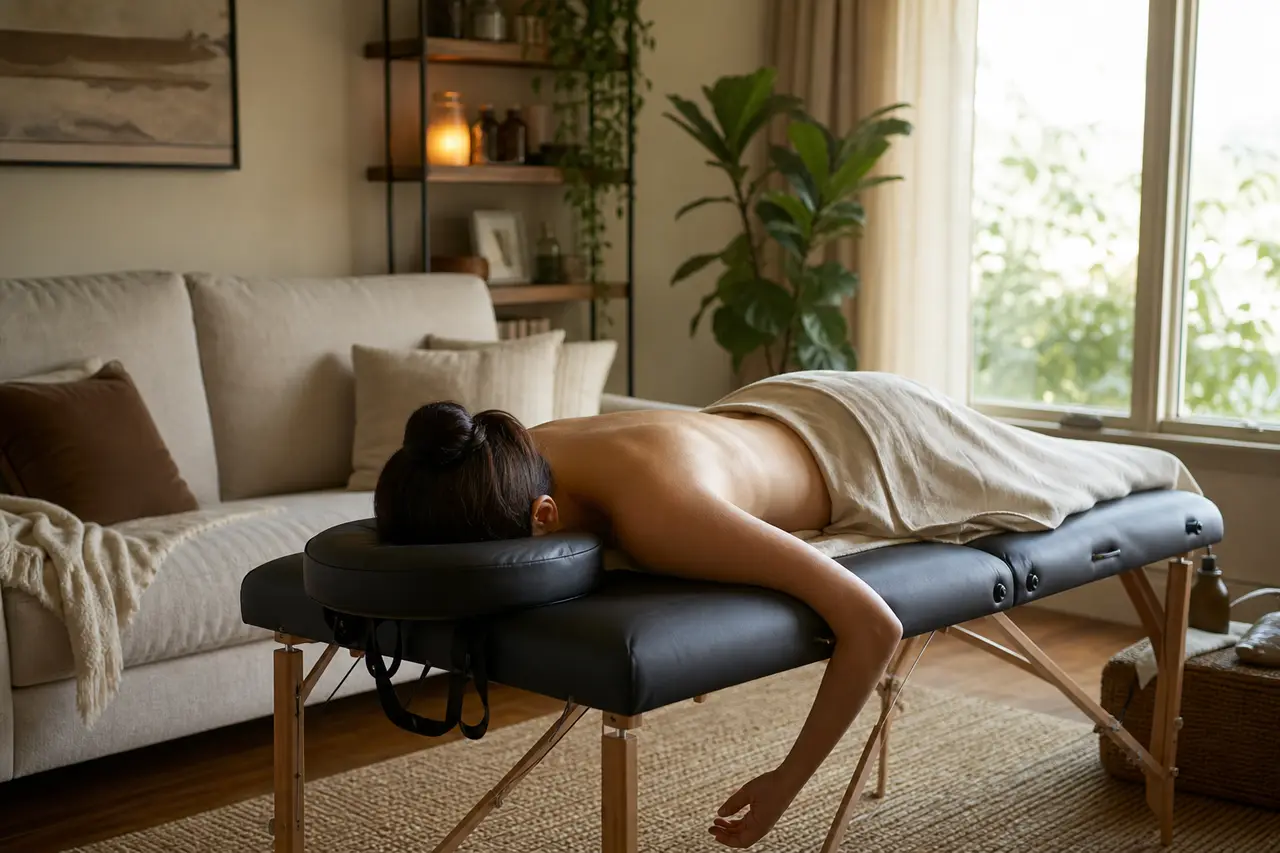
Short answer: Mobile massage buys the twenty minutes after the session: you stay put and can go straight to bed, which makes it the better choice for sleep, limited mobility or postpartum. A studio buys a stable height-adjustable table, a controlled room, heat beforehand and vetting. Verify a mobile therapist’s license with your state board yourself.
Mobile massage has gone from a niche service to an app-booked category, and the pitch is straightforward: the therapist comes to you, sets up a portable table, and you do not have to drive anywhere afterwards.
That last part is the genuine advantage and it is underrated. The main cost of a good massage is often the twenty minutes of re-entering the world immediately afterwards.
What you give up is equipment and environment, and for some purposes that matters a great deal. Here is how the two actually compare. We don’t take placement fees, so nothing here points you anywhere.
What does mobile massage genuinely do better?
You stay where you are afterwards.
The strongest argument is the end of the session. You do not get dressed properly, drive home, and lose the state you paid for. You can go straight to bed, which makes it a genuinely good choice if sleep or deep relaxation is the goal. Our guide on whether massage helps you sleep covers what to expect there.
It is also the better option when leaving is hard: limited mobility, no transport, a newborn asleep in the next room, recovery from illness, or simply a schedule with no slack. Our guides on postpartum wellness and accessible wellness cover cases where this tips the balance decisively.
And for a group at home, a birthday or a small event, it is far simpler than coordinating a venue.
What does a studio do better?
Equipment, environment, and vetting.
The table. Studio tables are often permanently installed, wider, height-adjustable, and hydraulically controlled. Portable tables are narrower, have stated weight limits, and are set to one height that has to work for both of you. For deep work in particular, a stable table at the right height makes a real difference to what the therapist can do.
The environment. A treatment room is quiet, warm, and controlled. Your living room has a doorbell, a thermostat you have not thought about, a neighbour’s dog, and lighting designed for something else.
Amenities. Showers, a heat room to warm up in first, and somewhere to sit afterwards. If you wanted a sauna before your massage, that is a studio. Our guide on planning a wellness day covers why that order helps.
Vetting. A licensed premises has a business address, insurance, and usually visible credentials. With a mobile booking you are doing that verification yourself.
Mobile and studio at a glance
| Mobile massage | Studio | |
|---|---|---|
| After the session | Stay put, go to bed | Get dressed, travel home |
| Table | Portable, narrower, fixed height, weight limits | Often wider, height-adjustable, more stable |
| Environment control | Yours to manage | Designed for it |
| Heat, shower, amenities | None | Usually available |
| Deep tissue quality | Adequate; table height limits leverage | Better |
| Price | Usually higher, plus travel fee and setup time | Usually lower per hour |
| Vetting the therapist | Your job entirely | Partly done by the venue |
| Best for | Sleep, low mobility, postpartum, no transport | Deep work, first-time bookings, full sessions |
| Space needed | Roughly 7 by 10 feet clear | Not your problem |
What about cost?
Usually more, and check what “an hour” means.
Mobile services typically cost more per session because the therapist absorbs travel, setup, and takedown, and can fit fewer clients into a day. Many add an explicit travel fee by distance.
The detail worth pinning down is whether the quoted duration is hands-on time or door-to-door. Setup and takedown of a portable table takes ten to fifteen minutes, and if that is inside your hour you are paying studio prices for forty-five minutes of massage. Ask directly.
Tipping conventions are the same as at a studio, and app-based platforms usually handle it in-app. Our guides on tipping at a wellness studio or spa and what a session costs cover the money side.
How do you vet a mobile therapist?
Do the checks the venue would have done.
Ask for their license number and verify it with your state board yourself; every state that licenses massage therapy has a public lookup. Ask whether they carry professional liability insurance. Both are normal questions and a professional will answer without hesitation.
Book through a platform with a verification process if you would rather not do this, and read reviews of the individual therapist rather than the platform.
Two practical safety points that apply to any in-home service: someone else knowing you have an appointment is sensible, and a therapist who is vague about credentials, pushes for cash-only, or communicates in a way that feels off is a booking to cancel. Our guide on checking a wellness practitioner’s credentials covers verification in detail.
Be aware that “massage” is also used as cover for other services in some listings. A legitimate therapist has a license number, uses professional language, and does not advertise ambiguously.
What do you need to have ready?
Space, warmth, and a plan for interruptions.
Clear a space roughly seven by ten feet with the table not against a wall, since the therapist needs to move around it. Move the coffee table before they arrive rather than during setup.
Set the room warmer than feels normal, because you will be still and partly undraped for an hour. Have towels available if asked, though most therapists bring their own linens.
Then handle the interruptions in advance: phone silent, doorbell off or a note on the door, dog in another room, and if you live with others, tell them. The single most common complaint about at-home massage is a session interrupted by ordinary household life.
When is each the right call?
Match it to the purpose.
Choose mobile if the goal is relaxation and sleep, if leaving is genuinely difficult, if you are postpartum or recovering, or if the travel afterwards is what has stopped you booking before.
Choose a studio for a first massage with a new therapist, for deep or focused work on a specific problem, if you want heat beforehand, or if your home has no quiet hour in it. Our guides on what to expect at your first massage and Swedish vs deep tissue vs sports massage cover choosing the session itself.
And if the issue is an actual injury or persistent pain, neither is the right first step. Our comparison of massage vs physical therapy covers when you need assessment instead.
FAQ: mobile massage
Is the massage itself as good? For relaxation work, essentially yes. For deep tissue, a stable table at the right height gives the therapist better leverage, so a studio has a genuine edge.
Does a mobile therapist bring everything? Table, linens, oil, and usually music. Confirm when booking, and ask what they need from you.
Do portable tables have weight limits? Yes, commonly in the 300 to 450 pound range depending on the model, and they are narrower than installed tables. Ask if it is relevant. Our guide on wellness in a larger body covers that question.
Can mobile therapists do couples massage at home? Some services send two therapists. You need space for two tables, which is more than most living rooms have. Our guide on booking a couples massage covers the format.
The bottom line on mobile massage
Mobile massage buys you the twenty minutes after the session, which is the part a studio takes back when you have to get dressed and drive. That makes it genuinely better for sleep, for limited mobility, and for anyone who cannot easily leave.
A studio buys better equipment, a controlled room, heat beforehand, and vetting you do not have to do. Verify a mobile therapist’s license yourself with the state board, and confirm whether the quoted hour includes setup.